

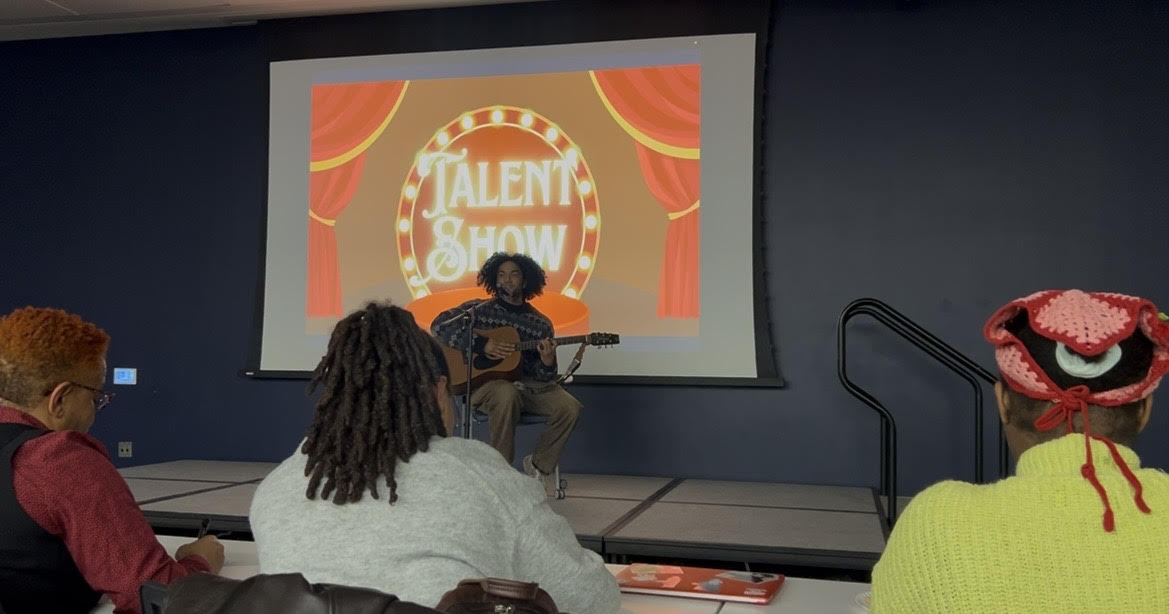

120 students packed into the Healey Family Student Center Social Room for Black Student Alliance (BSA) and Black Theatre Ensemble (BTE)’s joint talent show, “The Final Hour”. The Feb. 25 performance was one of the final programs for Black History Month at Georgetown.
Sophia Monsalvo (SFS ’26), winner of the talent show, performed an ethereal rendition of “Ser Mi Propio Amor” by Inbal Comedi, while Tiara Haggins (CAS ’28), resident of Black House, performed her own poem about swimming. Like many other events for Black History Month, it was a demonstration of collaboration and solidarity among Black student organizations.
Black student organizers told the Voice that they aimed to host events every day of Black History Month, connecting through the Black Leadership Forum (BLF), a coalition for Black clubs and organizations on campus.
Despite the events’ successes, Black students at Georgetown say it can be difficult to form community at the university, with it being a predominantly white institution.
Many Black students come from a background with more Black peers than the Georgetown student body and struggle to find that same level of community on campus, said Nestory Ngolle (CAS ’26), president of BSA.
“I still remember freshman year, walking into your big lecture classes, you take a look around the room, you’re like one of maybe three or maybe four Black students in a classroom with almost 200 students,” Ngolle said. “That was definitely a new experience for me and is a new experience for a lot of black students when they come to campus.”
The number of Black undergraduate students enrolled at Georgetown has decreased since 2020, from 6.6% of the student body in 2020 to 4.9% in the latest Common Data Set for 2024-2025. Georgetown University was also forced to eliminate its race-conscious admissions process in 2023 following a Supreme Court decision banning affirmative action.
“I feel a bit more wary now, being on a campus, because affirmative action has been overturned and because of just a general anti-black sentiment,” Evelyn Wiredu (SFS ’26), executive producer of BTE, said. “It feels like the world is trying to tell me I shouldn’t be here, even though I am here and I’ve had a great time.”
Wiredu said that some Black organizations have felt similar impacts.
“Black students on campus have decreased. I also think that we have not been as community forward, though there’s a strong desire to have community,” Wiredu said.
Black students also said the Trump administration’s attacks on Black history have fueled anti-Black sentiment, impacting their experiences on campus. For example, historians argued that Trump’s attack on the National Museum of African American History and Culture is an effort to sanitize Black history.
Wiredu said that she has noticed people becoming bolder with their bigotry. Similarly, Aidan Munroe (CAS ’27), assistant producer of BTE, has been more cautious about having discussions with people who have different opinions, despite his beliefs in reaching across the aisle and bridging gaps.
“With how polarized it is, it might not even be a discussion on different opinions on tax policies, but it’s like, ‘you don’t deserve rights,’” Munroe said.
Despite these challenges, Black student organizations have worked to increase collaboration and visibility, setting the goal of hosting an event every single day of Black History Month.
“We’re doing it during Black History Month, at a time when, as a country, we are struggling with anti-blackness,” Wiredu said. “This was really supposed to be an event to celebrate blackness and to see it front and center, which we don’t often see on Georgetown’s campus.”
One of the highlight events, “The Final Hour,” had an especially high attendance because it allowed first-year students to receive housing selection points for attendance. Many students who had not attended any other Black History Month programming came to the event.
Event organizers were excited to increase the visibility of Black student organizations.
“Part of the effect of having more people at the event was just more visibility that Black artists are here. Black artists exist on this campus,” Munroe said. “We are doing things that matter and are important, and can be received by the broader community.”
For BTE, this change is important because the organization has historically struggled with securing funding due to a lack of visibility. Unlike other theatre organizations, BTE does not have the funds to put on a full theatre production and instead collaborates with other theatre groups for its programming.
“Some people might not see our shows as being as accessible because they are not Black, and so they might feel like it’s not their place to be there or to attend or take part,” Wiredu said. “But I really wish that people would support and uplift us by showing up, by helping us become more visible on this campus, because it does directly correlate to funding.”
Similarly, Ngolle hopes increased publicity on Black programming on campus can reach all students and encourage cross-cultural awareness.
“I would encourage people to at least attend one event,” Ngolle said. “To learn more and see what other cultures are like is just something I think that’s essential to being a Georgetown student. It’s one of the best things about this campus that we have access to be able to see all these different cultures.”
A major initiative Fathia Fasasi (SOH ’26) pushed in BLF this year was cross-organizational collaboration. Fasasi is the co-facilitator of BLF, the director of the B.R.A.V.E. summit, an annual conference that focuses on increasing awareness of Black women’s history, co-director for Black Movements Dance Theatre (BMDT), and the residential director for Black House, an affinity residential hall and cultural hub for Black students.
BLF saw much success with the implementation of a centralized BLF calendar, which allows student organizations to post events to a shared Google Calendar accessible to all Georgetown community members. Fasasi and her co-coordinator, Shania Martin (CAS ’27), regularly hosted meetings and get-togethers between Black student organizers. Notably, the last event of Black History Month was a student leadership dinner at the Black House, celebrating the success of each organization’s programming.
“My biggest accomplishment this year was making sure all the clubs were in the room. That’s something we’ve always had trouble with in the past, like getting everybody together,” Fasasi said. “They’ve been encouraging collaboration with each other, and it’s a joy to watch.”
Fasasi said that increasing engagement and collaboration has been historically difficult. She noticed a strong momentum in Black student organizations in 2023, her freshman year, but said student engagement died down the following year.
“That’s frustrating for people who are organizers,” Fasasi said. “You put on an event, and the only people that are coming are the board members.”
As Fasasi took on more leadership roles in her third year, she began conversations with other Black student organization leaders to revive the enthusiasm from her freshman year by identifying the causes of low participation and increasing their publicity efforts.
“Some of the conversation was that people generally just didn’t know what was happening. It was like, ‘Okay, how do we hype up our better means of communication?’” Fasasi said. “Now, once one Black club posts something, everybody will repost it.”
Fasasi also began sending out personal invites to students to encourage more participation. By reaching out through both word of mouth and official communication channels, more people are showing up. The biggest sign of progress was when more student-athletes began showing up to events despite their sometimes disconnected schedules, Fasasi said.
She learned from a student athlete that the Black House programming was often too late in the night for the athletes who were tired from a day of practice and class. Fasasi said promoting more accessible events like Chop It Up, a space for Black men to get their haircuts, encouraged more athletes to participate.
“You can’t force community on people, but there are people who want it. They just need to know where it is and how it’s happening,” Fasasi said.
Apart from increasing publicity, student organizations have focused on building awareness through their programming. A central theme for BSA during Black History Month was giving credit to the impact of Black culture on American culture and highlighting typically overlooked topics in Black history, like Afrofuturism and the impacts of mass incarceration. Ngolle said that people often only focus on two main parts of Black history: slavery and segregation, or the civil rights movement.
“That would imply that Black history essentially started in the 1400s and is still somehow Eurocentric,” Ngolle said. “There’s so much Black history that people could have access to if they really tried to reach out to it.”
The tendency to solely discuss Black oppression can sometimes do more harm than good to Black movements, Munroe said.
“When we focus too much on the negative, like, ‘look at the things they had to overcome,’ it starts to become like pity party territory, in a way that isn’t productive,” Munroe said.
Many of the events hosted this Black History Month have focused on promoting Black arts and culture and historic roots.
“We have existed as black people for millennia,” Wiredu said. “I’m here today because of all the people that came before me.”
In particular, organizations have hosted performing arts events that highlight Black artists, including “The Final Hour” and Black Movements Dance Theatre’s concert “Awakening.” Organizers emphasized the importance of the arts as a means of celebrating Black joy, which they say has historically been overlooked when discussing Black history.
Munroe and Wiredu pointed out that this year’s performing arts programs have included a multitude of art forms and genres, including dance, original songs, spoken word, and poetry, highlighting the diversity of Black art and its influence on culture.
“We have always created art,” Wiredu said. “So many of the genres of music that we have today have come from not just our struggle, but also our joy.”
Apart from performing arts events, Black student clubs have also promoted opportunities to connect with Black faculty, alumni, and university administration. Fasasi highlighted a BLF student administration event that hosted a conversation with Rosemary Kilkenny, Vice President for Institutional Diversity and Equity at Georgetown. She said the event helped Black organizations get connected to support systems for better communication with administration and funding.
“We talked about how to bridge the gap on the disconnect between Black students, specifically, and the administration, and what can they do better to support us?” Fasasi said. “Moving forward, I think this lays the precedent now for future programming.”
Similarly, Black House’s “Ode to Black Faculty” event connected students with support systems on campus. Fasasi said the event was conceived to recognize Black faculty members and increase representation beyond the student body.
“Representation is important, not just in students but in the faculty members,” Fasasi said. “When you’re comfortable enough to identify a faculty and be like, ‘I want to talk to you about this. You’ve done so many things that I want to work in,’ and having that connection is really important.”
Beyond Black History Month, Black student organizations offer a host of programming throughout the spring semester. Students can look forward to the African Society’s annual Abissa cultural showcase, “MFALME: The One and True,” returning on April 17. Additionally, to close out the year, BSA hosts the Visions of Excellence Ball to recognize Black students’ achievements.
Event organizers hope the momentum and enthusiasm they saw during Black History Month can extend to other events. In particular, Fasasi highlights the B.R.A.V.E. summit, a conference by Black women for Black women, which returns on Mar. 21. While the summit is designed to uplift Black women, Fasasi emphasized that everyone is welcome.
B.R.A.V.E. stands for Black, resilient, artistic, vigilant, and enough. Each year, the B.R.A.V.E. summit picks a letter and builds the conference around it. This year, the theme is Black. The event will feature panels with Black women who have found success in myriad careers, including professors, artists, doctors, and politicians.
“It’s during women’s history month. That’s very intentional,” Fasasi said. “Nothing in this country would be done without the forefront of a Black woman.”
Fasasi hopes that attendees can connect with professionals, celebrate Black history, and, more importantly, have fun.
“It’s a joyous warrior type thing, like taking all the things that are said about us and just like, ‘Fuck y’all, Black women can experience joy. Black women deserve to experience joy,” Fasasi said.