



On a Friday afternoon in February, while some students may have been studying or taking a nap, Linsey Brookfield (CAS ’26) was cutting a piece of plywood with a circular saw. Brookfield was working down in the scene shop, a high-ceilinged room in the basement of Georgetown’s Davis Performing Arts Center (DPAC). Every cut needed to be meticulously measured to fit the set design for the upcoming student production of A Streetcar Named Desire.
During performances, audiences might be enthralled by the dynamic characters and plotlines onstage, but it’s the hours that production and direction staff, like Brookfield, devote behind the scenes that help make the shows shine. The Voice spoke to student directors, producers, choreographers, and others who are working to bring two student shows to life this spring.
A Streetcar Named Desire
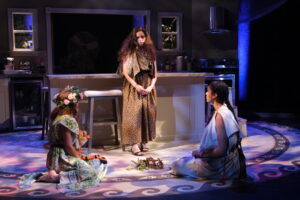
A few years after she first entered the scene shop and started working with “scary” power tools, Brookfield is now leading the team building the set for Nomadic Theatre and Black Theatre Ensemble’s production of A Streetcar Named Desire. The production is set to run in the Village C Theater March 19-28.
Brookfield’s primary job as a technical director is to execute the set designs drawn by the creative team. She’s found herself pushed to make creative choices throughout the process.
“The set we’re building is this rundown apartment, and so the division that we’re creating between the bedroom and the kitchen is actually just a sliding curtain,” Brookfield said. “I’ve never done that in a production, but I think it’s going to end up looking really cool.”
Because production staff build the set pieces in the DPAC scene shop and must transport them to the theater for rehearsals, Brookfield has to consider a variety of logistical factors.
“If you’ve been to the VC Theater, you’ll know that there is an elevator, but not all of our pieces fit in there, and so sometimes you’ll see us walking these really big wooden things down the stairs,” Brookfield laughed. “It’s always comical.”
Brookfield enjoys working around the challenges of show production, as well as the opportunity to pass skills onto other students in Nomadic.
“I get to teach other people how to do it, which I think is my favorite part about being a part of Nomadic, and getting to build these sets,” Brookfield said. “You’re bringing a lot of people who have been involved in theater and the arts together.”
For Evelyn Christina Wiredu (SFS ’26), Black Theatre Ensemble’s executive producer and the director of A Streetcar Named Desire, the production has been a learning process as well. Although she initially “stumbled into” directing after the original director stepped down, Wiredu said the support of other members of Georgetown’s theater community has helped her grow into the role. Fatima Dyfan, the faculty artistic director for all the co-curricular theater groups, was particularly supportive.
“She was really helpful in [saying], ‘Here are some things that you could do. Here’s some ways to be thinking about it,’ walking me through creating a vision statement and all of that,” Wiredu said.
Working with other members of the production staff allows her to give input on which design choices will work with her vision, which focuses on the show’s historical setting.
“I very much see it as a time capsule of the late-1940s, post-World War II era,” Wiredu said. “I’m more focused on the history aspect of it.”
Wiredu also appreciates the opportunity that directing has given her to focus on blocking, or the precise way that actors move within the show. This is an aspect that she finds is often overlooked in the theater.
“Every single movement is, to some extent, choreography, and I don’t think that’s talked about on stage as much when it’s not a musical, when they’re not literally dancing,” Wiredu said. “Every movement, picking up a glass, putting it down, it’s all part of a choreography.”
Like directors, producers must also look at shows in a new way, according to Felicity Misse-Ekwa (CAS ’28). Misse-Ekwa has encountered numerous surprises as the producer for A Streetcar Named Desire, with one of her first challenges being the casting process.
“I’ve never helped with casting before, and it honestly changed my mind, because I always thought, ‘Okay, the best actor gets the role,’’ Misse-Ekwa said. “But no, I learned that it’s whoever fits the role best that gets the role.”
While actors must believably portray their characters, production staff must immerse the audience in the play’s setting so they can see those characters in context.
“The actors can bring you to that character, but the role of the set and the music is to bring you to that area,” Misse-Ekwa said. “Streetcar is set in New Orleans, and so the role of the set, the role of the music, the role of the lights, is to also bring you into New Orleans.”
Making sure the crews for the set, music, and lights are running on a smooth schedule is the role of the stage manager. Despite not having much experience in theater before coming to Georgetown, Anandita Agarwal (SFS ’28) said she has felt welcome serving in that position for A Streetcar Named Desire.
“I do feel like some of it is a little hard to understand at first when you enter the world, but I think it’s easy to get involved, and if you really put in time and energy, it’s really easy to learn about the resources they have,” Agarwal said.
For Agarwal, the supportive and artistic theater community contrasts with the structured and preprofessional culture in other on-campus activities.
“I’m also a little surprised by how informal theater is. At Georgetown, it’s kind of in the margins, and it’s more of a third space,” Agarwal said. “Over here, it’s the investment banking clubs and the consulting clubs that get all the budget, right? So we had to make do with the remains of it. But there’s a very big community of artists.”
Agarwal highlighted members of the Nomadic community, including past stage managers, for giving her support and guidance. But even with their help, stage managing can be taxing.
“Not only do I have to be there at every rehearsal and be actually present and engaged in the process of putting together a product on stage, but I’m also working outside of rehearsal. I spend at least 10 hours a week on theater stuff,” Agarwal said.
Spring Awakening
In Mask and Bauble, Georgetown’s oldest theater troupe, students are also hard at work preparing for their production: the troupe will put on Spring Awakening this month. The show is scheduled to run April 10-18 in the Mask and Bauble Theater in Poulton Hall.
For director Nate Findlay (CAS ’27), working on Spring Awakening has allowed him to express his longtime love for the show and interpret it in a new, creative way.
“Spring Awakening has been my favorite show since God knows how long. Not only is the music incredible and the show dynamic, but I’ve never encountered a piece equally as fun and emotional,” Findlay said.
Although the show revolves around young teenagers in 19th-century Germany, Findlay said its themes of “personal repression, liberation, joy, and freedom” make it equally relevant to 2026.
Acting makes up much of Findlay’s previous theater experience, but he was excited to get involved in the creative side of production. He sees directing as an opportunity to give back to the theater community and create meaningful experiences for performers by supporting their personal expression and artistic development.
“It’s more than a production, it’s an extension of who they are […] manifested into the world,” Findlay said.
For Findlay, who is studying film, specific visual elements and symbols have become a big part of his creative process.
“I think through images: how images will help guide an audience through the story,” Findlay said.
For example, the set will prominently feature wood. The performers’ interactions with wooden or natural objects and human-made objects will make the characters’ internal battles between nature and nurture, a major theme in the show, more vivid to the audience, Findlay said.
Alexis Giaquinta (CAS ’28), who is producing Spring Awakening, has also worked thoughtfully on the show’s set pieces. Among the unusual problems Giaquinta had to tackle was finding a piano; instead of building a fake one, the team decided to find a real piano and hollow it out for the set. Giaquinta said the unpredictability involved in producing has changed her perspective on theater.
“With acting […] sometimes things are weird, but you know it’s written in the script, and you know what’s gonna happen,” Giaquinta, who acted in high school, said. “A lot of times with producing, I’ll get a question, and I’m like, ‘Well, I really wasn’t expecting to be asked this question today.’”
Giaquinta hopes audiences will recognize the attention to detail that producers have while building sets.
“A lot of people will look at art and enjoy it, and that’s really awesome. But it’s also important to think about it in a critical way, and realize that these are choices that are being made on purpose, and not just because we thought it would look cool,” Giaquinta said.
As one of the choreographers for Spring Awakening, Charlotte Bonneau (CAS ’27) is continuing her love for dance while helping execute the artistic vision of the show. Because a choreographer must design dances with both the actors and the people who operate lights and sound in mind, Bonneau stays in constant communication with everyone in the production.
Choreographing an ensemble of actors who all have different levels of dance experience can be challenging.
“You have to make everything very accessible for what we call a ‘strong mover,’ but not a dancer. It’s all about making the performers look good, and finding a really happy medium with something that’s challenging but not out of the realm of possibility,” Bonneau said.
In addition, a choreographer must consider the audience’s viewing experience. Spring Awakening will be staged in the round, meaning that audience members will be seated on three sides of the stage, watching the performance from several angles.
“How do we make it look cool to people sitting in the back, in the front, on all sides of the audience?” Bonneau said. “Adapting to the space is one of the most fun parts, because it forces our production to be unique.”
When Bonneau and others reflected on the amount of time and effort that goes into their shows, they said the process remains rewarding. It’s not a resume-builder, but a way to build community and appreciation for the performing arts.
“There’s no career incentive to college theater,” Bonneau said. “Everyone there is there for the love of the game.”