


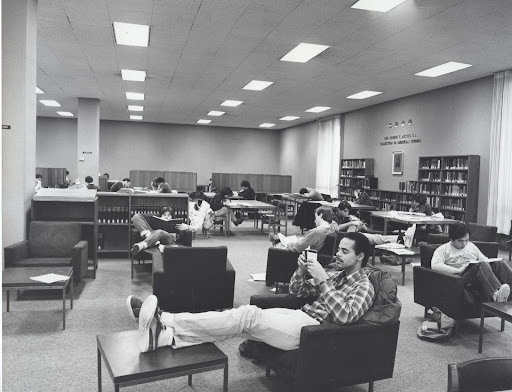

The Pierce Reading Room in Lauinger Library reopened to students after nearly a year of renovation on Jan. 12. Revealing a dramatically reimagined space has sparked a range of student reactions, from appreciation to concerns about how well the room actually serves practical study needs.
The changes include new furniture, architectural updates, and expansive window additions that produce significantly more natural light.
The Pierce Reading Room had remained largely unchanged since Lauinger Library (Lau) opened in 1970. The Student Library Council and faculty library leadership explained that the main goal of the construction was to preserve its identity as a quiet study space while creating a more modern and adaptable environment. University officials emphasized that supporting student work remained central throughout the process.
“The Pierce Reading Room supports both quiet reflection and collaborative study, giving students the freedom to choose the micro-environment that best fits their needs at any given moment,” Beth Marhanka, head of outreach and engagement at Lau, said in a statement to the Voice.
A university spokesperson echoed this statement in an email to the Voice.
“Making the room a welcoming, comfortable place to study has always been the guiding principle,” the university spokesperson said.
The project initially aimed to simply refurbish the room with new furnishings and seating. But plans evolved when construction began.
“We realized that there were opportunities to make the space truly exceptional,” the university spokesperson said.
One of the most noticeable changes is the addition of expansive windows overlooking the Potomac River, allowing for significantly more natural light. Students have responded positively to this feature.
“As someone who really values natural light, I think that the open and bright design of the Pierce Reading Room makes it one of the best places on campus to study,” Sarah Davidson (CAS ’26), co-chair of the Student Library Council, said. “Opening up the space provides many more opportunities for students to get the light levels they want.”
In addition to updated seating and lighting, the renovation introduced new features designed to support a wider range of academic activities. These include the glass-enclosed Visualization and Learning Lab, a technology-enabled space for research and data visualization, as well as an exhibition area showcasing faculty and student work.
Dean of the Georgetown library Alexia Hudson-Ward framed these additions as part of a broader shift in how academic libraries serve their communities.
“The Pierce Reading Room reflects how academic libraries are evolving into flexible, inclusive environments designed around a range of student needs,” Hudson-Ward said. “One of our goals with Pierce is to honor the many ways students learn and create knowledge by balancing traditional space usage with innovation.”
At the same time, some students question whether the redesign prioritizes aesthetics over meeting students’ practical study needs.
“I appreciate the natural light and new additions,” Allie Dornfeld (CAS ’27) said. “But realistically, it isn’t an efficient use of space. There aren’t enough tables to accommodate students.”
This creates a clear tension: the renovation leaned heavily into comfort, openness, and flexibility, but some students had hoped for a layout that would maximize the number of individual study stations like the pre-renovation room had.
University officials emphasized that student input played a significant role in shaping the renovation.
“The Student Library Council had several opportunities to give feedback,” the university spokesperson said. “We also gave the entire Georgetown community the opportunity to vote on the furniture. We brought in 20 different chairs and asked students, faculty, and staff to rate each one on a scale of ‘Hate It’ to ‘Love It.’ The highest-rated chairs are the ones we selected.”
Members of the Student Library Council confirmed that the council advocated for student needs by prioritizing comfort and usability.
“The council made an effort to represent the need for comfort and ergonomics when it comes to doing work on a laptop,” Sarah Davidson (CAS ‘26), co-chair of the Student Library Council, said. “We have also made it clear that the library is a deeply valuable space for student work, which makes it all the more important that a study space was the first place renovated.”
Since the room only reopened in January, both administration and student leaders expect feedback to continue shaping its use. Catherine Zenher, the Student Library Council’s communication chair, explained that the council plans to gather additional student input and host events in the room as students become more familiar with its layout.
“We’re trying to make the room as versatile as possible and it’s been really interesting to watch students shape the space to their needs,” said Zenher.