

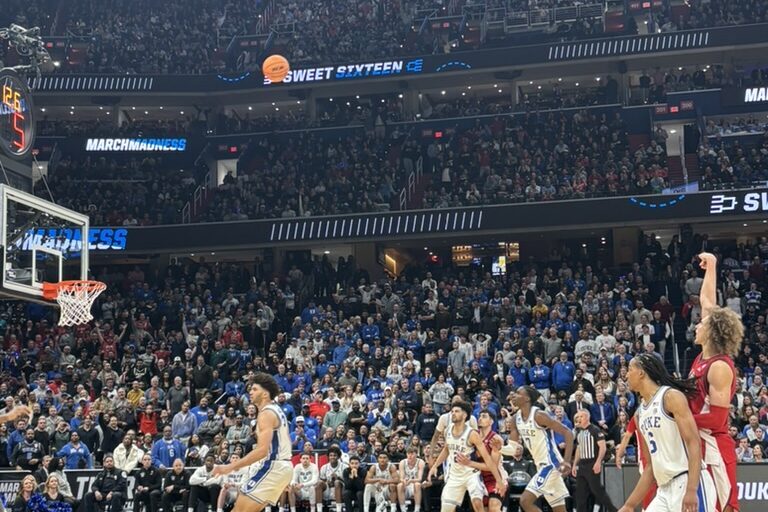
On Friday, March 27, Capital One Arena was the place to be: the 2026 NCAA Men’s East Regional Sweet Sixteen was a set of matchups for the history books. Not only did the games consist of four superstar rosters, but the head coaches brought nearly 100 years of combined coaching experience.
In the first game, Rick Pitino and St. John’s fell to Jon Scheyer’s Duke Blue Devils. In the second act, Dan Hurley’s UConn squad eked out a win over Michigan State, led by Tom Izzo.
Pitino and Izzo are no strangers to the Big Dance. Both coaches have led multiple teams deep into the tournament, and Pitino is the only coach to record two NCAA championship wins with two different schools: University of Kentucky in 1996 and University of Louisville in 2013, though the latter was later vacated due to a scandal. Izzo has also brought teams to the Final Four six times in his 31 year career at Michigan State.
While these two Hall-of-Fame inductees bring thousands of games of wisdom to their respective teams, Scheyer and Hurley continue to prove that they can hang with the best of the best. Compared to the other two, Scheyer and Hurley were the youngsters of the weekend, though they still have 20 years of head coaching experience between them—with Hurley recording 16 of those alone.
However, neither coach was shy about acknowledging the legacies their opposing coach represented. In a pre-game interview, Scheyer said, “When I first fell in love with college basketball, it was actually watching Duke-Kentucky in ’92”—a reference to “The Shot” that Duke scored over Pitino’s University of Kentucky with 2.1 seconds left to go to the Final Four in 1992.
Despite Pitino and Izzo’s experience, Hurley and Scheyer ultimately showed that they might be the new top dogs in the college basketball arena.
How it happened:
Duke’s 80-75 win over St. John’s
In the first game of the night, the St. John’s Red Storm (30-6, 18-2 BIG EAST) weren’t afraid to match up against the No. 1 seed and the legacy that follows the Duke University Blue Devils (34-2, 17-1 ACC).
Duke doesn’t have many weaknesses, but St. John’s found a way to exploit one of them by forcing Duke to work hard in order to bring the ball up the court. Just over five minutes into the game, senior forward Dillon Mitchell stole a Duke inbound pass and converted the subsequent layup, lifting the Johnnies fans to their feet. He immediately deflected the next pass out of bounds, forcing Duke head coach Jon Scheyer to call a time-out and setting the tone that the Blue Devils wouldn’t win without a fight.
Despite Duke’s usual stars failing to establish themselves early thanks to the Johnnies’ intensity, sophomore guard Isaiah Evans and senior forward Maliq Brown proved integral to the Blue Devils’ overall efforts in the first half. Evans had a couple of monster dunks that maintained Duke’s momentum and caused Capital One to erupt. Brown also showed why he was named ACC Defensive Player of the Year with several key blocks and deflections that forced St. John’s to take tough shots.
Both teams continued to go on runs until the Johnnies offense stagnated briefly, pushing the Blue Devils on top 35-28 with 4:20 left in the first half. St. John’s’ redshirt junior guard Dylan Darling hit a three-pointer with 3:02 left in the half, and started a 12-4 Johnnies run. A three from senior forward Zuby Ejiofor as well as a pair of threes from sophomore forward Ruben Prey sent the Red Storm up 40-39 at halftime.
St. John’s carried their momentum into the second half, putting relentless pressure on the Blue Devils. Multiple consecutive Duke trips down the floor ended in steals with easy layups for Ejiofor. Head coach Rick Pitino didn’t let up either—the Johnnies relentlessly pulled the trigger from three. Defensively, their full court press made it difficult for the Blue Devils to get down the floor, and with just under ten minutes left in the game, their pressure forced a ten-second backcourt violation.
St. John’s pressure put them up 55-45, but Duke crawled out of the hole thanks to the efforts of junior guard Caleb Foster. This was Foster’s first game back after suffering a fractured foot in Duke’s March 7 game against the University of North Carolina.
As Scheyer said in the post-game interview, “[Foster] had no business playing tonight.” Friday’s game was the first time Foster had even scrimmaged, let alone played, since his injury.
Foster scored 11 points in the second half, and his poise at point guard brought the calm that the Blue Devils needed to get the job done. With 2:22 left in the game, Foster made a long jumpshot to bring the score to 75-69 Duke.
Despite valiant efforts, the Johnnies were forced to play the foul game in the final seconds to give themselves a shot retaking the lead. With 10.8 seconds left, the Blue Devils found themselves up 77-75 with Evans at the free throw line. When game time finally ran out, St. John’s was unable to find the basket and the Blue Devils won 80-75.
UConn hangs on 67-63 over Michigan State
If the first game was a nail-biter, the second couldn’t have been more different. The University of Connecticut Huskies (31-5, 17-3 BIG EAST) quickly took a commanding lead over the Michigan State Spartans (27-7, 15-5 Big Ten). The Huskies played the epitome of team basketball, and found each other around the arc for three-pointers in rhythm with assists. With 11:01 left in the half, the score was 21-6 UConn.
Just 26 seconds later, star junior guard Solo Ball sank a tough three-pointer to make the score 24-6. It took Michigan State more than 11 minutes to finally get on the board with double digits. Throughout the half, the Huskies consistently looked faster and stronger than the Spartans, and continued to maintain about a 12 point lead.
Despite the struggles, the Spartans showed signs of hope, including an alley-oop from redshirt sophomore guard Jeremy Fears Jr. to senior center Carson Cooper with 4:45 left in the half. Then, with three minutes to go, Spartan senior forward Jaxon Kohler showed up big with a three-pointer to make the score 33-21 UConn. This spurred an energetic run by the Spartans which had Michigan State fans on their feet as Kohler continued to find the back of the net and grab key rebounds. While the Spartans only shot 34.5% from the field, and an abysmal 12.5% from three in the half, they went into halftime down only eight, with the score 35-27.
Still, in Tom Izzo’s 31-year coaching career, he’s certainly seen it all. With an overall 764-309 record, Izzo clearly knew exactly what to tell his team at halftime. When they started the second half, they looked like a completely different set of Spartans. In the first three-and-a-half minutes, Michigan State went on a 7-0 run to bring the score to 35-34 UConn.
The Spartans were finally able to take the lead off an and-one by Kohler to make the score 45-44 with 10:06 left in the game. Kohler’s score amped up the crowd late into the night and Capital One got loud.
While Michigan State had the momentum, the Huskies battled to keep the game from slipping into the Spartans’ hands. Both teams traded baskets and the Spartans did not lead again. With 1:37 left in the game, Husky redshirt senior Alex Karaban sank a deep three to make the game 61-57.
With 22.5 seconds left, Michigan State was forced to foul Karaban to get a shot of getting the ball back, and his shots put the Huskies up 65-62. Michigan State tried to tie the game but after trading fouls with UConn the game was 67-63 with four seconds left. Down by four, there wasn’t much Izzo’s Spartans could do and the game ended 67-63 UConn.
What this means:
This region’s showdowns were some of the best basketball we have yet to see in this tournament, but beyond the in-game excitement, the coaches each put on a masterclass in excellence.
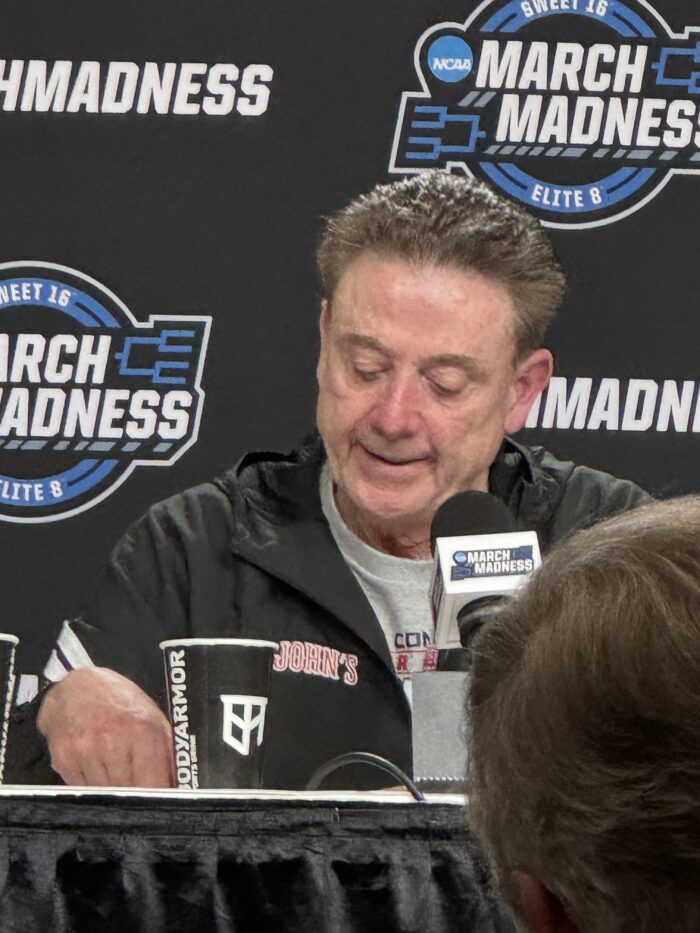
Photo by Megan Geiger St. John’s head coach Rick PitinoPhoto by Megan Geiger
Despite St. John’s loss, Rick Pitino showed that he is as sharp as ever in his 14th Sweet Sixteen appearance. Watching like a hawk, Pitino stalked up and down the sidelined continuously in his immaculately tailored suit. His stoic, analytical demeanor broke only for impassioned exchanges with referees. The second seat on the bench remained open for the entirety of the game as Pitino stayed close to his guys, commanding short orders with arms folded or clasped behind his back. Praise came in the form of approving nods and clear respect in his expression. Pitino changed into a full St. John’s sweatsuit for the press conference, where he gave well-deserved credit to Duke’s strength and recognized his remarkable group of players. After his seniors broke down in tears on the podium, Pitino let them leave without missing a beat and called them “just the greatest kids in the world”.
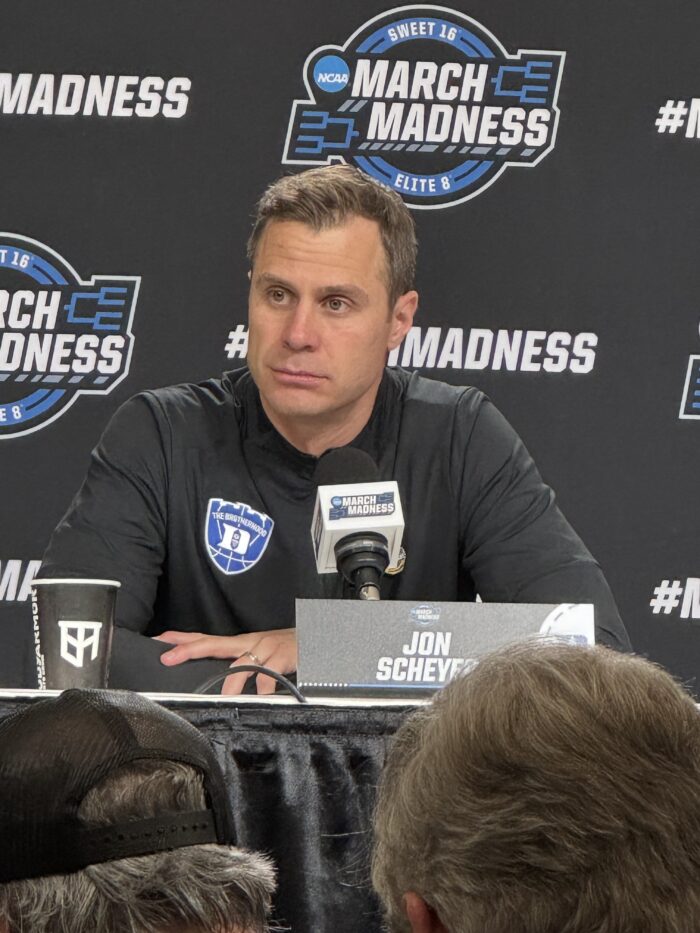
Photo by Megan Geiger Duke head coach Jon ScheyerPhoto by Megan Geiger
Compared to Pitino, Scheyer’s coaching relied much more on dramatic physical signals and vocal direction—alternating between watching intently from the bench and energetically gesticulating at his team from the sideline. His coaches and managers were a physical representation of Scheyer’s style, forming a sea of Duke blue athletic quarter-zips roaring in support. Scheyer built up his players with overt support as they gathered in huddles, and he showed overwhelming admiration for them in the post-game press conference, even putting his arm around star guard Caleb Foster on the podium. Expounding upon individual players’ accomplishments is a signature of Scheyer’s strong leadership.
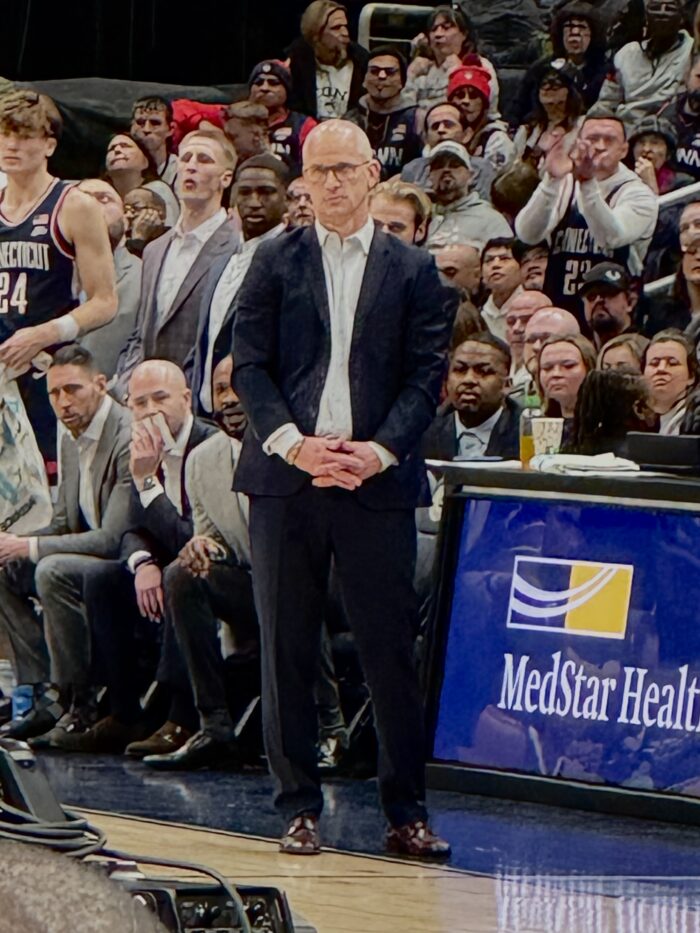
Photo by Megan Geiger UConn head coach Dan HurleyPhoto by Megan Geiger
Clad in a sport coat, Dan Hurley’s coaching was a series of contained explosions. Frequently gripping a stat sheet, Hurley fired up his Huskies by dancing down the sideline, animatedly directing players and pushing back on questionable calls with dramatic reenactments. Hurley was frequently halfway across the floor with outsized emotions, even headbutting players in celebration and high-fiving senior forward Alex Karaban in transition in the middle of the court after a big three. When players came off the court, Hurley was waiting with ample words of encouragement. He expressed deep pride for his team and confronted questions with his classic dry humor in the presser.
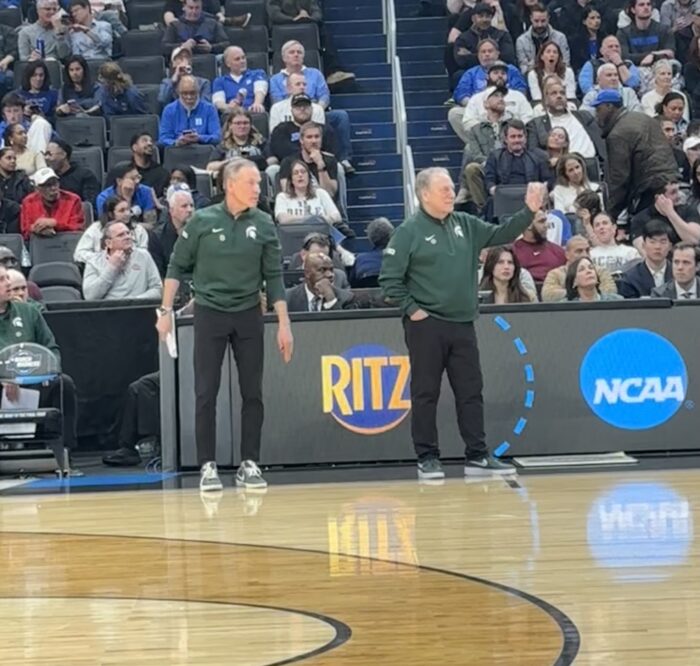
Photo by Julia Maurer Michigan State head coach Tom IzzoPhoto by Julia Maurer
Tom Izzo commanded the Spartans with a simmering intensity. Sporting a bright green zip-up, Izzo switched periodically between analyzing from the bench and with his hands on his knees in concentration from the sideline. Pointing to the exact spot of the event, Izzo excitably contended with missed calls, unafraid to advocate for his players. He took time before each huddle to converse with individual players, and their close relationships were clear in the post-game press conference, as both players emotionally grasped his shoulders on their way back to the locker room.
Hurley and Scheyer represent the next generation of all-time coaches, bringing new forms of fire and intensity to the game. Dominant wins in these Sweet Sixteen games adds another sparkling line item to already immense resumes as these two continue their growing legacies. The changing of the guard, however, is not yet complete. Storied coaches like Pitino and Izzo keep pace, pushing newer coaches to their limits amidst continued success with their own programs. Even as a new era of basketball emerges, wisdom and experience are still a winning formula.