

Editor’s Note: This article was initially reported in Street Sense Media
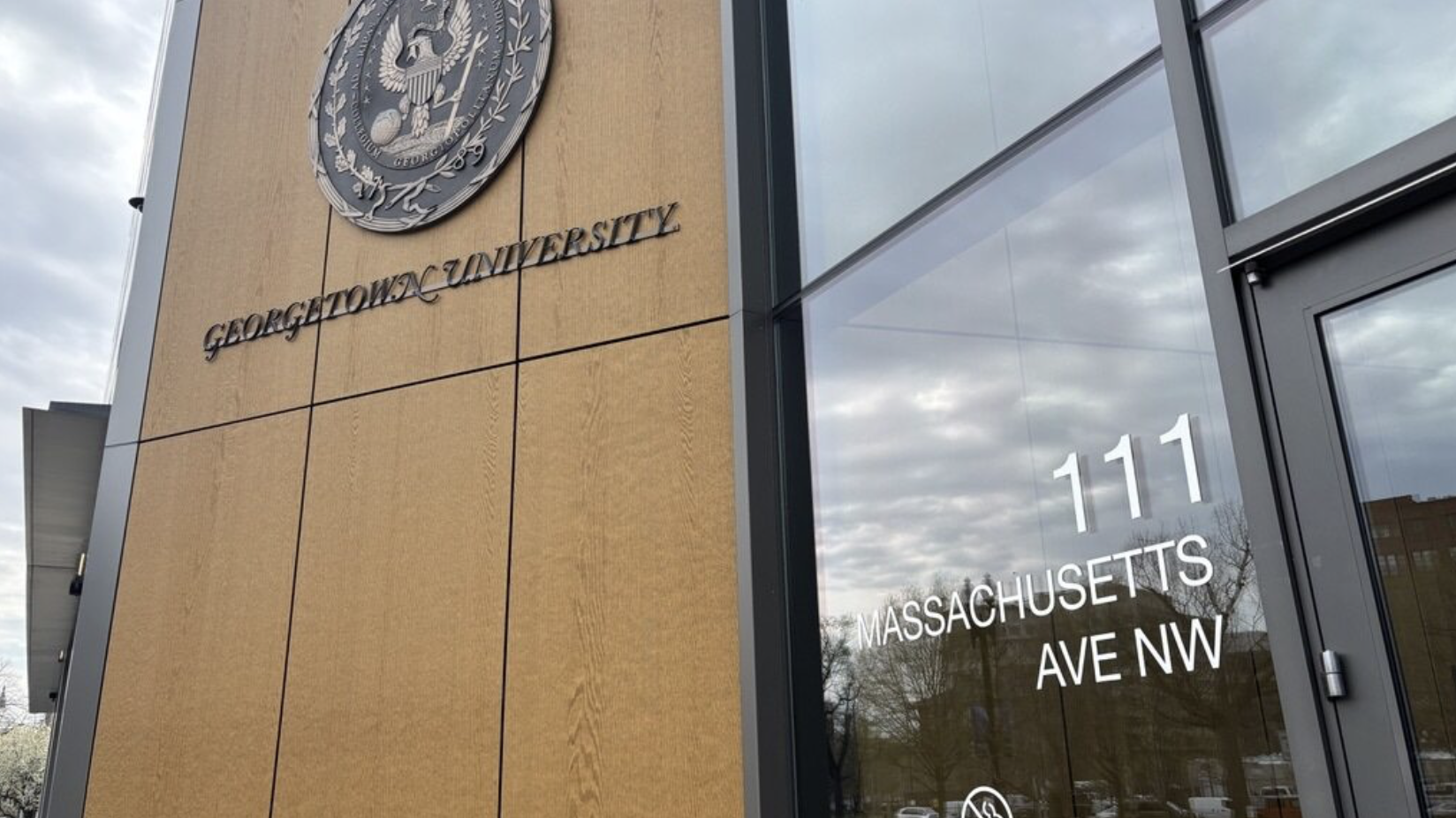
In 2022, Georgetown University was preparing to break ground on a new building for its downtown D.C. campus. At the time, there were about 20 people experiencing homelessness living around the soon-to-be construction site.
That summer, the university quietly paid the h3 Project, a nonprofit homeless outreach organization, to survey the people in the encampment and connect them with housing, health care, and other services before the D.C. government cleared their encampment.
Dozens of universities have bought buildings in downtown D.C. in recent years, often leading to construction or redevelopment. But it’s not the norm for a university to invest in direct outreach work with unhoused communities living around their new property. What Georgetown did was “extremely unique,” Alexis Johannessen, the associate director of outreach at the h3 Project, said. Outreach workers hope Georgetown’s project could serve as a model for other developments. Georgetown never advertised or spoke publicly about its work with h3 over that summer, but h3 told Street Sense the partnership had a significant impact on people experiencing homelessness living in the area, some of whom the organization is still in touch with. Some encampment residents started new jobs or got into housing with h3’s help.
“In some cases, it was absolutely life-changing,” Ami Angell, founder and director of outreach at h3, said.
According to Angell, a few months before the Georgetown partnership, h3 worked on a similar project with one of Kaiser Permanente’s buildings in NoMa. She said the projects with Kaiser and Georgetown are the only examples she knows of any university, corporation, or other large organization funding this kind of work in D.C.
When downtown developers begin construction or ask for encampment closures around their new property, it can displace residents experiencing homelessness and make outreach organizations’ work more difficult. While city workers offer to connect residents with services during an encampment closure, the closures usually result in people continuing to live outside, even if they move to new spots.
“When they’re dislocated, it’s more difficult to find them and follow up on services. If they get matched to housing, we can’t find them. This happens all throughout the city, with the encampment clearings, and it actually creates more havoc for us, because we don’t know where the folks have relocated to,” Angell said.
Georgetown’s partnership with h3 sought to avoid these impacts. Angell said she originally connected with the university through the Mount Vernon Triangle Community Improvement District, which oversees the area the building, located at 111 Massachusetts Ave. NW, is in.
“[h3] had a very clear understanding of what some of the day-to-day needs of what these communities could be,” Dave Green, the executive vice president and chief operating officer of Georgetown, told Street Sense. “They were a perfect fit,” Green said.
After meeting with Georgetown’s then-president John DeGioia and other university leaders, a team from h3 spent June and July surveying encampment residents about the circumstances that led them to homelessness and connecting them with resources. After D.C. cleared the encampment on Aug. 12, 2022, h3 staffers continued working on individualized case management plans with the residents.
Eighteen of the 21 encampment residents participated in h3’s survey. According to a July 2022 report on the survey findings, which h3 shared with Street Sense, most participants said they didn’t know where they would go if they had to move from the encampment. “I should have a backup contingency plan, but I don’t,” one resident is quoted as saying. Most participants — 10 of them — said they did not have a case manager.
h3 filled in: the outreach team helped residents secure vital documents like birth certificates and IDs, enroll in Medicaid or the Supplemental Nutrition Assistance Program, create resumes and apply to jobs, connect with housing programs, and more.
“I have no doubt that by [Georgetown’s] direct action of investing in the people that were on their property when they could have turned the other way, that their action of allowing us that intensive case management did save lives,” Angell said.
Many of the encampment residents had been experiencing homelessness for several years, according to the report, most commonly becoming homeless due to disputes with family members or a relationship fallout. However, all survey participants said they had been living at the 111 Massachusetts Ave. location for 12 weeks or less, except for two residents who were unsure. The encampment was not there when Georgetown first bought the building in 2021, university leadership told Street Sense.

Asked how they envisioned the next year, most encampment residents told h3 they hoped to find housing. “That’s all I can imagine right now,” one resident is quoted as saying in the survey report. Another said, “I want to be complete. Have housing, have community, have things of my own.”
h3 gave out 18 referrals to housing resources to encampment residents, according to a September 2022 project impact report h3 shared with Street Sense. Two people were already matched with housing by that September.
Sixteen of the 18 survey participants were interested in working, though none were employed. “I am not helpless! I just need a little help,” one encampment resident is quoted in the survey report as saying. “I am not the guy saying I will never work again. I just need a little boost. Then I’ll be fine. I just need an interview. A chance to prove I am worth it.”
Now, some residents are still working in jobs the organization helped them apply to in 2022, according to Angell and Johannessen.
Both outreach workers said without Georgetown’s support and funding, it would have been much harder to provide the same resources to the encampment residents. “We would not have been able to do it as quickly and have as positive outcomes in such a short time frame,” Angell said.

The 111 Massachusetts Ave. building is now part of Georgetown’s Capitol Campus, where some students live and take classes away from the university’s main campus in the Georgetown neighborhood.
Georgetown is one of more than 50 colleges and universities that have a presence — either a satellite campus or main campus — in downtown D.C., according to data from the Washington D.C. Economic Partnership. This includes nine universities that launched new campuses since 2024. Most people who live outside in D.C. also live downtown, where there’s a greater concentration of service providers and proximity to community spaces and organizations, according to 2024 data.
However, Angell and Johannessen said they have never worked with or heard of another university investing in this kind of direct outreach work when they buy or develop property in the city.
Some other universities in D.C. engage with homelessness outreach organizations in different ways, such as through partnerships offering volunteer opportunities. Johannessen encouraged universities and other institutions to be intentional about how their development projects impact the local community.
“Even if they’re not able to fund a project in the same way that Georgetown did, they can reach out and connect with community organizations that are on the ground doing the work to make sure that [the local community] is aware of changes that might be coming, and maybe get some extra support around that area for folks,” Johannessen said.
Georgetown leadership told Street Sense the partnership with h3 was an important way for the university to live up to its mission.
“What was exciting about the work is how it really supported the university’s mission to serve the unhoused, serve the poor with dignity, and addressing justice there for the most vulnerable,” Cory Peterson, Georgetown’s associate vice president for community engagement and local government affairs, said.
Georgetown’s main campus is peppered with banners declaring the university’s values: “people for others,” “faith that does justice,” and “cura personalis” (“care of the whole person”), to name a few. The project was part of living out those values as a Jesuit university, Green, Georgetown’s executive vice president, said.
“That was something that we didn’t come up with and sit in a room and say, ‘Oh, how is this going to look good for Georgetown, look bad for Georgetown?’ It was, ‘We already have our core values. Now, how do we execute on them?’” Green said.
Georgetown’s leadership has never spoken publicly about the project.
“We should be doing this every day, without the fanfare,” Green said. “We’re supposed to be doing this.”