



Parents in D.C. pay more for child care than anywhere else in the country, and D.C.’s mayoral candidates are seizing on that frustration as a central campaign issue.
“Child care is probably our second biggest line-item expense, after housing, and I think it’s really a very, very close second,” Sam Rosenthal, a parent who lives in Petworth, a Northwest D.C. neighborhood, said. Rosenthal and his wife have just one child—a daughter who is almost 2—but her day care alone costs the family close to $30,000 a year.
Rosenthal’s situation isn’t out of the ordinary. In D.C., the average annual cost of child care is $26,193 for a single kid, or roughly $2,200 per month. That’s about 17% of the median income for families with children in D.C. and nearly double the national average. While the District already provides universal free pre-K for children ages 3 and 4, parents of younger children often shoulder these costs alone.
As the city’s mayoral race heats up, child care has become a major issue, particularly for Ward 4 Councilmember and mayoral hopeful Janeese Lewis George. Her progressive child care proposal has sparked questions on whether it would offer relief to D.C. families or be a financial blunder given the city’s tight finances.
Child care is one of the key issues in the broader debate around “affordability,” which has dominated political rhetoric in 2026, including in local D.C. politics. While both frontrunners in the mayoral race—Lewis George and former D.C. Councilmember Kenyan McDuffie—have emphasized affordability in their campaigns, Lewis George has positioned herself as the more progressive candidate, including on the issue of child care.
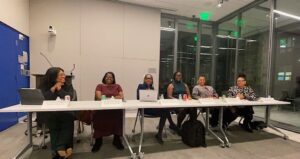
“Everybody from Dupont to Deanwood, from the middle class to the margins, are feeling the squeeze in this city. And we need a mayor who is going to make this city more affordable for all of us,” Lewis George said at a March candidates forum organized by a coalition of D.C.-area advocacy organizations.
Lewis George’s child care proposal would expand the existing child care subsidy, which is currently limited to low-income families, so that no household spends more than 7% of its income on child care. Her plan would also seek to increase child care worker wages, invest in training and subsidies for child care provided by family and friends, and locate more child care centers in school buildings with excess space.
In contrast to Lewis George, McDuffie’s child care platform takes a more modest approach. It includes changing zoning rules to support home-based child care providers, expanding the city’s local child tax credit, and providing tax incentives for employers to provide child care benefits.
Voters who support Lewis George’s proposal told the Voice that an ambitious plan is necessary to keep families in D.C.
“I know myself and a lot of others in D.C. are just straight up not considering children as an option for us while we live in the District, because we know how expensive it is,” Kurtis Hagans, Chair of Metro D.C. Democratic Socialists of America (DSA), said. The DSA chapter endorsed Lewis George, who is also a democratic socialist, for mayor.
Travis Ballie, organizing director at DC Action—a group that advocates for policies supporting children and families but does not endorse candidates—said access to child care is important for the District’s economic interests.
“People want District residents to get back to work, to show up in offices, and District families need child care in order to make that happen,” Ballie said. “This is an economic issue as much as it is a child development issue.”
Lewis George’s campaign comes on the heels of fellow democratic socialist Zohran Mamdani’s successful run for New York City mayor. From the beginning, many have compared Lewis George’s campaign to Mamdani’s, and not always favorably: McDuffie has criticized her for trying to “run D.C. using a New York City playbook.”
Mamdani’s campaign featured ambitious promises, including a call for free child care that his office has already made strides toward implementing. However, unlike Mamdani, Lewis George’s proposal is not free child care; instead, its goal is “universal affordable child care.”
Some supporters, including Hagans and Rosenthal—who also volunteers with DSA—say they would prefer fully free universal child care, but see Lewis George’s proposal as an important first step.
“There’s always room to imagine more, and we see this as a good starting spot,” Hagans said. “We also understand that the political pressures in the District are such that anytime the word ‘free’ is thrown around, people just kind of roll their eyes. It’s not right that that happens, but it is just the case.”
Hagans added that Lewis George’s plan for “affordable” rather than free child care is “understandable” given D.C.’s political climate and tight budget.
D.C. officials estimate that keeping local programs running at the current level would require $1.1 billion more in revenue than the city has. To account for the shortfall, Mayor Muriel Bowser’s proposed budget for the next year includes cuts to child care worker wages and a new waiting list for the child care subsidy that Lewis George wants to expand.
Still, Lewis George’s campaign maintains that the city can find the funding for her proposal.
“We can do this without raising taxes on working people,” Amanda Michelle Gomez, Lewis George’s campaign communications director, wrote in a statement to the Voice. She said that the proposal will be funded by cutting “budget waste” and closing “tax loopholes” for out-of-state business owners.
Critics of Lewis George’s proposal argue that the plan is unrealistic and that business taxes will be economically detrimental.
“The District is already struggling to keep businesses in the city. Her plan is not well thought out. It is not something that is feasible or without negative consequences,” Aaron Carr, chair of A United DC Research Council, wrote to the Voice. Carr’s group, a nonprofit, funded an ad attacking Lewis George for supporting raised taxes.
Still, supporters say Lewis George’s child care proposal is worth the investment, even if it’s costly.
“We fund things much less important and much more expensive on a regular basis, and nobody bats an eye,” Hagans said, citing the Robert F. Kennedy Stadium deal as an example. “There are always trade-offs, and we think that there are pretty clear trade-offs here so that we can ensure that kids are healthy and safe and are getting good education in the District.”