

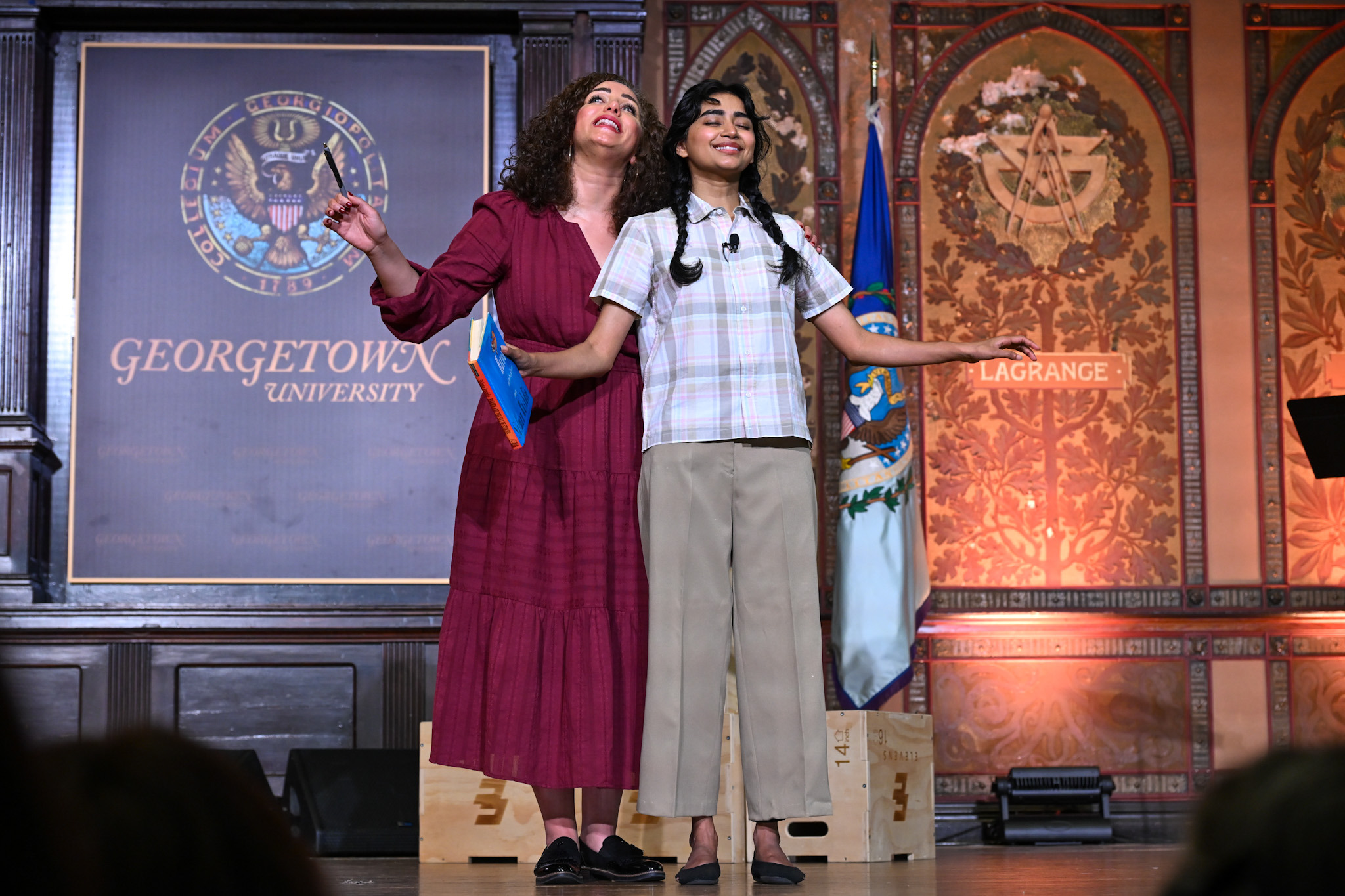

“What is the use of telling stories that aren’t even true?” asked actress Surasree Das, as she plays Haroun in Salman Rushdie’s book Haroun and the Sea of Stories. She calls out to her father, played by Arian Moayed, a desperate plea to understand why he has devoted his life to storytelling.
A new theater work by Georgetown professor and Director of Theater & Performance Studies Undergraduate Program, Derek Goldman, The Use of Stories, explored fiction and its impact through works such as Haroun on the third and final day of the Lannan Literary Festival in Gaston Hall on April 2.
The Lannan Center for Poetics and Social Practices, a center at Georgetown that focuses on public engagement of the contemporary literary arts, hosts the festival every other year, inviting writers to explore their works and celebrate the impact of art and writing. In the year when the festival does not take place, the center hosts a writing symposia, inviting writers, journalists, poets, and other intellectuals to speak on pertinent social and cultural topics.
The theme of this year’s literary festival was “Writing Through Change,” exploring how writing can be a medium for processing changes in or to oneself. After nearly being killed in 2022, when Rushdie was stabbed by an attacker multiple times, the author explained how writing about his experience was the best way to get through it.
Rushdie was one of three writers invited to the Lannan Literary Festival events, in addition to Julia Alvarez, a poet and novelist who wrote her way through forced migration from Latin America, and Travis Chi Wing Lau, a poet whose work explores his experiences with disability and chronic pain. For each of the days of the festival, writers gave talks surrounding how writing became an outlet to the changes in their lives, accompanied by book signings and student music performances.
The final event featured Rushdie and opened with an inaugural performance of Goldman’s play, which was produced especially for the festival. It wove the escapism of The Wizard of Oz and the imagination of Haroun with Rushdie’s own internal thoughts (narrated by actor Omar Metwally) as he writes and creates under the fatwa.
After Rushdie published his novel, The Satanic Verses, in 1988, the then-leader of Iran, Ayatollah Ruhollah Khomeini, issued a fatwa, a death order that condemned him for blasphemy. Rushdie’s attack came as a result of the order, over three decades after it was originally issued.
Haroun was the first book he published after the order was initiated. The story follows Haroun, the son of storyteller Rashid, as he helps his father find the confidence to tell stories again after Haroun’s mother leaves Rashid for another.
In addition to exploring Haroun’s struggle to save his father, Goldman’s play wove in the central conflict of The Wizard of Oz: the human desire to leave, juxtaposed with the dream of having a place to call home, as another way to highlight Rushdie’s inner turmoil. Metwally explained how the song “Somewhere Over the Rainbow” was an anthem to migrants, describing it as a celebration of escape and “hymn to elsewhere.” This mirrored real-life Rushdie’s need for escape after being threatened and forced into hiding.
Metwally continued by narrating the importance of free speech, asking what is the value one places on the “maker of stories?”
“Free speech is life itself,” he said. “You must decide what a man’s heart and soul and conscience is worth.”
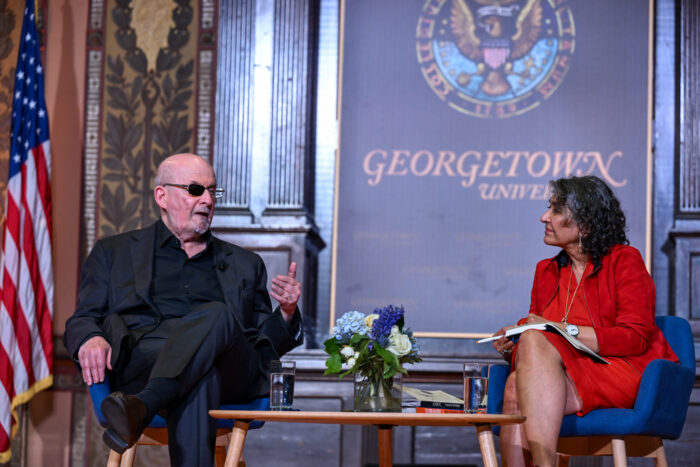
Photo by Leslie E Kossoff Salman Rushdie explains his work to Razia Iqbal.Photo by Leslie E Kossoff
After the play, real-life Rushdie emerged on stage for a dialogue moderated by journalist Razia Iqbal.
Iqbal opened the conversation with the question at the heart of Haroun: “What is the use of telling stories that aren’t even true?”
“I think the book is the answer to that question,” Rushdie said, to laughter from the audience.
Writing through change
Aminatta Forna is the director of the Lannan Center. The original inspiration for this year’s theme, Forna said, came from the ideas of Boris Cyrulnik, a French psychiatrist who studied the mental health of young people.
“Boris Hyelnick had a very strong belief, which is now very well established, that if you narrate your own story, and you narrate it in terms that make sense to you, then you can survive some of the worst traumas,” Forna said.
She emphasized that the current climate makes writing about change an especially pertinent theme. Forna highlighted the many different changes the country as a whole has been experiencing, specifically the rise of artificial intelligence (A.I.) and the aftermath of the coronavirus pandemic.
Lukas Soloman (SFS ’26) is a Lannan Fellow, a fellowship program the center offers that gives students a space to engage with the study of writing in a classroom setting. As a part of the fellowship, Soloman attended each of the Lannan Literary Festival events and saw Julia Alvarez’s work as a clear example of writing through change.
He pointed to her novel, In the Time of Butterflies, a fictionalized memoir of three of the Mirabal sisters who were critical actors in the resistance against fascism in the Dominican Republic. Solomon explained that the novel was an example of the power of writing in spreading messages of resistance. He believes that without her book, the story of the Mirabal sisters would not have been as accessible to the world.
“I think there are so many beautiful stories of resistance and perseverance that get lost in the sands of time and make history feel very dark and grim, which it is,” he said. “But there is so much beauty that comes in the form of the indomitable human spirit.”
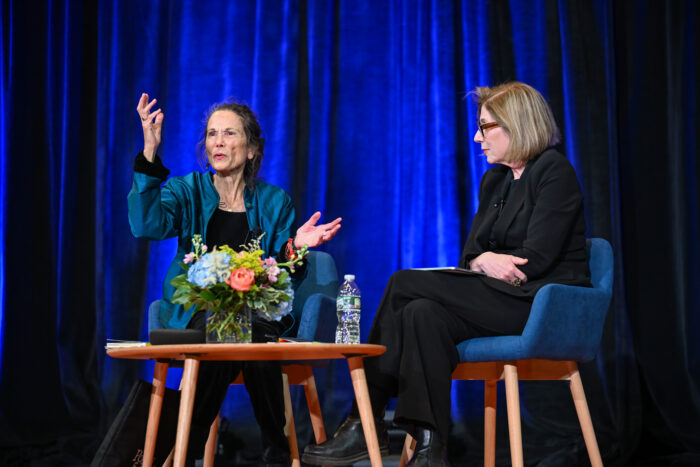
Photo by Leslie E Kossoff Julia Alvarez at her event during the literary festival.Photo by Leslie E Kossoff
Soloman said he first learned about the fellowship at the literary festival his freshman year. He attended to see the Irish poet and author Séan Hewitt speak about his book All Down Darkness Wide.
“Just listening to him speak and listening to him read from his book—I knew at that moment that [writing] is not just a hobby for me, this is something that I actually want to cultivate and pursue,” Soloman said.
Now, as a senior, Soloman described his fellowship class as the highlight of his week, where he receives feedback on his work from other students who love writing and world-renowned authors guide his poetry as his professors.
“It really allows us to engage with the human condition in a way that I don’t normally get to in my other classes with a very, poli-sci, international relations focus,” he said. “There’s something very real and human and raw about poetry.”
The reach of writing
When she took over as director of the Lannan Center, one of Forma’s missions was to expand the center beyond poetry, writing in abstract verse, and into prose, writing in a more structured and narrative form. She also wanted to extend the reach of creative writing on campus by collaborating with other initiatives, centers, and programs.
“For example, my course, ‘Writing Through Change,’ is cross-listed both with Medical Humanities and with the Disability Studies Program,” Forna said. “It’s all about trying to find ways to partner with the other programs on campus, the other areas of study on campus, and take creative writing out of its silo and bring it into the real world.”
She highlighted the student talent the center was able to feature during the festival, with student music performances from acapella groups, such as The Phantoms and the Grace Notes, as well as student bands, like Hieroglyph.
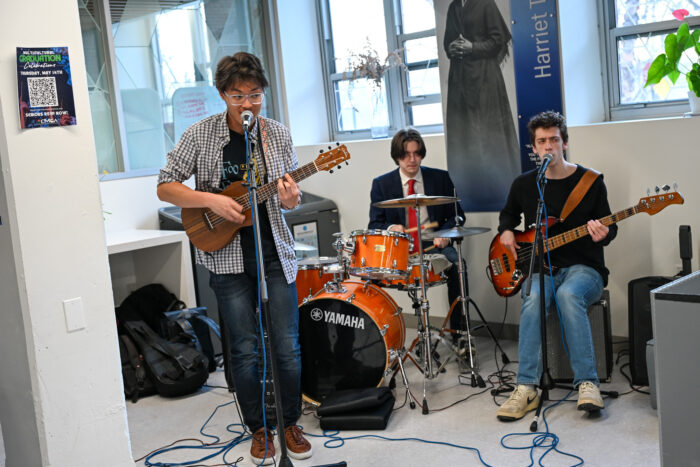
Photo by Leslie E Kossoff Student band Hieroglyph performing at Travis Chi Wing Lau’s speaker event in the Office of Student Equity and Inclusion.Photo by Leslie E Kossoff
Soloman mentioned that the student musical performances were a “really beautiful touch,” contrasting the human creativity showcased at the festival with the recent “A.I. boom” and “industrialization of creativity.”
“Something I hear a lot is people say, ‘Well, I’m not good at writing, or I’m not good at art, or I’m not good at music,’ Who cares? I believe that anything that the human mind creates, be that writing, art, music, or anything of the like, is infinitely more valuable and beautiful than anything synthesized together out of pre-existing work by AI,” Soloman said.
Writing for the world
Within the realm of creativity, Forna emphasized that people can write anything they’d like, but within the Lannan Fellowship, students are “writing for the world.” In particular, the feedback offered through creative writing classes, such as the fellowships, allows writers to better understand how their works may be interpreted.
“It gives them an idea of what it’s like to have a readership, and what people understand out of a work, and what they take from a work,” Forna said. “One of the strangest things to get used to as a writer is the fact that once you’ve written something and you’ve published it, it’s no longer yours.”
Forna emphasized the importance of collaboration in the work of writing, what she believes has become increasingly seen as a solo, independent project that a writer does for themselves.
“I never really saw writing like that,” Forna said. “I always saw writing a conversation with the world. It’s a conversation with the readers of the world, it’s a conversation with the other writers of the world, but it’s also a conversation with the whole intellectual energy of the world.”