

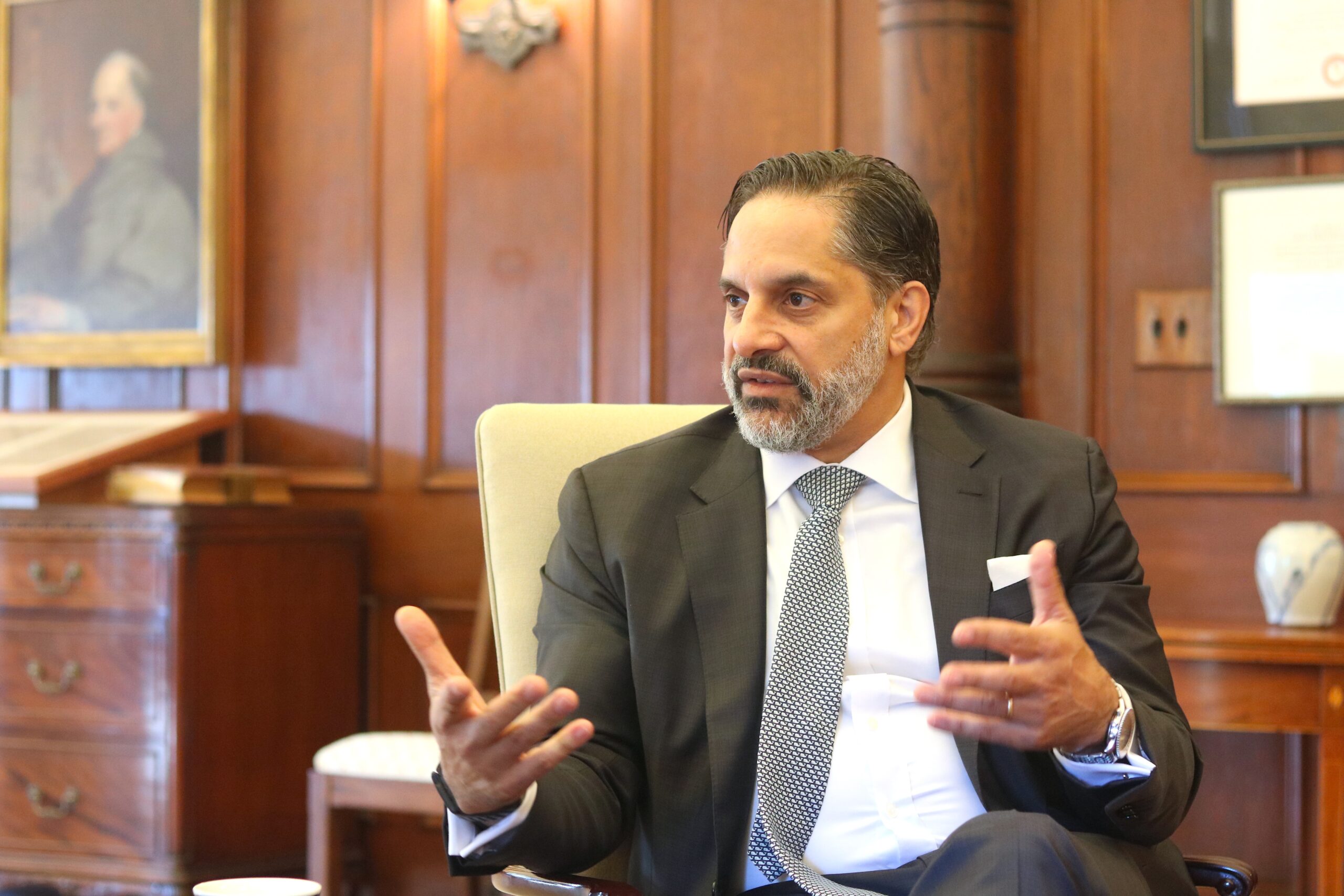
After taking office in July, Eduardo Peñalver sat down with the Voice on Aug. 24 for his first interview as Georgetown’s president. During the 30-minute interview, Peñalver discussed a wide range of topics including divestment and student referendums, legacy admissions, workers rights, and his own background. An edited version of the interview is below.
On adjusting to Georgetown
“I felt really welcomed by the community. I’ve been surprised by the intensity of the warmth and kind of sense of community of this place,” Peñalver said.
He said he first felt truly welcomed to the community when one of his neighbors in Seattle hosted an alumni gathering at his home after he was named president. He also spoke about being struck by the passion of students at New Student Orientation chanting during freshman move-in, along with the welcoming atmosphere as new students arrived on campus. This “strong sense of ownership” is something that Peñalver is excited to continue experiencing as he learns more about campus.
“The more I get to know Georgetown, the more I do feel like I fit in here in terms of my experiences and values, and so that’s been great,” he said. “There’s a lot to learn, both about the culture of the school, the history, the things we need to work on. It’s an incredibly complex institution [with] 237 years of accretion, and I see part of my job is to kind of first understand that, and then to just try to set it up for future success.”
On being a ‘first’
Peñalver is Georgetown’s first non-interim Hispanic president and the second lay (non-clergy) president, following President Emeritus John DeGioia. When asked about his status as a “first” for Georgetown, Peñalver acknowledged that he has often been one of the first Latinos or people of color in most of his roles in higher education, and that it doesn’t intimidate him.
“That’s been almost kind of the case throughout my career in higher education,” he said. “It’s part of what animates my leadership, is [the] sense that that’s that’s an important process for higher education, and one that we need to be kind of conscious of and thoughtful about, and important that I do well because that sort of creates opportunities for the people who are coming up behind me.”
On institutional neutrality
Peñalver was asked about his past policies at Seattle University, including what the Spectator, Seattle’s student newspaper, described as a policy of “institutional neutrality.” He pushed back on that depiction.
“I’ve always been a big critic of institutional neutrality. I know the student newspaper in Seattle characterized it that way, but that was not our approach. In fact, I’ve written things and [at] many speaking opportunities, kind of criticized the framework of institutional neutrality,” he said.
He added that he doesn’t believe that a university can or should be neutral, especially when many issues are, in some way, political. However, he doesn’t see the position as incompatible with academic freedom or with a university serving as a space for diverse thought.
“For a Jesuit university, it’s even harder. I mean, the Pope has said, ‘We can’t be neutral.’ That’s not a viable option for us in the world,” Peñalver said. “We are a university. What do universities do? We produce truth and we form leaders for the future. And so that’s our primary mission, and that requires us to maintain a certain kind of environment of openness and debate and disagreement.”
He pointed to issues including the treatment of employees and support for the dignity of migrants as directly connected to Georgetown’s Catholic and Jesuit values.
Peñalver said he opposes “performative and empty” statements made by universities and does not feel it necessary to comment on issues that do not directly pertain to the life of the university. Still, he rejected the notion that supporting academic freedom requires a university to remain strictly neutral or apolitical.
“I think the one thing Georgetown can do is articulate a different approach that still supports academic freedom, freedom of expression, the importance of a diversity of viewpoints on campus, while still making room for us to be an institution that has values and that expresses those values,” he said.
On divestment and student referendums
Peñalver was then asked about his openness to student feedback and protest, including via referendum. In April 2025, 67.9% of voting students supported a student referendum calling on Georgetown to divest from companies connected to the Israeli military. Interim President Robert Groves rejected the referendum’s divestment proposal less than half an hour after the results were released.
Speaking about the referendum, Peñalver said that he understands why students felt unheard but also suggested that institutional discussions may have occurred before the results, which students weren’t privy to.
“I wasn’t here when that happened, but my impression is you know none of these things come like a bolt from the blue. So you’re aware that this referendum is coming, you are talking about it with the board, and so I assume it was taken seriously and studied, and the swiftness of the response doesn’t mean that it wasn’t taken seriously,” he said. “The fact that, in one case or another, a decision might go one way and be contrary to a majority of student opinion, for example, doesn’t mean that people aren’t taking student voices seriously or respecting student voices.”
When similar protests and calls for divestment took place while he was president at Seattle University, Peñalver said he ultimately decided not to issue a statement on the matter.
“At that time, the issue there was a call for divestment, and there was a demand that I issue a statement. Now, the statement, that was my decision and I explained my reasons for not issuing a statement because that, to me, fell in the category of empty and performative,” Peñalver said. “We issue statements when something happens that relates directly to the community in a specific way, and or when there’s some potential to have an impact on the course of events.”
Although he declined to issue a statement, Peñalver said he liaised between student groups and the university’s proper channels when calls for divestment were made.
“I facilitated a meeting between the Students for Justice in Palestine and the Investment Committee of the board, and they had a very good and frank conversation,” he said.
Peñalver emphasized his hope to maintain an open dialogue with students at Georgetown. He recalled that he had never, to his knowledge, rejected a student meeting, even if scheduling may take time or students would benefit from consulting a different faculty member.
“I’m always happy to meet with, hear from, talk to students, and kind of listen to their perspective, explain my perspective, or try to translate the perspective of the decisionmakers,” Peñalver said.
On admissions equity and legacy
The discussion also turned to admissions at Georgetown. Following the Supreme Court’s 2023 decision banning race-conscious admissions, Georgetown has implemented several new policies aimed at maintaining a diverse student body, such as considering Pell eligibility in admissions.
Peñalver said admissions equity has long been a priority for him, and something he looks forward to continuing to work on at Georgetown.
“Diversity in higher education has always been very important to me,” he said. “I think it’s an important expression of our Catholic and Jesuit values. It’s also in our mission statement, and so obviously the legal landscape has changed, and we always seek to comply with our legal obligations, but that doesn’t change our values or our institutional commitments.”
He acknowledged that identifying the root causes of inequities in admissions can be challenging, including determining whether recruitment, yield, or other factors are driving access gaps. However, he stressed the role of financial aid in making Georgetown more accessible to students from all backgrounds.
“Financial aid packaging, that’s a yield question, I think, as much as a recruitment question, right? And if our packages are not competitive at the lowest end, and even maybe as we creep towards the middle of the income distribution, we could admit a lot of people and yield a less diverse class because of people’s price sensitivity,” he said. “So we need to look at the competitiveness of our financial aid packaging, and we are doing that.”
However, he did push back on student calls to eliminate legacy preference, arguing that the pool of students who benefit from them is becoming more diverse as Georgetown’s alumni base diversifies.
“I think it isn’t an impediment to diversity,” he said. “I’ve talked to a lot of parents of color about this, and there’s some sense of kind of irony for them. They’re like, ‘As soon as you know our kids are old enough to get legacy admissions, now a bunch of schools are eliminating legacy admissions,’ and there’s some bitterness about that.”
“Many of the arguments that people leverage against legacy admissions are identical to the arguments that have been raised against affirmative action, and I just find that interesting,” he added.
Peñalver highlighted that he does not believe legacy admissions necessarily specifically exclude students from underrepresented groups. Instead, he pointed to financial aid as a factor that can determine whether admitted low-income students ultimately attend Georgetown.
He did say that he hopes to maintain “multi-generational relationships” with families at Georgetown, which he sees as an important part of the university’s culture.
“To say eliminate it, I think it would be a mistake,” he said. “I love to discuss this, and I’ve always been kind of frank about my own view on it, but it’s something that you know I’m open to discussion and persuasion on,” he said. “I think the devil is in the details, right? It’s sort of, how do you manifest legacy preferences and how big of a preference is it? That’s really the question, and not, is it appropriate to consider a family’s connection to the university in the admissions process? It strikes me as totally appropriate.”
He emphasized that, above all, he’s open to hearing others’ thoughts.
“I’m always happy to have that conversation and listen and hear people’s different perspectives on this,” Peñalver said.