

Playoff baseball is different. Hearing the roars from the bleachers at Yankee Stadium and seeing the yellow rally towels waving at Petco Park in this year’s Wild Card games was enough to make even the most diligent student look up from their CPS midterm study guide. But no current Georgetown undergraduate, barring some exorbitant cross-country trip to see their hometown team, has been able to experience this playoff atmosphere for themselves.
It has been almost seven years since the Washington Nationals clinched the ultimate baseball glory. Winning the 2019 World Series with the likes of Juan Soto, Stephen Strasburg, Anthony Rendon, and Max Scherzer seemed to prove to the world that the Nationals had finally cracked the code. However, a series of unfortunate events including losing Rendon in free agency and later Strasburg to season-ending injury, triggered a major rebuilding phase in 2021 for the Nationals, which included trading away and not re-signing many remaining stars.
From 2021 to 2025, the Nationals went a combined 328-482, always finishing last or second-to-last in their division, the National League East. 2019 has increasingly felt like a long-ago fever dream, as in the seven years since the glorious championship run, the Nationals have yet to come close to the playoffs.
This season finally gave the District’s baseball fans a spark of hope. The Nationals hit the ground running, beginning with a 10-4 win against the Chicago Cubs at Wrigley Field, which ultimately led to a series win on opening weekend. The team’s offense drove this early success, as the Nats ranked first league-wide in stolen bases (103), tied for first with the Pittsburgh Pirates in runs scored (516), and ranked second both in home runs (138) and runs batted in (RBI) (490) before the All-Star break.
Behind those numbers were several offensive leaders who helped fuel the Nats’ fire. Outfielder James Wood had a stellar start to his third season, leading the league in runs scored (89) and walks (70), fourth in home runs (28), and second in on-base percentage (.410) before the All-Star break. Shortstop CJ Abrams also produced consistently, slashing .275/.352/.510 and ranking fourth in RBIs (67) pre-All-Star break. Prior to being traded, first baseman Luis Garcia Jr. also enjoyed a breakout first half, hitting 20 home runs and ranking just above Abrams in RBIs (68). Together, these players’ ability to get on base and generate runs helped establish the Nationals’ competitiveness early on.
But, the wheels started to fall off the bus after the break, culminating in a deadly skid at the end of July and beginning of August. A painful set of series against the Toronto Blue Jays, Atlanta Braves, and Philadelphia Phillies sent the team into a total tailspin, losing nine of 11 games over this stretch. Following the series in Philly, the team sat squarely in fourth place in the division with a 56-61 record.
Dreams of the playoffs were no longer compatible with reality, and the Nationals shifted to sellers before the Aug. 3 Trade Deadline. Swirling trade rumors put an additional layer of pressure on the already emotionally strained team. The Nationals front office made their position clear by first trading 3B Curtis Mead to the Boston Red Sox in exchange for injured LHP Connelly Early, and then shipping INF Luis Garcia Jr. to the New York Yankees for a handful of pitching prospects. At the 11th hour, the Nationals sent OF Christian Franklin to Baltimore for a minor-league pitcher before making their biggest splash: trading All-Star hurler Foster Griffin to Cleveland in exchange for four prospects. This move especially tore at the heartstrings of Nationals fans everywhere who had hoped to see this young stud as a lynchpin in the next era of D.C. dominance.
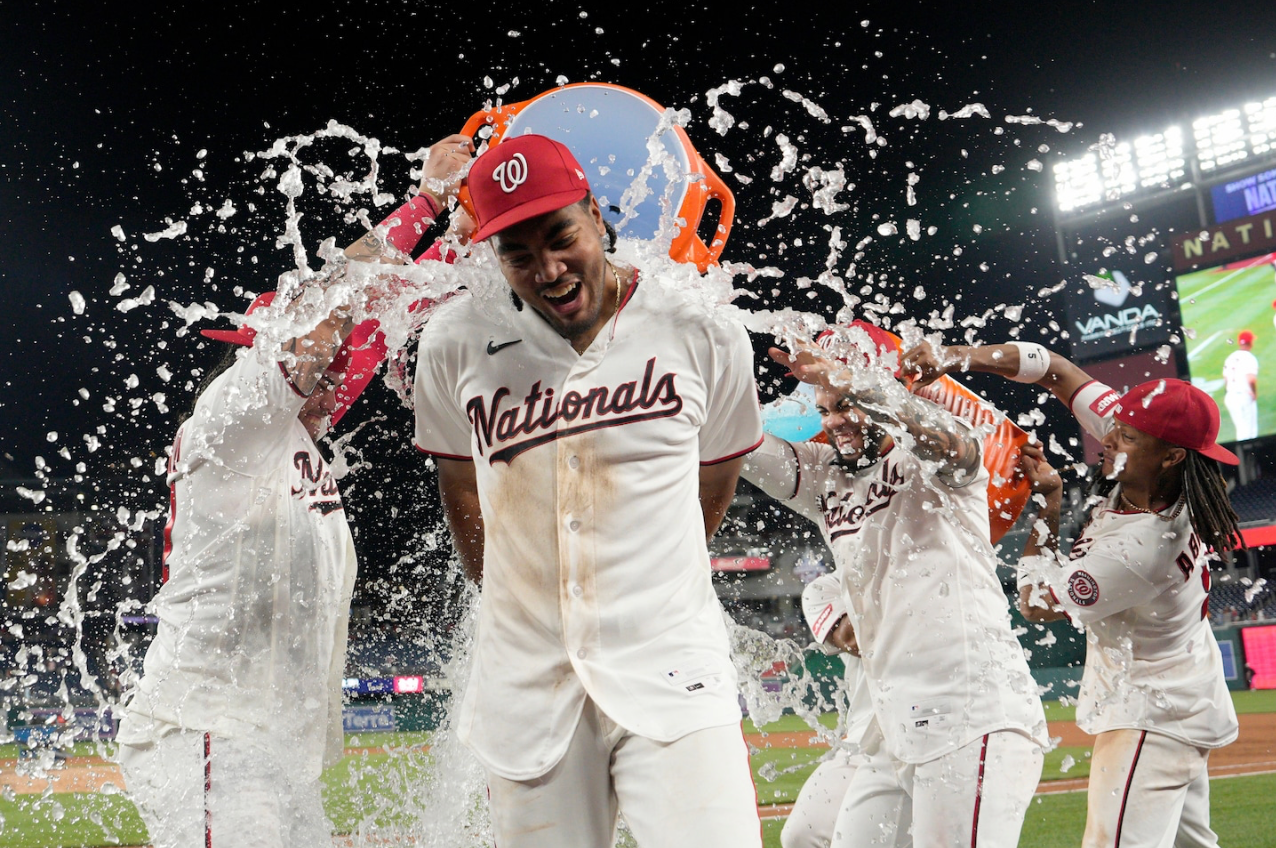
With a depleted core and an untimely oblique injury to James Wood, the end of the fateful 2026 season seemed an awfully long way away. Over the next two months, the Nationals broke up painful losing streaks with occasional bursts of greatness. The bullpen continued to be the squad’s biggest weakness, blowing an MLB-record 42 saves. The Nationals ended their season with two consecutive series victories against the Colorado Rockies and New York Mets, respectively, to bring their final record to 77-85 and earn them a fourth-place finish in the NL East.
Despite second-half struggles, there is hope yet for Georgetown students looking to trade October midterms for October baseball come next fall. This has been the Nationals’ best season record-wise since 2019, marking the first time the team has finished with fewer than 90 losses since its magical World Series run. Washington also won 11 more games than last season after going 66-96 in 2025.
The squad’s second-to-last-place division finish only tells part of the story. The young core, led by Wood and Abrams, continues to establish itself as the foundation for the future. Wood ended the season leading the team in both batting average (.265) and on-base percentage (.388), while Abrams continued to prove his run-generation ability, leading the Nats in home runs (33) and RBIs (106). From the field to the mound, ace Cade Cavalli gives fans another reason to believe, leading the pitching staff in wins (13), strikeouts (200), and ERA (3.02).
The team’s decision to extend Cavalli through 2030 provides the organization with another building block for a successful future of postseason play. Meanwhile, CF Jacob Young continues to make his case as one of the team’s most reliable defensive players with exceptional throwing range and speed. Additionally, lefty prospect Andrew Alvarez has emerged as another young arm who has the potential to secure a spot in the Nationals 2027 starting rotation. Through 25 appearances, Alvarez owned a 3.43 ERA and a WHIP of 1.30 this year.
Together, this core gives the Nationals a solid foundation to build around. Wood put it well when he told Federal Baseball that the team “should be proud of how far [they have] come, but there is still a lot more to improve on.”
Assuming that the 2027 season commences without major lockout disruption, the Nationals have some sizable holes to fill if they are ready to put their money where their mouths are.
Most obviously, the bullpen with its 4.99 ERA (28 in MLB) and -3.3 fWAR (last in MLB) needs to be completely restructured. If every close (and not-so-close) lead continues to result in a blown save, it doesn’t matter how much pop the offense might have. Returners Josiah Gray, Erik Tolman, Orlando Ribalta, Jack Sinclair, Yovanny Cruz, and Will Dion will likely continue to take on the bulk of the work, with a handful of prospects and possible breakthrough players that could fill in some of the gaps. If the front office is bold enough, the addition of free agents David Bednar or Adrián Morejón, or even Raisel Iglesias, Bryan Abreu, or Evan Phillips would add some serious firepower behind the blazing starting rotation. Signing a big closer would help boost the bullpen from the back, and one to two additional strong arms besides internal development would fill the rest of the roster out nicely.
Though Wood, Abrams, Young, Keibert Ruiz, and Daylen Lile each had some of the best seasons of their careers so far, there is no guarantee that this success will be entirely replicated going forward. It therefore is in the Nationals’ best interest to acquire a few solid hitters. Starting with the empty spot at first base is a logical choice. Some of the best offensive free-agent fits for the team might be Ryan Mountcastle (if healthy), Andrew Vaughn, or Paul Goldschmidt. Luis Arraez would also provide elite consistency if the Nationals are willing to be generous in contract negotiations.
The Nationals proved this year that they have the components of a competitive team. It’s now a matter of synchronizing those pieces and supplementing weaknesses in the roster with a few tasteful additions through both free agency and development of prospects this summer to catapult D.C.’s team into the playoff picture.
Georgetown students may be notorious for their addiction to studying and seemingly infinite passion for networking and coffee chats, but it would be all but impossible to ignore America’s pastime in America’s capital if the Nationals can put together the 2027 season they are capable of.