

Every once in a while, some director or writer grabs a classic novel and thinks, “Step aside, Shelley/Orwell/Dickens/[Insert Important Person Here]. I’ve got this.” Sometimes it’s genius. Sometimes it’s hubris. Sometimes… it’s Netflix.
Guillermo del Toro’s Frankenstein is, ostensibly, a film of astonishing craft, a gothic painting swaddled in candlelight and stitched together with pathos. It’s beautiful in the way only del Toro can manage, brimming with texture, haunted eyes, and an affection for monsters that is questionable yet justified by his repeatedly incredible execution.
Yet, as my watch concluded, I couldn’t shake the sense that, for all its elegance, the film falters under the weight of its own sentimentality. For a story born of Mary Shelley’s rage and intellect—a nightmarish probe into what it means to create and destroy—del Toro’s version feels like a gilded echo: visually ravishing but thematically restrained, as if afraid of the very chaos Shelley demanded we face.
The film opens faithfully enough: Victor Frankenstein, played with sharp exhaustion by Oscar Isaac, is a scientist seduced by the promise of transcending death. Del Toro keeps the original literature’s iconic setup with a brilliant young academic, a tangle of grief and ego, and an experiment no one should reasonably attempt. The creature (played by Jacob Elordi, of course) emerges from this alchemy of ambition with the usual stitched skin and startled, searching eyes. But where Shelley’s novel launches immediately into a meditation on unchecked creation and its subsequent moral abyss, del Toro reframes the story around inheritance and familial trauma.
In the film, Victor is no longer simply a man maddened by forbidden knowledge; he’s, above all else, a son buckling under the weight of an abusive father’s legacy. He’s someone who builds life out of a desperate need to repair what was broken in him. The creature is softened in parallel: rather than Shelley’s terrifying mixture of eloquence, rage, longing, and violence, Elordi’s version is innocence misread by a cruel world—less existential threat, more tragic byproduct of generational dysfunction. The result is emotionally cohesive, yes, but it trades Shelley’s philosophical horror for domestic melodrama.
Admittedly, Jacob Elordi’s performance is the film’s saving grace. His wide, pleading eyes anchor the moral center in compassion rather than dread. In Shelley, the creature is both victim and villain. It is capable of tenderness and brutality, persuasion and vengeance, love and catastrophic rage. Unfortunately, the writing’s fixation on freshly minted themes—chiefly Victor’s daddy issues—hems him in; Elordi can only elevate so much when the focus is elsewhere.
It’s a subtler monster, easier to love and harder to fear. And therein lies the problem for me. By sanding down the edges of Shelley’s creation, the film forfeits some of the moral complexity that made the novel revolutionary. Del Toro’s version becomes a mirror of Victor’s trauma rather than an indictment of his hubris: beautiful for sure, but far safer than I think Shelley ever intended.
Isaac’s Victor is excellent, but he encounters a similar struggle against the film’s script. Shelley’s Victor is consumed by ego, unwilling to confront the moral cost of his creation until it is too late. Del Toro’s Victor, however, is self-aware from the start. He knows he is broken, he knows his ambition is dangerous, and yet he persists. The result is less tragedy than therapy session. Isaac delivers each line with deliberate precision, his voice curling around guilt and exhaustion, but the film’s insistence on psychologizing him makes the story feel smaller. The horror of Shelley’s Frankenstein lies in its refusal to let Victor explain himself; del Toro’s version lets him monologue his way toward redemption.
Then there’s Elizabeth… sigh. She was my final straw. In Mary Shelley’s novel, Elizabeth Lavenza (Mia Goth) is murdered by the creature on her wedding night, a devastating act that exposes the full cost of Victor’s choices and forces him to confront the ruin he’s created. Del Toro could have expanded her into a radical moral counterweight; instead, Elizabeth just hovers somewhere between muse and martyr. She is clever, and even a bit daring—she debates Victor’s work, tends to his experiments—but ultimately she exists primarily to suffer beautifully. The film flirts with feminist revisionism but never commits. Other women disappear from del Toro’s Frankenstein (Justine, Safie), which is certainly a choice. Shelley’s Frankenstein had so few women to begin with; to erase the remaining ones and mischaracterize the central one feels less like adaptation and more like carelessness.
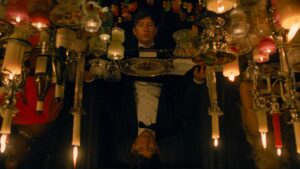
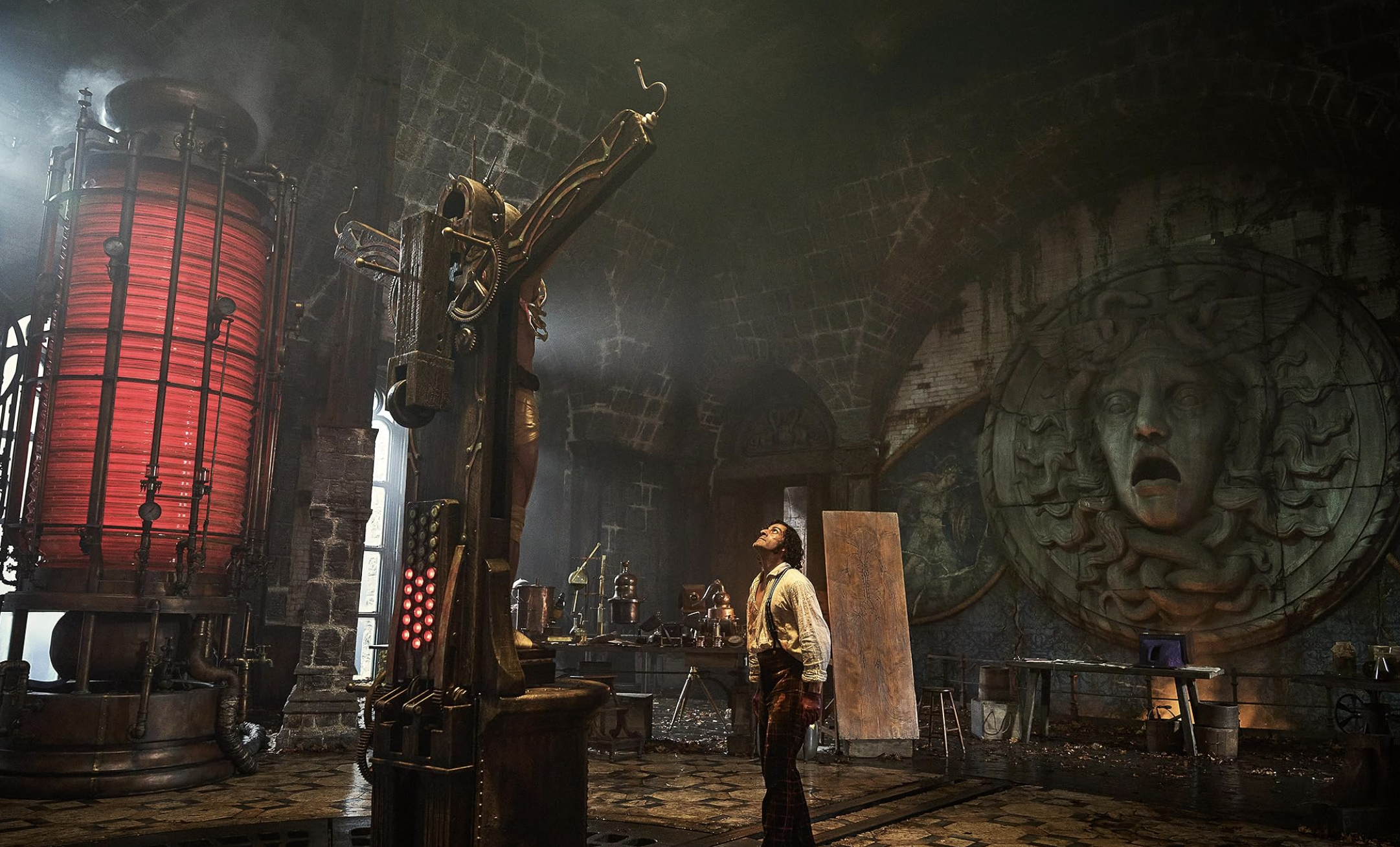
Of course, del Toro preserves his fascination with the grotesque. Dan Laustsen’s cinematography is breathtaking: arctic wastelands rendered in glacial blues, laboratories glowing with infernal reds, faces half-lit like confessions. Every frame feels deliberate, painterly, alive. The creature’s first appearance is both horrifying and oddly sacred. In moments like these, the film achieves what Shelley did on the page. It makes creation feel blasphemous and divine all at once.
But the ending breaks that spell. In Shelley, both creator and creation are doomed: Victor dies consumed by obsession, and the creature vows to destroy himself. Del Toro, however, offers reconciliation. The creature forgives Victor, mourns him, and the film closes not in fire or ice but in muted peace. It is undeniably moving, yet it diverges sharply from the novel’s moral purpose. Shelley wrote Frankenstein as a warning against the arrogance of unchecked ambition; del Toro rewrites it as a fable of understanding.
That kindness is a recurring tendency in del Toro’s work. His monsters are never purely monstrous—they are wounded, misunderstood, beautiful in their own way. Frankenstein fits neatly within that canon, but it also exposes its limits. By turning every act of horror into an opportunity for grace, del Toro risks sentimentalizing what should terrify. In Shelley, the creature’s tragedy is not that he is unloved, but that he cannot fully escape the consequences of his actions. To forgive him, or Victor, is to soften that moral edge.
Ultimately, Frankenstein (2025) is a contradiction, a film that celebrates creation while misunderstanding some of its costs. It is both a love letter to Shelley and an occasionally misguided reinterpretation of her daring. It invites us to feel, but not to confront the existential dread she demanded. Still, it is hard not to be seduced by its beauty, by Elordi’s heartbreak, by the flicker of candlelight on stitched skin. Perhaps del Toro’s true trick is to make us mistake empathy for resolution. Frankenstein is not a failure, but it is not a resurrection either. It’s a lovely corpse: well-dressed, tenderly mourned, but still a little cold to the touch.