


Growing up in D.C., Ronald Moten remembers his mother blasting music in the kitchen throughout the day. These beats were a distinct homegrown blend of funk, hip-hop, jazz, and R&B. It was go-go music, something entirely fresh and exciting for the people of Washington, D.C.
“When I was a child, my mother used to play it all the time. She used to blast it,” Moten said. “Trouble Funk and EU were her two favorite bands at the time.”
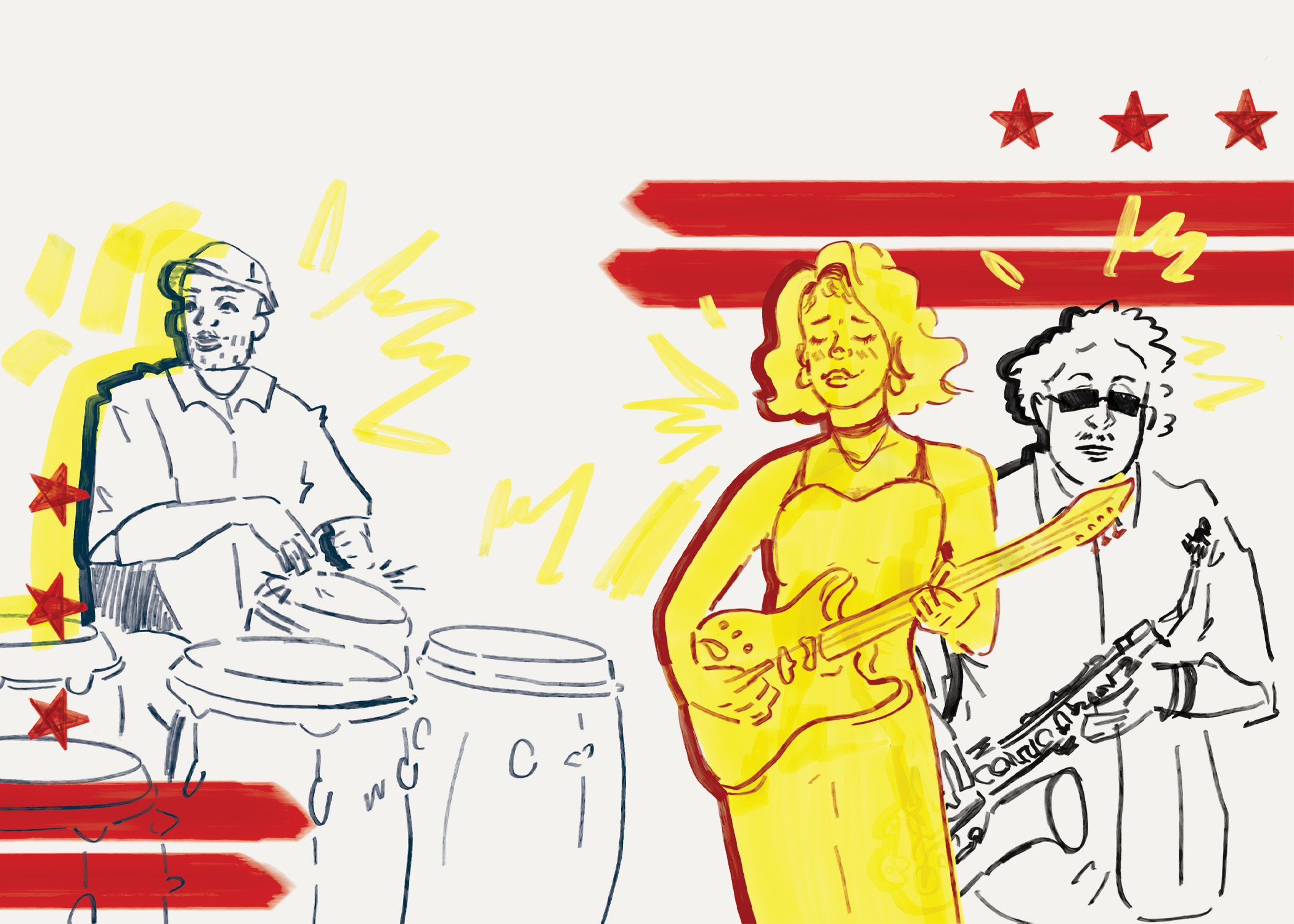
First developed in 1976, go-go grew out of funk but quickly took on a rhythm of its own, known for vivid instrumentation, heavy congas, and a call-and-response between the artists and the audience. Guitarist and singer Chuck Brown shaped the style by combining Latin, R&B, and hip-hop sounds to keep people “going and going” on the dance floor in between songs.
As go-go approaches the 50th anniversary of its creation, artists and activists in the District are reflecting on the importance of go-go to D.C. and the ongoing mission to preserve this music through cultural changes.
For Brown, often referred to as the “Godfather of go-go,” success came fast, with countless songs and albums that embodied a distinct identity for D.C. residents. His most popular single, “Bustin’ Loose,” topped R&B charts and helped establish go-go in the national consciousness.
The genre has adapted alongside the city itself, shifting its sound to blend with other popular music styles of each time period, from hip-hop and gangsta rap in the 90s to a modern “bounce beat,” which brings heavy percussion and high energy with a hip-hop rhythm.
However, go-go has previously been harshly criticized by mainstream media and denied support by D.C. officials. In the 1990s, when D.C. was considered the “murder capital” of the U.S., police and government officials characterized go-go as synonymous with violence. Many go-go clubs were forced to close after being blamed for inciting violence, leaving the remaining parts of the go-go community wary of interacting with the greater D.C. area.
Moten explained that Black music has frequently been influenced by other cultures, taking away some of the authority that Black artists have.
“One of the hardest parts of Black music is not getting colonized,” Moten said.
Moten appreciates that go-go helps give Black residents not only a community and identity through music, but also a means of expression.
“It’s the heartbeat of the city. It connects to our ancestors, and it’s a social movement,” Moten said. “It gives us our secret power to address issues in our community. It gives us the secret power to heal, and therefore to love.”
Though go-go has changed over the years, its core remains constant. Particularly, its emphasis on call and response and audience interaction continues to define go-go as an inclusive, community-based music style.
From go-go to JoGo
Elijah Jamal Balbed recalls driving down Georgia Avenue and hearing cars and buses blasting go-go music. Later, as a jazz musician at Howard University, Balbed got the opportunity to play the saxophone alongside Brown during the final months of his life. The experience solidified Balbed’s interest in the genre and inspired him to begin his own band.
While doing an artist-in-residence program at Strathmore, a music center in North Bethesda, Balbed founded The JoGo Project, a band that blends go-go and jazz music. For Balbed, however, this meshing of styles isn’t particularly unique.
“If you listen to Chuck Brown in particular—especially Chuck—he was a huge jazz head, but even Trouble Funk, Little Benny and the Masters, Rare Essence. A lot of these bands have, if you will, ‘JoGo’ within them already,” Balbed said.
Nevertheless, distinguishing the band and finding a way to create a unique sound were, at times, challenging for the JoGo Project.
“I think in our early days, it was definitely an experiment for one, but we were also trying to find that balance of, are we a jazz group with some go-go elements? Are we a go-go band that has jazz elements within it, or is it 50/50?” Balbed said.
The band performs across the country and, in 2019, won their first Wammie, an award recognizing talent in the Washington Metropolitan area. They won the award for best go-go song for their single, “Dear Draylen,” a tribute to Draylen Mason, a Black student musician who was murdered in a hate crime in 2018.
“When I heard about the story, I was just heartbroken and impacted by it, and that ends up being the inspiration to some of my songs, when I feel very passionate about something that’s happened in the world,” Balbed said.
Beyond this motivation, Balbed also finds inspiration in celebrating the city that popularized go-go. His song “D.C. Has Been Good to Me” highlights the beauty in the District.
“D.C. can be such a transient place, but you find that some people come here with the intention of leaving, but they fall in love with it and stay for years and sometimes decades,” Balbed said.
For Balbed, D.C. and go-go are inextricably linked. The artist said that the style is “a part of the breadth and the fabric of D.C.” However, Balbed noted that go-go has not always been celebrated. He said the impacts of gentrification in D.C. have tried to silence go-go, and that officials and some residents have criminalized the music.
In spring 2019, a Central Communications electronic store in Shaw received noise complaints from residents in a nearby building for playing go-go music. While the city monitored the sound and said noise levels were okay, the resident complained to T-Mobile, the corporation overseeing the store, and T-Mobile agreed to stop the music. This sparked the beginning of the Don’t Mute D.C. movement, led in part by Moten, and an online petition to bring back the music that gained more than 80,000 signatures.
The movement aimed to protect Black artists’ right to free expression in D.C., and helped bring the music back to the store.
“All these folks came together, essentially, and actually, I think, to a lot of people’s surprise, advocated for ourselves as a community. And that was pretty monumental,” Balbed said. “It shows what can be done when we all come together.”
A go-go museum for D.C.
Moten’s concern that go-go was not properly celebrated in D.C led him to bring more attention to the genre at the 2009 Go-Go Awards. In front of 4,000 people, Moten announced a plan to build a museum purely dedicated to go-go.
“It was D.C.’s official music, but not labelled as D.C.’s official music. Our music was not being supported,” Moten said.
For many D.C. residents, especially Black Washingtonians, go-go has become a defining aspect of their community. Moten founded the Go-Go Museum and Cafe in Anacostia to create a space for Black people to have agency over their music and celebrate go-go’s history.
While it took some time to begin work on the project, a virtual museum launched in 2020. In 2019, construction of the Go-Go Museum & Cafe began, and the brick-and-mortar museum launched in 2025.
Nestled in Anacostia, there now lies a quaint building and cafe rich in history. Featuring 60 physical artifacts and 300 digital artifacts, the museum is a celebration of D.C. culture.
For Natalie Hopkinson, helping to found and curate the Go-Go Museum was a continuation of her work to preserve this music. Hopkinson is currently an Associate Professor of Media, Democracy, and Society at American University, as well as the chief curator of the museum. She has done extensive research on go-go as a journalist and for her doctoral thesis.
After being introduced to go-go as an arts and culture reporter at The Washington Post, Hopkinson initially struggled to connect with the community in her attempts to incorporate the style into her work.
“I thought that I would get a lot more eager participation from the go-go community, but they were not interested in talking to me at all, which made me want to do it even more,” Hopkinson said. “But, because of the way that the music had been treated by mainstream media, they just were not interested.”
This was a welcome challenge for Hopkinson, who dedicated time to understanding the world of go-go.
“How I understand go-go is that it’s a Black and Indigenous knowledge system,” Hopkinson said. “Go-go was kind of a cultural information network, kind of a news network, a way of sharing news and building community.”
Hopkinson worked alongside Moten to bring his vision of a museum to life and better understand this community. She felt particularly motivated by the local support she saw for Moten’s ideas.
Initially, the group wasn’t sure if they’d be able to raise money for the museum. They were told by the city that the museum would cost $8 million, but they only had about $3 million to work with. However, seeing the support from the community, particularly during a telethon Moten held for the museum, helped move the process forward.
“I was deeply moved by the reaction to the community, and how people came out, and they gave their money. They pulled over and gave crumpled ones and $5 bills,” Hopkinson said. “And so I said, ‘Okay, well, if they want it, let’s figure out how we can do it.’”
While many physical artifacts came from Moten’s collection, Hopkinson helped to curate materials from the museum and focused on conducting oral interviews.
Hopkinson explained that community partnerships played a big role in making the museum a possibility despite limited resources.
Still, Hopkinson believes that the city should be doing more to recognize go-go’s significance to D.C. history and culture.
“What was really important to me was that this work is not just some symbolic gesture. Like if you name an official bird, for example, you also have to protect it, and make sure that it can thrive,” Hopkinson said. “And so there’s definitely more that could be done.”
Moten said that the money the Go-Go Museum has received from D.C. is “nowhere near what we need to survive.” He said that more attention and resources dedicated to go-go will result in more people joining the go-go scene as patrons or as artists.
Celebrating 50 years
Over the past few years, and for the 50th anniversary of go-go, D.C. officials have been hoping to bring more visibility to the genre. Through the D.C. Public Library, the D.C. Office of Cable Television, Film, Music, and Entertainment (OCTFME) established “Keep the Beat Week” to archive recordings, photographs, flyers, and oral histories so future generations understand the origins and impact of go-go.
“Protecting Go-Go is not just symbolic; it is also about preserving culture, strengthening neighborhoods, and investing in a creative ecosystem that supports artists and small businesses,” OCTFME wrote to the Voice.
OCTFME also mentioned a variety of concerts, community events, and citywide programming for the anniversary. In January, there were the Go-Go Awards, where important artists within the genre were recognized for their contributions to D.C. music.
For many, go-go continues to be a way to come together, celebrate a shared identity, and advocate for a greater change in society.
“It’s time for us to start telling our story so that when people come to the city, they know the impact that go-go music has had on D.C. and its people,” Moten said.