

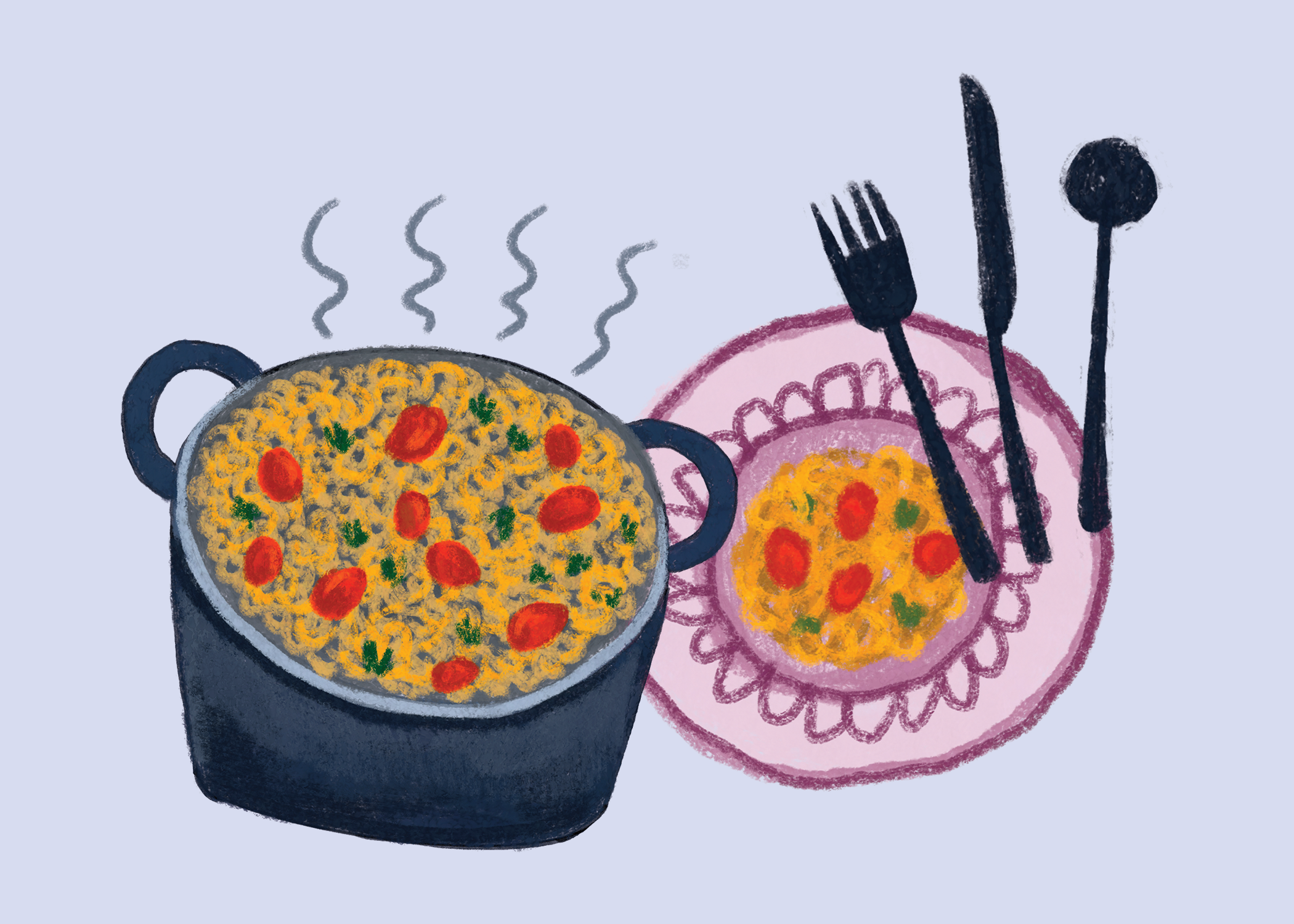
The kitchen breathes in small movements: the subdued sweetness of onions melting in olive oil, the whistle of a kettle brewing tea, and cutlery clinking underneath the sink’s running water. On the counter, a bowl of water-soaked rice and potatoes sits beside tomatoes and pots overflowing with herbs. It is a lived-in warmth, the kind of kitchen that feels like home, even though it isn’t the home B.H. had no choice but to leave behind.
At the stove, B.H. (MAAS ’26)—a Georgetown master’s student who spoke to me on the condition that she be identified by her initials due to safety concerns—slips between the stove flame and counter with a quiet certainty. She stirs the broth, then waves away a bloom of steam that envelops her face. Tonight, she is making maqluba, meaning “upside-down” in Arabic.
B.H. begins to layer the dish as she has done many times before: thin slices of fried eggplant, each one delicately placed across the bottom. Crisped potatoes fill the spaces in between.
“The way I’m putting all the ingredients together, this is my mother’s way,” B.H. says, gesturing toward the jar of ground black pepper beside her.
“Use your sense,” she says when I pause, unsure how much of the spice to add. “Don’t worry.”
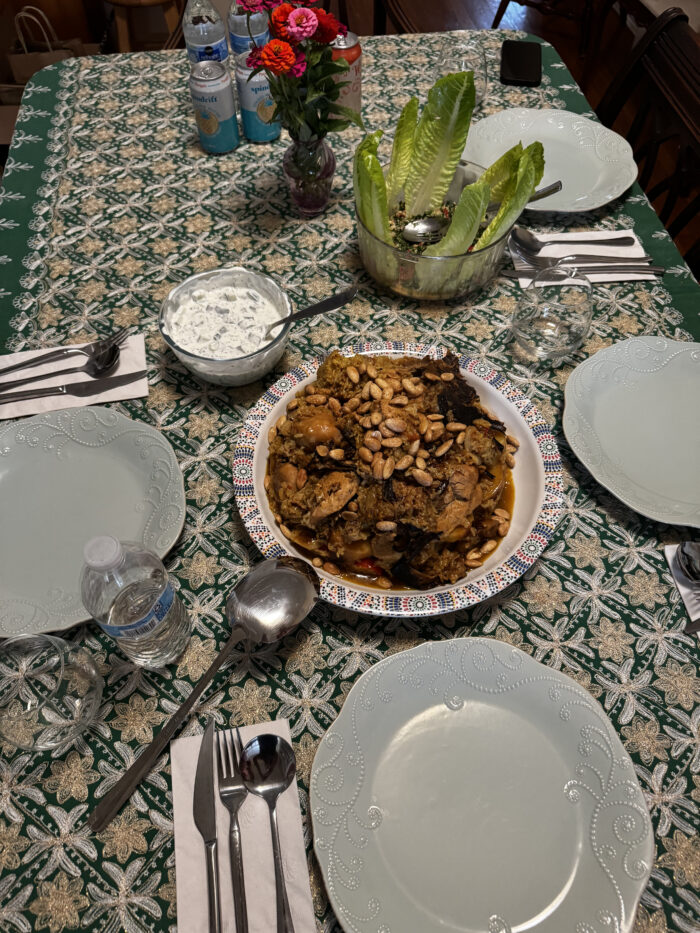
Before Israel’s genocide in Palestine, B.H. was an English teacher in Gaza, just like her mother. In Gaza, her mother cooked for everyone. B.H. has lived in Washington, D.C. for a year and a half since leaving her family in Palestine. Here, B.H. has taken on the same role: cooking for neighbors, cousins, friends, or anyone passing through. Cooking is how she loves, how she finds continuity.
“Every time I cooked any of my mother’s recipe,” B.H. tells me, “I felt like I’m recalling her again. I felt like her spirit with me in the kitchen.”
As the pot of layered vegetables, chicken, and spiced rice is left to simmer, she pours fresh strawberry-banana-apple juice into glasses—the “winter juice” her mother would make for her as a child. The kitchen smells like memory: the scent of fruit, oil, and cardamom suspended in the air.
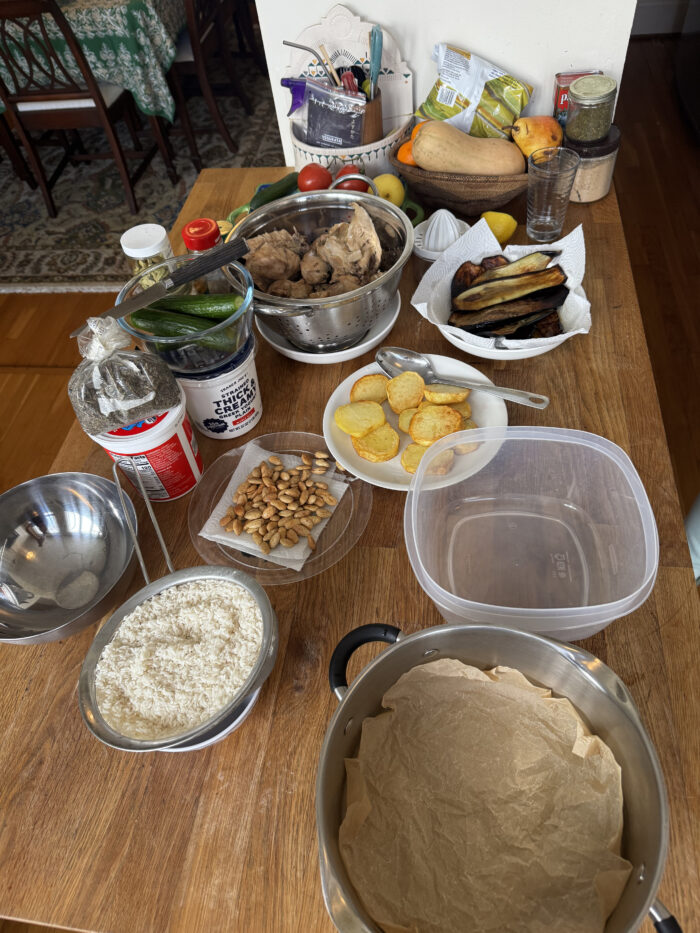
Photo by Selma Zuaiter/The Georgetown Voice Maqlouba ingredientsPhoto by Selma Zuaiter/The Georgetown Voice
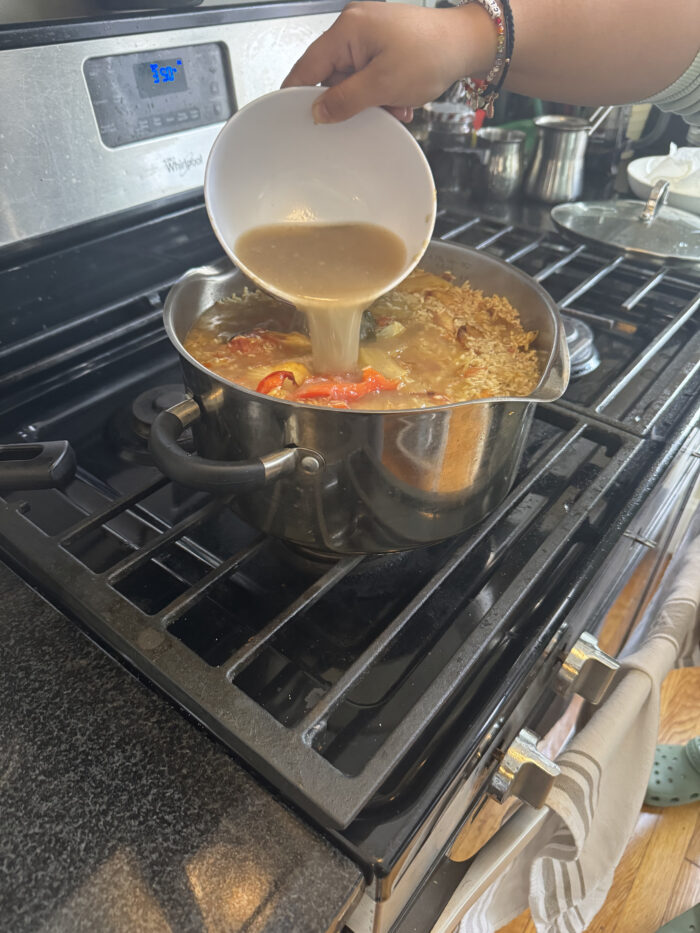
Photo by Selma Zuaiter/The Georgetown Voice Maqlouba cookingPhoto by Selma Zuaiter/The Georgetown Voice
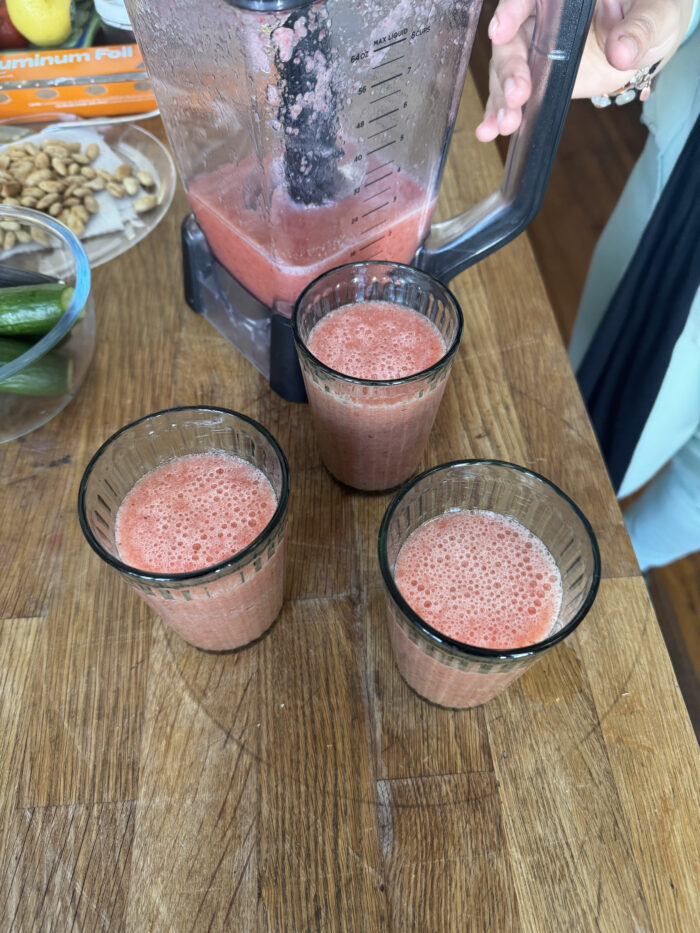
Photo Selma Zuaiter/The Georgetown Voice B.H.’s “winter juice”Photo Selma Zuaiter/The Georgetown Voice
B.H.’s D.C. kitchen is bountiful, but her kitchen in Gaza is debris buried under settled dust. Since October 2023, Israel’s bombardment of Gaza has destroyed more than half of its buildings, decimating approximately 360,000 homes, including B.H.’s. According to the United Nations, as of October 2025, approximately 81% of all structures had been damaged.
The United Nations Office for the Coordination of Humanitarian Affairs found that nine in 10 Palestinians—Gaza’s population is 2.2 million—have been displaced and forced to cook in tents, shelters, and the exposed frames of houses that lay open to the sky. Even before October 2023, decades of Israel’s blockade of the city propelled families into chronic starvation: food insecurity and poverty rates in Gaza had risen to 65% in July 2022.
Now in 2026, almost every Gazan, including 100% of people in the cities of Deir al Balah and Khan Yunis, is experiencing acute levels of hunger. It is from this reality, one built upon decades of loss, displacement, and ethnic cleansing, that four Palestinians—three in the diaspora and one still living in Gaza—cook to preserve memory and, in turn, their existence.
Cooking in absence
While B.H.’s kitchen holds the memory of what she lost, Hamada Shaqoura’s kitchen bears what that loss looks like up close. Shaqoura, a chef in Gaza, labors every day to cook something out of almost nothing.
Shaqoura’s kitchen in Khan Yunis is not a room, but a remnant: a rented house stripped to its bones. And yet, in this place that no longer resembles home, he cooks.
Shaqoura works as a content creator in Gaza, promoting recipes and local restaurants on his Instagram page. He witnessed the emergence of a culinary microcosm, even under blockade, where chefs were expanding what was possible in the strip.
“When the genocide began I became known as an internet chef, showing what it means to cook under siege,” Shaqoura wrote to me. “I usually introduce myself through food, because for me cooking is the clearest way to connect with people, to show resilience, and to keep our story alive.”
After one of the first ceasefires, some ingredients returned, but even before the genocide, it had never been enough, according to Shaqoura. In his Instagram videos, Shaqoura is often pictured cooking for children running around with empty pots the size of their bodies, sometimes with enough lentils or rice to feed just themselves. Shaqoura craves small blinks of home: the fresh parsley, mint, and dill that once threaded their brightness through every meal.
“Without them, the food feels dead, as if it lost its soul,” Shaqoura wrote.

Image courtesy of Business Insider Hamada ShoImage courtesy of Business Insider
Olive oil, the pith of Palestinian cooking, was a loss that hollowed Shaqoura. Pressed from the indigenous olive trees that grow in silver-green rows, the olive oil comes from groves that, time and time again, are bulldozed. Yet every season, the trees still grow, as if the land refuses to let them die.
“We use it in almost every recipe, and when it is missing, the food does not feel like food to me,” Shaqoura wrote.
Since the genocide started, Shaqoura has learned to improvise his meals, once using dulled vegetables, milk, and rice to recreate a comfort meal of chicken and cream from his old life.
“It actually tasted really good,” Shaqoura wrote, “I am not sure if it was because it truly did, or because I was imagining eating the real thing the whole time.”
What inspires Shaqoura’s resilience isn’t the memory of food, but the children he feeds. Shaqoura’s nickname among children has become Zaki, delicious in Arabic. He remembers the children who call him Zaki when cooking feels like an impossible feat.
“People outside may think cooking is still about recipes or choices. Here it is about survival,” Shaqoura wrote. “Every meal I prepare says we are still alive, we are still here, we will not disappear.”
In his Instagram cooking videos, Shaqoura looks into the camera without speaking, his face set in a silent, solemn stillness. Shaqoura never utters a word, yet says so much.
“I am staring at every free soul in the world, challenging them to speak up,” Shaqoura said.
The smell of bread browning in an oven, or the bustle of children waiting for food keeps Shaqoura going, where even the faintest sounds and smells become joys that stay alive.
Inventing survival
For Shaqoura, surviving means coaxing meals with a makeshift creativity. Similarly true for A. (MSFS ’26) and N., Gaza is “the city of the mother of invention,” where kitchens became places of engineering more than just cooking. A. and N., a Georgetown master’s student and his wife, spoke to me on the condition that they be identified by their first initials due to safety concerns.
Before arriving in the U.S. in 2024 with their two children, A. and N. had been forced to cook using mud ovens, scavenging for fish along Gaza’s coastline.
They were first displaced to Khan Yunis on Oct. 13, 2023, the day before A.’s birthday.
They settled in an apartment stripped down to its concrete skeleton, arriving with nothing. Soon, A. began doing what was necessary to survive.
“You literally have to go hunting in order to secure some portions of food,” A. said.
When flour disappeared entirely, panic consumed them. Bread, the anchor of a Palestinian table, became impossible to find.
Without nearby bakeries or gas, A. and N. bought the mud oven. A.’s sister, the only person who knew how to use it, baked for 10 people: kneading dough by hand, feeding the fire, then pulling hot rounds of bread from the clay.
“It’s very difficult,” N. said. But bread meant fullness and, thus, a day survived.
When N. decided to learn, it took her a week or so of practice to master the touch, timing, and gut feeling that is required for a perfect piece of bread.
“All of my family and A. were very happy. Like, ‘Wow! I did it!’” she said proudly. In a place consumed with loss, baking a single round of bread felt like proof that something could still make A. and N. smile.

Photo courtesy of N. N.’s baked bread from her mud oven (behind) in GazaPhoto courtesy of N.
What the body carries
B.H. moved to the District in the fall of 2024 and soon after stopped eating chicken or fish when her mother could not find any back home.
“I cooked the same thing that they cook in Gaza,” B.H. says. “If it is pasta without chicken, so it is just pasta here. I have this feeling that it’s like I cannot enjoy the food that they don’t have.”
When she admitted to doing this, her mother laughed.
“No, ya’ma, you have to enjoy food,” B.H says her mother told her, using the Arabic word for my darling. “Allah gives you this.”
The warmth that soothes her in the kitchen fails to do so outside of it. Her curiosity carried her to the U.S., but now it coexists with fear.
For B.H., the fear has become physical. She began wearing a sweatshirt hood pulled over her hijab and stopped walking in her neighborhood, even to buy groceries.
“I’m worried about myself. But I’m more worried about my family’s feeling, my mom and my dad’s feelings,” B.H. tells me. “They are really comfortable that I’m safe [here] and I’m doing my research. And I don’t want to put them under another pressure [than] on what’s happening in Gaza.”
On Nov. 4, 2024, B.H. was at an event with Francesca Albanese, the U.N. Special Rapporteur for Palestine. Her phone lit up with messages.
“My neighbor, she sent me some photos and the news that they destroyed [my] house. They burned it,” B.H. says.
At first, B.H. wasn’t sure. But then she saw a TikTok video, filmed by Israeli soldiers, with footage of her neighborhood, Al-Nuseirat, reduced to rubble.
“They were talking in the video of proudly destroying the whole area,” B.H. says.
At first, she didn’t know that this was her home until she noticed the faded off-white walls and a brick-red stripe that surrounded what remained of the structure.
She left the lecture hall mid-speech.
“I lost the house, I lost the house,” she recalls crying to her friends. Her parents had spent thirty years working for that home—her father in healthcare, her mother in education.
“My mom, she always called it beit al-amour, the dream house,” B.H. says. “Losing the house was the biggest thing. But sometimes I stop caring about the house. Because when you lose people, you felt like, no, it’s not the house. It’s people.”
Last July, three families—30 of B.H.’s neighbors—were killed in the middle of the night after returning home to put up their tents after a ceasefire, B.H. said. Among them were her childhood friends, neighbors, and neighborhood ammos—the “uncles” she called family growing up.
B.H. describes her attempts to cope with the killings through cooking as a kind of internal switch, a defense mechanism, a means to endure.
“I have here a whole life,” B.H. tells me. “I have to be strong because I want to support my family. I don’t have time or this privilege to collapse. I’m not ready to collapse now.”
B.H. checks her watch; she gets up to unwrap the foil from the pot of maqluba, and turns off the gas.
“Ready?” she asks, gripping the pot handles.
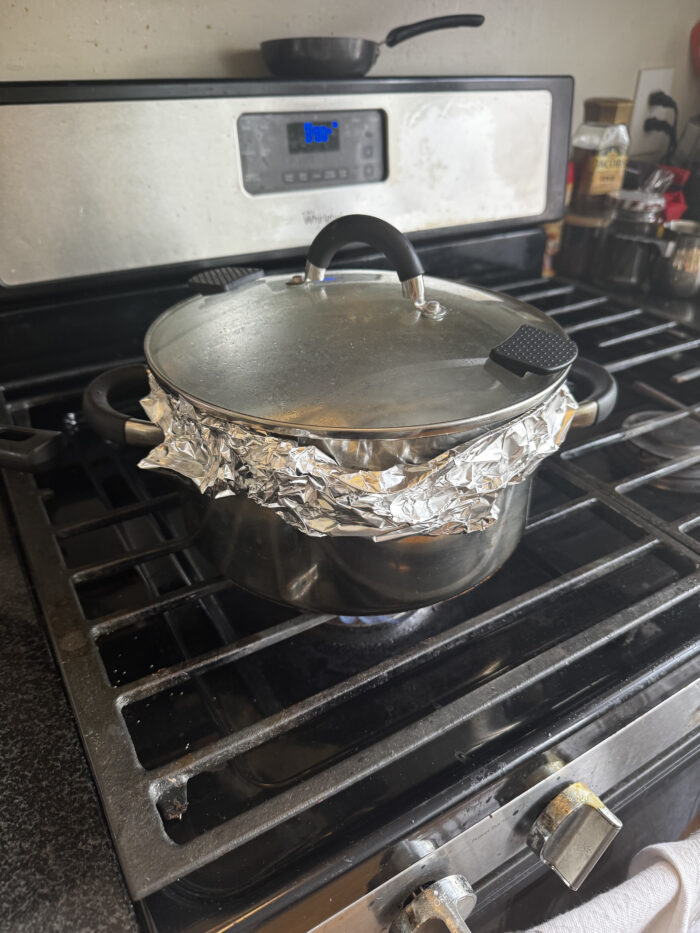
Photo by Selma Zuiater/The Georgetown Voice Maqlouba cookingPhoto by Selma Zuiater/The Georgetown Voice
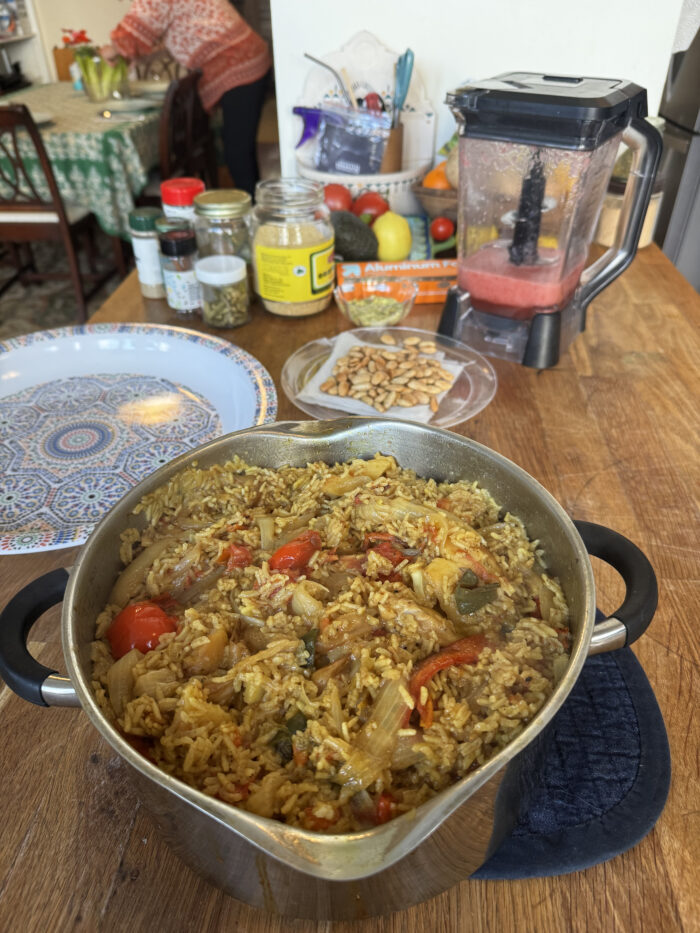
Photo by Selma Zuiater/The Georgtown Voice Finished maqlouba mealPhoto by Selma Zuiater/The Georgtown Voice