

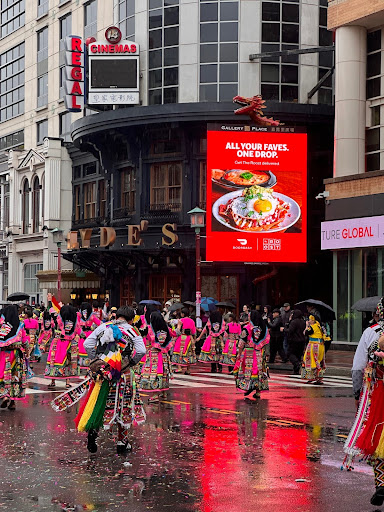

Cold rain fell over D.C.’s Chinatown on Sunday afternoon, doing little to thin the crowd. By 2 p.m., an estimated 500 spectators with rain jackets and umbrellas packed the sidewalks, braving the weather for over two hours to celebrate the Lunar New Year, which began on Feb. 17.
The annual D.C. Chinese Lunar New Year Parade, hosted by the Chinese Consolidated Benevolent Association of Washington, D.C. (CCBA), stretched across several blocks of Chinatown, drawing performers, community organizations, and city leaders into the heart of the District’s downtown. Commemorated across the world, the holiday centers on renewal, family, and the welcoming of good fortune in the year ahead.
Performers moved through the streets, and traditional dragon dancers guided their prop dragon through puddles and around spectators. Originally a ritual to pray for rain and honor ancestors, dragon dancing has evolved into a Lunar New Year tradition symbolizing power, wisdom, and good fortune.
“It’s very good that they can pull it off during this bad weather,” Cheng Xiao, a 34-year-old attendee from China who moved to D.C. two months ago, said.
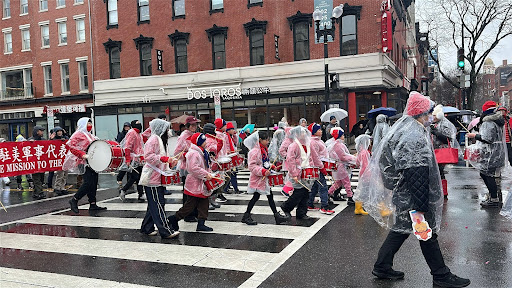 Photo by Upasya Swarna
The celebration ushered in the Year of the Fire Horse, a Chinese zodiac sign traditionally associated with energy, resilience, and bold spirit. In a city navigating political uncertainty, the parade provided a public display of community and cultural preservation. The fire horse, it seemed, was not put out by the rain.
Stefanie Diaz, 31, attended the parade with her daughter, making it Diaz’s first since her own childhood. For the Chinese-American Washingtonian, the parade brings mixed emotions.
“Growing up, it was always hard being Chinese because of all the bullying,” Diaz said.
She isn’t alone. In a recent survey, 56.9% of Asian students reported experiences of race-centered bullying, a number higher than any other ethnic group.
At the same time, Diaz noted that with more Asian trends like Korean skincare and Taiwanese bubble tea becoming mainstream, she feels like she can better engage with her Chinese identity, even wearing a red qipao — a traditional one-piece Chinese dress — under her puffer.
“It’s been more like a connection culture because now I feel like I can finally connect with the Chinese identity part,” Diaz said. “Right now, it’s a mix between actually going back to culture, coming over here, and introducing my daughter to the Chinese side of things.”
The parade featured Chinese, Taiwanese, and even Bolivian cultural community organizations. Alongside these groups, the celebrations included local institutions such as the Smithsonian, D.C. Police, the U.S. Naval Sea Cadets, and the Girl Scout Council of the Nation’s Capital.
Among the performers was 32-year-old lion dancer Angelica Chang, a kung fu student under Shifu Chua at Chua Martial Arts and regular performer at cultural events across the DMV.
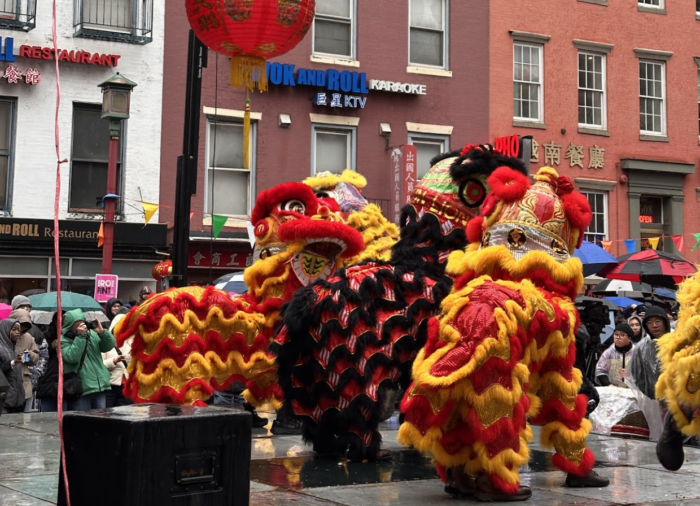 Photo by Upasya Swarna
“We come out to community events like this just to support the community and showcase the cultural arts that we have to offer,” Chang said.
Although she has participated in the parade for several years, Chang said the turnout was extra special this time, given the weather.
“It’s always fun to get out and see all the rest of the troops, see the rest of the community coming out, especially in this weather today. Everybody still showed up and showed out with a lot of pride,” Chang said.
A Penn State University study showed that D.C. is one of the most diverse regions in the nation. Yet, this diversity has not shielded Chinatown from dramatic change. In recent years, the gentrification of Chinatown has spiked the cost of living there, decreasing its population from a high of 3,000 residents to around just 300.
“Chinatown is changing. D.C. is changing,” Chang noted. “But that’s just how times go.”
Even so, she emphasized that the community remains strong despite the challenges they face.
“We’re all banding together and making sure that the arts and the culture stay alive,” Chang said. “The sense of community is what this event is all about.”
Several city leaders also headed the parade procession, including D.C. Mayor Muriel Bowser, Interim Police Chief of Metropolitan P.D. Jeffery Carroll, officials from D.C.’s CCBA, and D.C. Shadow Representative Oye Owolewa.
The procession ended at a platform where some of these leaders addressed the crowd, including Rep. Owolewa.
Owolewa’s speech emphasized the diversity of the nation’s capital and encouraged immigrant solidarity. Acknowledging the fear and anxiety that increased Immigration and Customs Enforcement has caused immigrant communities in recent times, Owolewa called D.C.’s residents’ commitment to diversity, equity, and inclusion a “noble goal.”
“Today, we are here, and we know that the rain will not stop us. The snow will not stop us. ICE will not stop us,” Owolewa said, as the crowd roared in approval.
Commending the community’s resilience and activism in recent years, he called on the crowd to continue to fight for a D.C. that belongs to everybody.
“Immigrants make our community stronger and keep D.C. the way it is: the greatest capital on Earth,” Owolewa said.
27-year-old spectator and newer D.C. resident Dawson Petersen agreed with Owolewa’s speech, emphasizing the importance of the District’s diversity.
“The call to community totally makes sense, community’s really important. This is a really great city,” Petersen said. “There’s so many different kinds of people here, and it’s important to try to connect them.”
Across the city, similar celebrations unfolded.
On campus, Georgetown’s Chinese Student Association (CSA) held its own Lunar New Year celebration. Hosted in the Healy Family Student Center on Feb. 22nd, the event drew more than 80 students to share food, watch student performances, and simply enjoy each other’s company.
Co-President Maggie Liu (CAS ’27) emphasised the importance of bringing Chinese culture to campus for those who celebrate.
“CSA is really about community and trying to create and bring a sense of what feels familiar and comfortable and homey to us at Georgetown,” Liu said.
For Alice Ma (MSB ’26), CSA’s other co-president, the event reinforced the sense of togetherness Hoyas gain from the communities they choose to be a part of on campus.
“I think there’s something extra special about being on campus because the campus and the people that you’re surrounded by becomes your home and becomes your family,” Ma said.
Even as D.C.’s Chinese population continues to shrink, the community endures, in the city and on campus alike.
“We’re small and mighty,” Ma said. “And there’s people who will always continue to put events together like this to bring people together.”