


After debuting her Nickelodeon breakaway with a witty yet harrowing memoir, I’m Glad My Mom Died, Jennette McCurdy returns with her first novel—and another pithy title that speaks for itself—Half His Age.
The novel follows Waldo, a socially isolated teenager living in Alaska who becomes increasingly entangled in a relationship with her creative writing teacher, Mr. Korgy. Though Half His Age is fiction and I’m Glad My Mom Died is a memoir, their emotional DNA is unmistakable; both explore female rage and fractured authority. The key difference lies in perspective. Where the memoir offers retrospective clarity, the novel withholds it.
From a technical perspective, McCurdy’s structural choices are among the novel’s most compelling features. In its 288 pages, Half His Age contains more than 50 chapters, creating a tense, fragmented reading experience that suits its provocative and ethically fraught subject matter. Scenes arrive and vanish quickly, mirroring Waldo’s impulsive, restless psychology. Yet that same velocity comes at a cost: while the novel attempts to engage with sex, class, loneliness, power, internet culture, and digital-age validation, its short chapters often leave those themes underdeveloped.
Still, the form is largely effective. McCurdy said in an interview with Interview Magazine that Half His Age is “not at all focused on the taboo itself,” but rather on the experience as a whole, and the structure reinforces that aim. Rather than building toward a clear moral thesis, the book accumulates fragments of shame, thrill, self-justification, and humiliation. The reader experiences the relationship as Waldo does: piecemeal, confusing, and contradictory.
Although the novel does not hinge on shock value alone, the glaring taboo of the student-teacher, age-gap relationship provides an avenue to grapple with Waldo’s relationship with sex. In the task of “courting” Mr. Korgy, Waldo experiments with just how much she can push the boundaries of her sexual prowess, gaining a newfound sense of her sexuality through power-play. She bends Korgy against his family, his profession, his morals, just for the chance to sleep with her.
McCurdy hardly advocates for such a relationship, though, and she certainly doesn’t romanticize it. If anything, Waldo’s sexuality is clawing, carnal, and absurd. Often, age-gap romances set the younger woman up to be “taught” by her older partner, a naiveté which is fetishized and blatantly exploited. But Waldo never feels like Mr. Korgy’s sexual pupil or plaything. She appears “in control,” completely intent on using her sex to claim an indulgent, forbidden fantasy. Of course, Waldo is still a victim, and Mr. Korgy is at fault. But if we accept that base moral wrong, McCurdy presents us with a more interesting look into the internal power struggle of female sexuality.
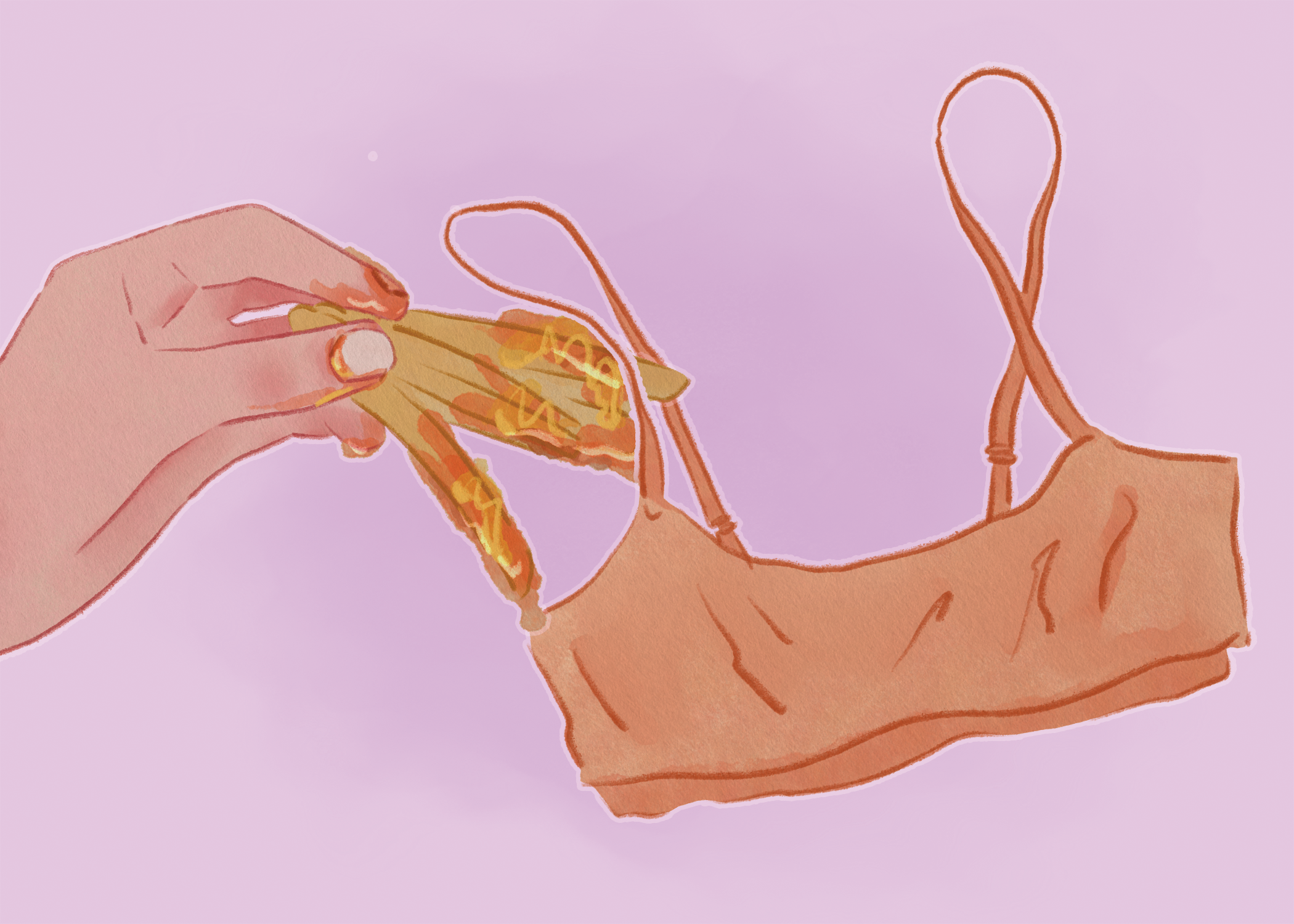
Intertwined with this exploration of sexuality is a concern with consumerism and the marketing of personal fulfillment. Waldo’s sex is in many ways a frantic chase for fulfillment that is inextricable from the capitalist culture that feeds off of it. Waldo frequently masturbates to tacky, ad-plastered products you could buy at a CVS or a Chili’s. She grinds on a bottle of TUMS, gets off to designer cologne, and in one of the novel’s more visceral moments, sticks her “chili-cheese-stained” fingers inside herself. All of these experiences elicit a stinging discomfort, a mismatch of what many would consider to be self-pleasure. Waldo acts as a masochist, shoving out-of-place objects inside her body to try to make herself whole.
The way Waldo shops also mirrors this desire. While getting ready for a date with Mr. Korgy, Waldo tears through her closet “like a madwoman,” searching for what she calls “different identities,” each with the promise to fill the void of what she cannot be or have. The scene evokes Cassie’s ever-relatable Euphoria (2019–present) morning routine, or more recently, The Substance (2024), where beauty devolves into violent self-sabotage.
Ultimately, Waldo admits that her desperation is perhaps her object of pleasure. She confesses that sex is the only context in which she can “want” without the limits of societal judgement or her credit card: “The one place where my needs aren’t too big and all my yearning is acceptable. The one place where I can show how deep the well is within me. The void. The one place where I can beg and whine and scream to have it be filled.”
Here, McCurdy captures perhaps one of the most honest, unmitigated accounts of sex in recent years. Despite Waldo’s frequent frustration with and disgust of her mother’s self-proclaimed addiction to men who can’t seem to love her back, as the novel progresses, Waldo becomes more willing to admit to that same destructive need. In naming that void so plainly, McCurdy renders sex as an excavation, an attempt to reach the bottom of a need Waldo slowly realizes she has inherited from her mother.
It is this same unflinching attention to desire and self-perception that allows Half His Age to function almost as a bildungsroman, or coming-of-age novel. Waldo’s coming-of-age unfolds not simply through romance or rebellion but through consumption, surveillance, and the performativity of modern life. Waldo believes she is exceptional, mature, and capable of handling an adult relationship, when in fact that belief reveals her vulnerability.
In this sense, Waldo’s growth comes not through triumph but disillusionment. What first feels like agency gradually reveals itself to be desperation; the novel’s arc follows her recognition that the power she’d imagined she had was never really hers.
Evidently, Half His Age does not clarify so much as it accumulates. In doing so, it captures something rare: the uneasy realization that what once felt like control was never control at all.