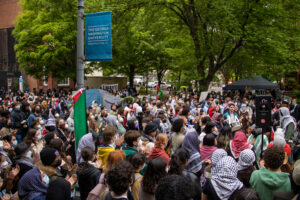


Thousands gathered from the Memorial Bridge to the Washington Monument for “March to DC,” one of six events hosted throughout the Washington, D.C. area for the third national “No Kings” rally in protest of the Trump administration.
Over 3,200 events were planned across all 50 states and a number of cities outside the U.S. Similar to the first two rallies in June and October 2025, organizers strove to make history, hoping the March 28 installment would be the largest single-day protest in U.S. history.
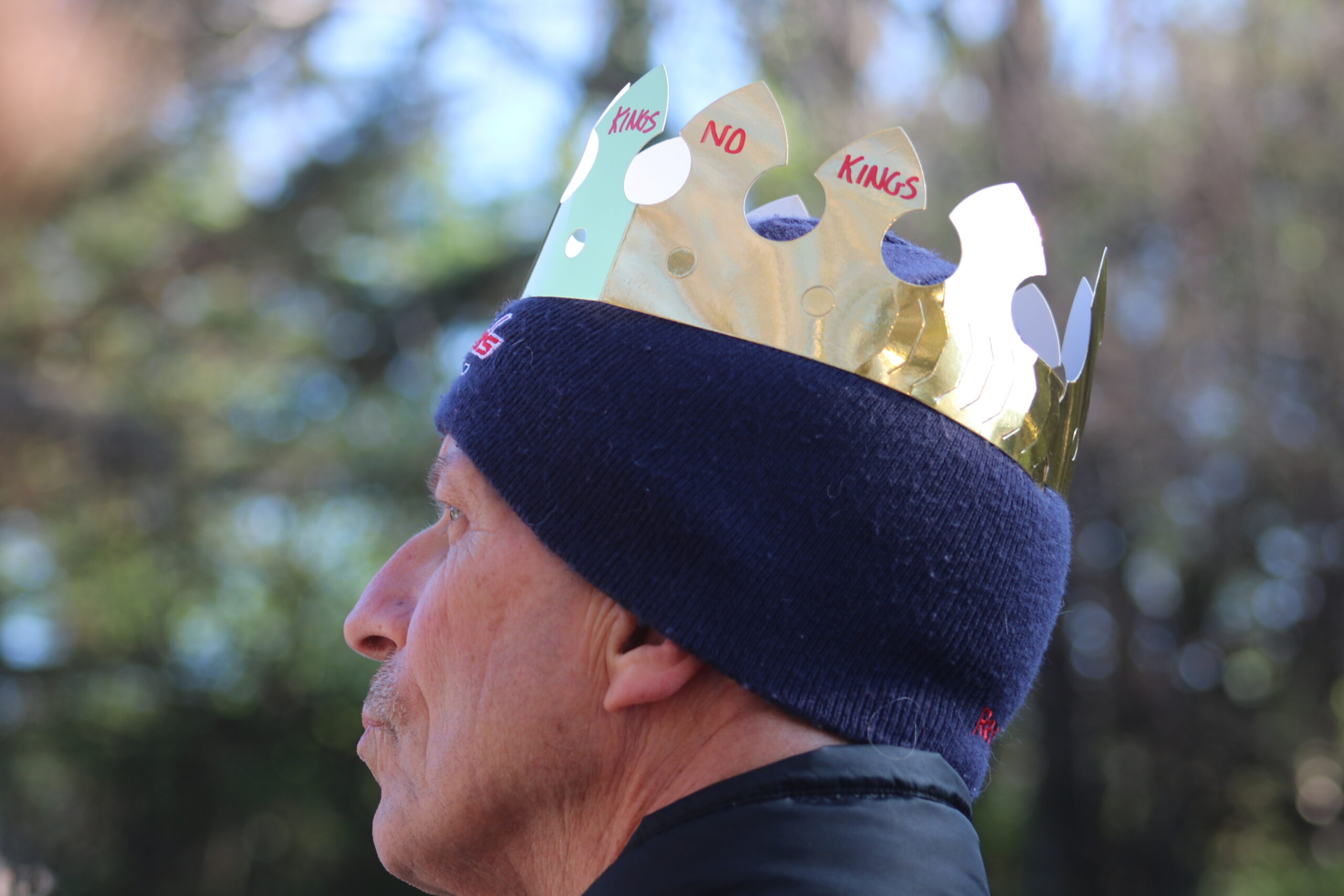
The D.C. rally began at Arlington National Cemetery, with crowds lining the metro platform holding signs, blow-up figures of President Trump, and crowns reading, “No Kings.”
The rally attracted students from multiple organizations at Georgetown University, residents from D.C., Maryland, and Virginia, and people traveling from out-of-state for the weekend. Protesters spoke to the Voice about the Trump administration’s attacks on immigrants, the Iran War, and the importance of civic engagement, especially among young people.
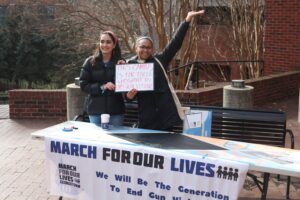
For Georgetown’s progressive organizations, such as Georgetown University ACLU, H*yas for Choice, Georgetown University Students Demand Action, Georgetown University Pride, and Georgetown University College Democrats (GUCD), this most recent “No Kings” protest provided students with an opportunity to build community.
“We really wanted to promote inter-club solidarity,” Reid Shepard (SFS ’29), the director of education at Georgetown University ACLU, said. “Just making sure that we advance progressive solidarity on campus has been important.”
Hannah Gilheany (CAS ’28), GUCD advocacy director, further emphasized the potential for cross-club collaborations to advance organizations’ goals and support students in a disheartening political climate.
“Coming together and working with one another can really help us be more effective in making real change,” she said. “Just seeing how many other groups and how many other people care is pretty uplifting.”
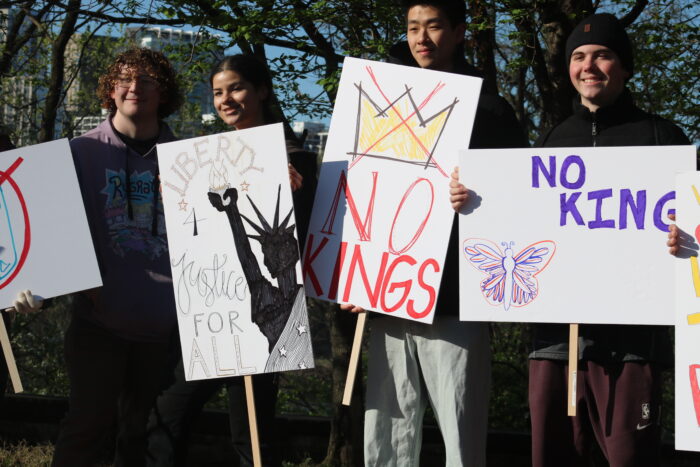 Photo by Chih-Rong Kuo
Despite the record turnout, attendees say that more political engagement from all groups of people is needed. While student groups collaborated to bring more Georgetown students to the demonstration, there was a noticeable lack of young people in attendance at the rally, according to Gilheany.
“I wish there were more young people coming out,” she said. “It feels like the crowd is older. It’s great to see those people standing up, but I wish our generation was showing up a little bit more, because I think there’s still a lot of hope to be had.”
The protest drew in a record-breaking number of protesters advocating for overarching concerns with the Trump administration, with many concerned about the Trump administration’s recent actions in the Middle East. Trump authorized an American-Israeli military bombardment of Iran on Feb. 28, however, these strikes were launched without congressional approval, despite Congress being granted the sole authority to declare war by the Constitution. The war that has developed since has resulted in nearly 1,500 Iranian civilian fatalities as of Mar. 27.
Edward Cleary, a Manassas, VA resident, regularly protests in the DMV area. While his motivations for attending the rally remained consistent with past demonstrations, he noted that the Iran war was a central concern.
“The war against Iran, is a clearly senseless war that’s having horrible repercussions for not only our country but the whole world,” Clearly said. “It just gives a lot more urgency that this is so destructive.”
However, Cleary was also optimistic about political shifts on the horizon, stating that he hoped the results of the 2026 general midterm elections would swing in favor of the Democratic Party.
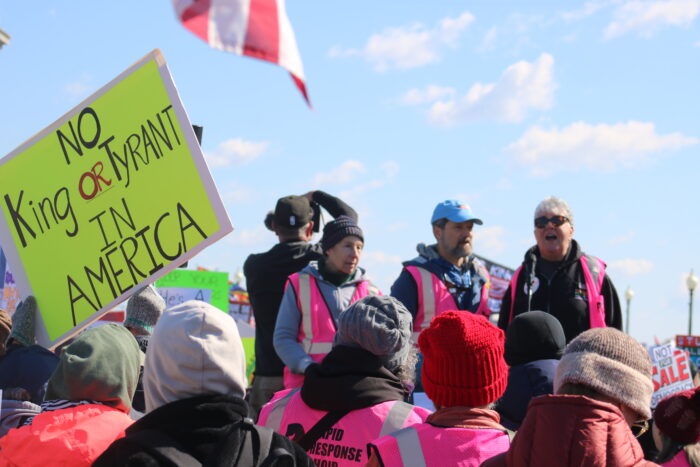 Photo by Chih-Rong Kuo
Other protestors came with more specific causes in mind. Sarah Wholey attended as a protester for Moms Demand Action, a grassroots organization advocating for public safety measures to prevent gun violence. She hopes her advocacy work can increase common-sense gun laws and prevent gun violence. Gun violence, including school shootings, continues to be a major issue in the U.S., with D.C. having the highest rate of shootings relative to its population.
“I have a niece who’s three years old, and I don’t want her to be doing shooter drills when she gets to school, but unfortunately, that’s the reality today,” Wholey said.
Wholey noted the increased gun violence in the U.S. under the Trump administration, particularly by federal agents. Earlier this year, demonstrators across the country protested against U.S. Immigration and Customs Enforcement (ICE) after the fatal shootings of Alex Pretti and Renee Good by federal agents.
“It’s now the government that’s coming after the people and shooting people, and it’s not right,” Wholey said. “Too many innocent people have been killed by ICE agents.”
Over the last year the number of people held in ICE detention centers increased by 75%, now totaling a record-breaking 73,000 people as of January. This includes a 2,450% increase in the number of people with no criminal record being held in an ICE detention center on any given day. As of October 2025, at least 20 people had died in ICE custody, making it the deadliest year since the early 2000s. Conditions inside detention facilities have reportedly worsened and rapid expansion has made the detainee locator system unreliable, resulting in “disappearances.”
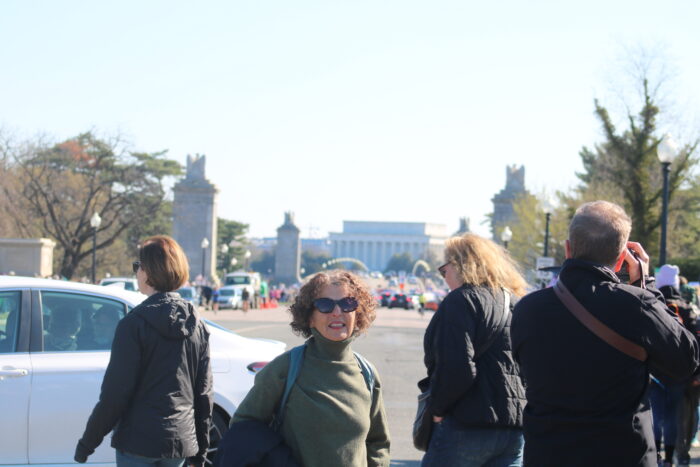 Photo by Chih-Rong Kuo
Like Wholey and Cleary, Joanna Snyder has attended many protests in downtown D.C. This time, she brought her two daughters to the rally, who donned Pride flags and held handmade signs. Snyder recalls attending the first Women’s March in 2016 while pregnant with one of her daughters.
“It’s really important for them to see that other people feel the same way and to be part of a movement to try to bring back some kindness and compassion to how we govern,” Snyder said.
Similarly, Nancy Feldman, a D.C. resident, lives near the White House and attends protests whenever she can. She emphasized the need for young people to become more politically engaged by attending protests and critically thinking about current events.
“Young people need to really know their history,” Feldman said. “World War Two, when the Nazis killed Jews, gay people, and Roma, and we said, we will never let it happen again. And here it is happening again.”
At the same time, Feldman acknowledged that not everyone can attend protests freely. In particular, noncitizens may face additional political repercussions for participating in protests, and are encouraged to speak to immigration attorneys, whenever possible, before participating, according to the Immigrant Legal Resource Center. Trump’s second administration, in particular, has targeted both people who have violated immigration law and legal immigrants, putting many at risk of deportation.
“We’re here for the immigrants, for everybody who can’t be here,” Feldman said. “We are here for them. And it’s important to show that we care about our country.”
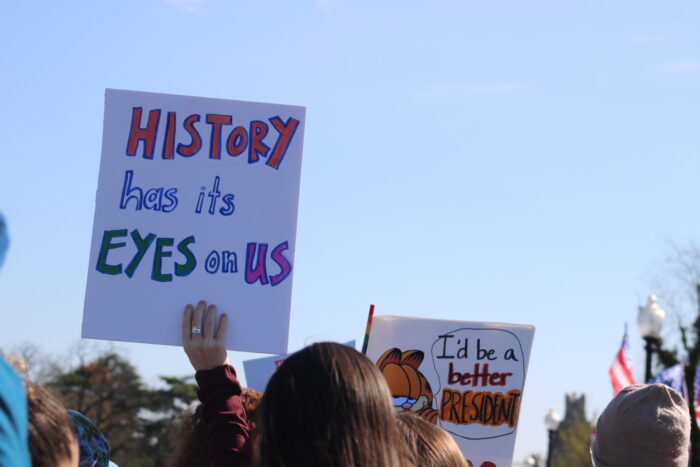 Photo by Chih-Rong Kuo
Yet, not every attendee was marching. Maryland resident Cathy White, for example, has attended 15 protests just since last summer, passing out free snacks and water to attendees. She and her family set up a station near Arlington Cemetery for participants to fuel up before continuing their march to the National Mall. Following this ‘No Kings’ demonstration, White estimated that she will have passed out close to 2,000 water bottles.
White shared that she tends to feel helpless while watching the news. Contributing to political demonstrations has served as a way for her to combat these feelings, describing it as “the antidote to despair.”
“I’ve always been anxious at protests because I don’t quite know what to do with myself,” she said. “If I bring snacks to give out, then I have something to do.”
For White, providing Oreos and plastic water bottles was not just about finding a place in demonstrations, but about supporting her community and making protests accessible.
“I want to be able to make people’s day better. I want it to be fun for people to come out to a protest,” White said. “You can come to these, and there will be people to help you if you don’t have what you need.”
For students who are passionate but may be hesitant about attending a political demonstration, Gilheany argued that the most intimidating part is waking up early.
“[Protesting] is not a hard thing to do,” Gilheany said. “It takes an hour or two out of your day, and it’s a really important way to show that you care.”