


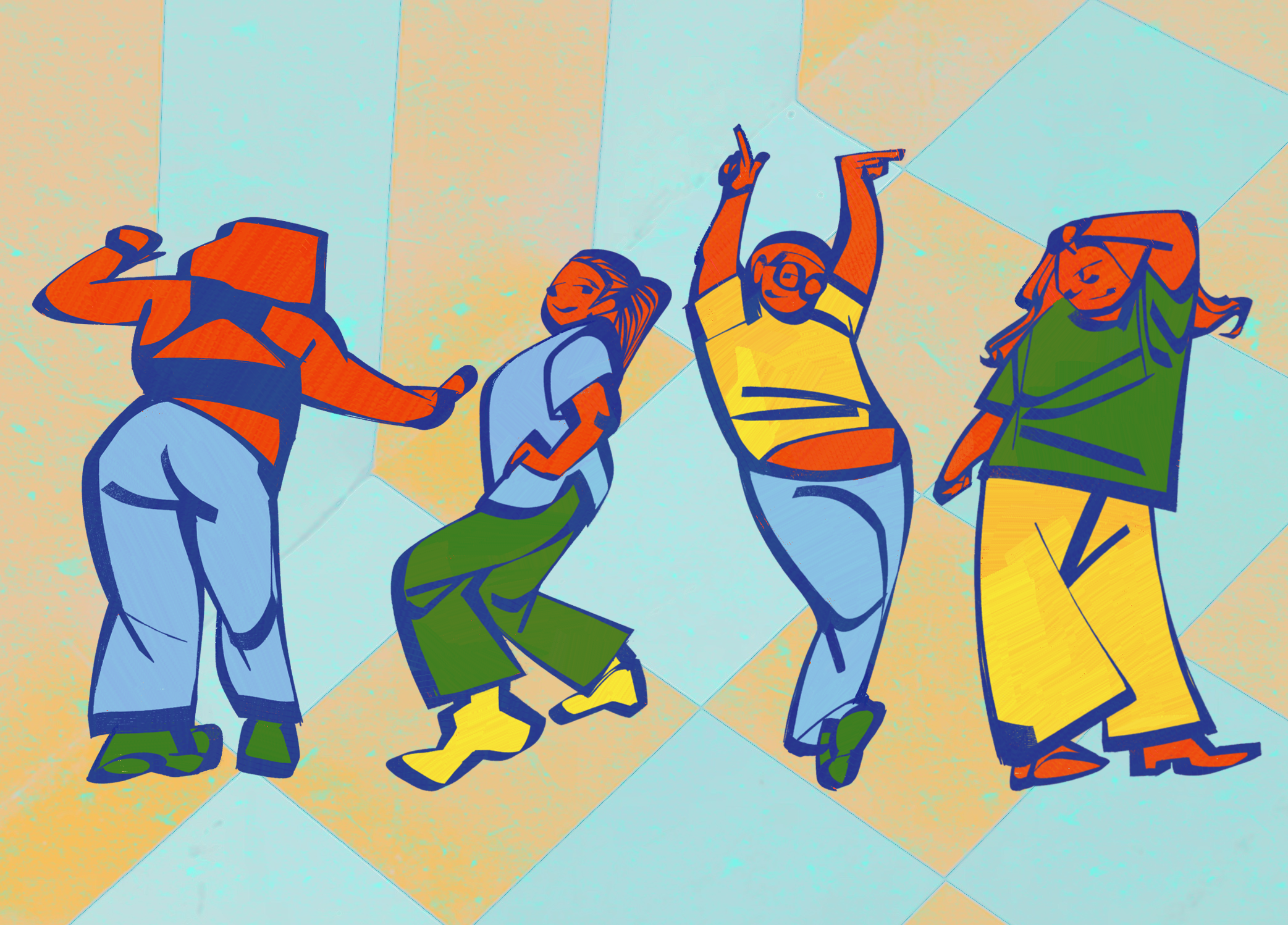
The evening of March 20, students poured into Gaston Hall to see “One Move, One Groove,” a dance showcase hosted by Groove Theory, Georgetown’s hip-hop dance team. By the end of the night, they got a glimpse into the diversity of the Georgetown dance scene and the community that many dancers, amateur and experienced alike, find on the Hilltop.
This year marks the 16th annual performance of “One Move, One Groove.” Featuring guest performances from campus groups GU Jawani, Ritmo y Sabor, Hoya Break Squad, and GU VIBE, the show was an opportunity for Georgetown’s dance community to come together, share their styles, and spotlight the art of dance.
The showcase’s program was organized around three mixes, or dance numbers to mashups, featuring all Groove Theory members. One mix, “The Groove Prix,” had a car theme, featuring a mashup of songs about driving (such as Rihanna’s “Shut Up And Drive” and Tate McRae’s “Sports Car”) and dancers sporting race-car-inspired looks. In between mixes were smaller vignettes, ranging in style and genre, demonstrating the true breadth of ability within the dance group.
Groove Theory began working on their pieces at the start of the semester, according to Groove Theory Community Captain Mia Tyler Rich (SFS ’28). Alongside their new dances, Groove Theory performs a few older numbers typically seen at their basketball game performances.
Rich fondly recalled the process of creating “The Groove Prix,” which started with the idea of choreographing to the song “Tokyo Drift” by Teriyaki Boyz. The group was initially unsure how to pull the concept off, but Rich was ready to try anything to make it happen.
“That process is so fun, talking through that, because we get to come up with really outlandish ideas,” she said.
Early in the semester, Groove Theory members had the opportunity to teach a dance class in the style of their choosing as a bonding activity. In addition to encouraging members to come up with innovative choreography and experiment with new types of dance (bringing about the genius of a brat (2024) tap number), the exercise gave Rich and the ensemble a vast repertoire of numbers to develop into performances for the ensemble.
“[The showcase] kind of formalizes it in a way, [so] you can see your choreo on the stage, and that’s just really, really cool,” Rich said.
Each year, Groove Theory looks for ways for new talent to take the lead in performances and choreography.
“A lot of times our mixes will be choreographed by new members,” Rachel Miyamoto (CAS ’26), a junior captain for Groove Theory, said. “It’s a really cool chance to be able to see such a wide variety of experiences [being] expressed by all of our different dancers.”
There often isn’t a unified thread tying the different dances within the showcase together, and that’s intentional.
“It really shows the diversity of dances,” Veronica Arty (CAS ’27), another junior captain for Groove Theory, said. “Even within our mixes, each dance and each mix is very different, and you can see the type of choreographer, their perception of what the dance should look like.”
Scattered throughout the showcase were performances from guest groups.
Ritmo y Sabor, Georgetown’s Latin dance group, performed three numbers taken from their own annual showcase, Tras Los Años (“through the ages”), which occurred the following day. Alejandra Cova (SOH ’26), one of Ritmo’s Co-Directors, said that the showcase celebrated the group’s 20-year anniversary, looking at how Latin dance has changed since the group’s founding.
For Groove Theory, Ritmo picked their most modern and energetic numbers to perform. Their set included a merengue to Karol G’s “Si Antes Te Hubiera Conocido,” a reggaeton to “X’clusivo” by Gonzy and Saiko, a bachata to “En Privado” by Xavi and Manuel Turizo, and a merengue to Bad Bunny’s “Despuès de la Playa.”
For Cova, Ritmo has become a place where she can celebrate her culture and meet a diverse array of people from all around campus.
“We have people on the team who are from Hispanic backgrounds and are Latino or Latinx, and we have people who are first generation as well, and then people who have no tie to Latin culture, and they still come every single day with such enthusiasm and such love for our culture,” Cova said.
Similarly, for Vrinda Jhingan (SFS ’28), vice captain of Jawani, Georgetown’s bhangra dance group, the community is the heart of the group, and a lot of time is dedicated to building strong bonds between teammates.
“Obviously, we all love to dance, that’s a big part of why we’re in Jawani, but it’s also become a space to make friends and hang out,” Jhingan said.
Cova sees Ritmo as both an opportunity to perform and to connect with others.
“I really love how Ritmo has brought people together from different parts of Georgetown, all with the sheer desire to dance, to move your hips and enjoy good music,” Cova said.
With an incredible diversity of styles, Groove Theory’s “One Move, One Groove” showcased the variety of talent in the greater Hoya dance community. Rich encouraged those outside of dance—regardless of skill level—to consider getting involved in dance ensembles on campus.
“Let your preconceptions go. We’re all here to have fun,” Rich said. “I promise you’ll walk out laughing, maybe with a couple new skills.”