

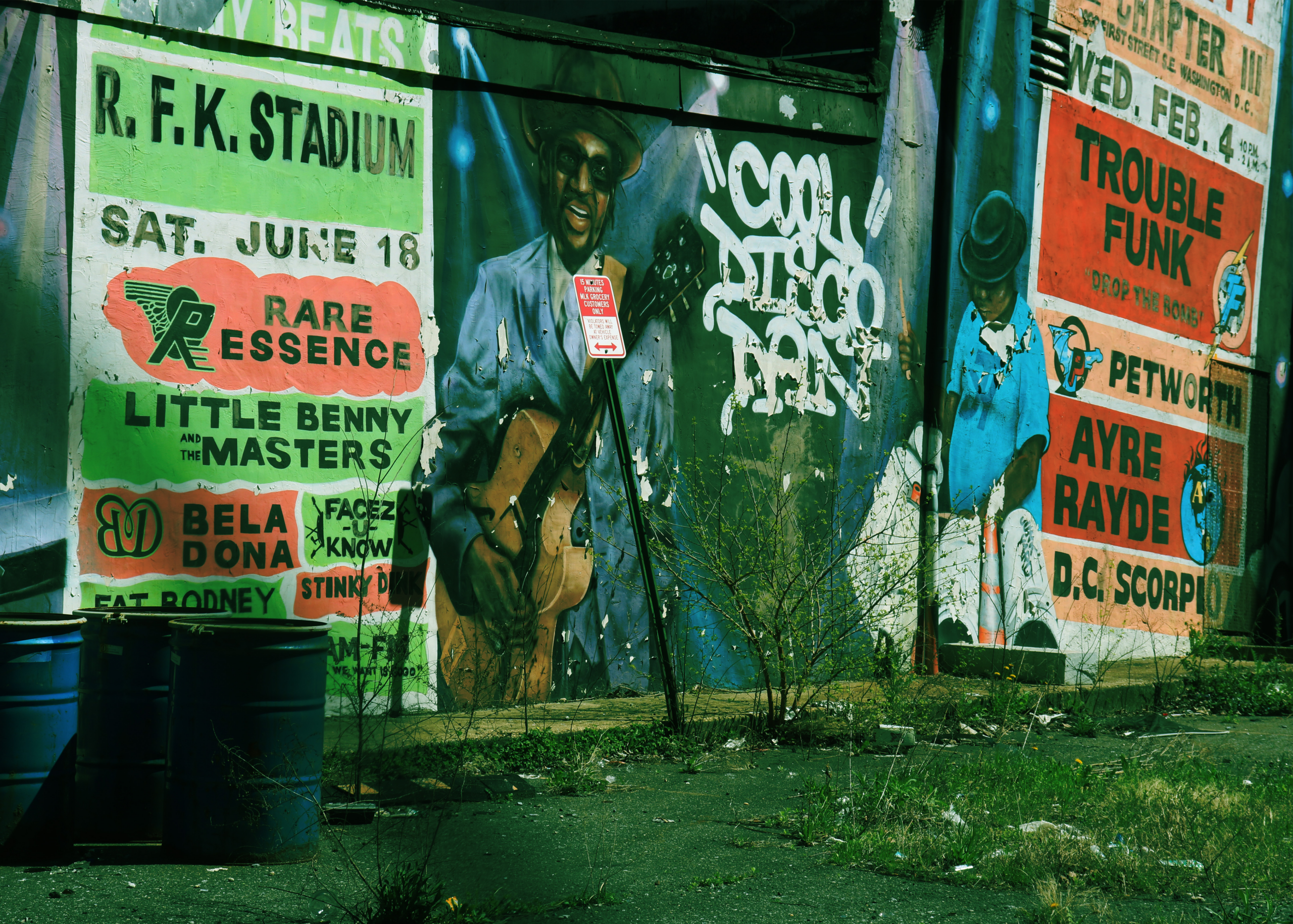
As far as Jason Anderson, a multidisciplinary artist from Anacostia who goes by the artist name Jay Sun, can remember, there has always been construction in Washington, D.C. While much of this gentrification has historically plagued downtown and Northwest Washington, Anderson said that Anacostia, a neighborhood in Southeast D.C., is becoming increasingly unrecognizable. New development is threatening to erase the spread of multicolored murals in every alley, local poetry collectives, art exhibitions, museums, and the boom of go-go music as one struts down Martin Luther King Jr. Avenue SE.
Anacostia’s history runs deep. Before D.C.’s inception, it began as a thriving community and trading center in the larger village of Nacotchtank, where Algonquian Indigenous people of the Northeastern Woodlands lived. Following European colonization and the formation of the District, the community evolved into Uniontown, a suburb for the large Navy Yard workforce. It was in Anacostia that Frederick Douglass, the father of the abolition movement, spent the last quarter-century of his life, and where he served as a thespian in a community theater company.
Today, Anacostia’s artistic roots live on. The neighborhood is rife with community artists preserving its historical roots and propelling the next generation of local artists, even as widespread gentrification threatens the community that has long called it home. In Anacostia, art is not just a passion: it’s a vehicle through which residents maintain the area’s roots.
Anacostia is more than 90% Black, but Lamont Mitchell, the chairman and chief operating officer of the Anacostia Coordinating Council, which focuses on community organizing to revitalize the neighborhood, pointed out that newcomers to the area are predominantly non-Black. Housing prices in D.C. have increased exponentially in the last decade, and Mitchell anticipates further price hikes in Anacostia with the advent of new buildings and the Department of Health moving to the area.
“There’s a lot of pressure on the real estate market in historic Anacostia, and [prices] are moving upward, but east of the [Anacostia] river is where the last only affordable housing will be found in D.C.,” Mitchell said.
While inflationary pressures often price out locals, certain inclusionary zoning policies now require new units to have a percentage of residents with a targeted income, which allows residents to reap the benefits of investment, according to Mitchell. However, even with comparatively affordable housing, housing costs in Anacostia continue to rise, pushing out residents.
Anderson recalled the most recognizable gentrification of Anacostia in the 2000s, when residents began leaving D.C. and selling family homes that had been passed down for generations.
“The community changes—there aren’t as many block parties, there aren’t as many festivals and go-go bands playing randomly, cookouts,” Anderson said. “People like to speak negatively about gentrification, and rightfully so, because of the loss of ownership. But when you remove the indigenous people from the communities, there goes the culture also.”
Similarly, Dwayne Lawson-Brown, or Crochet Kingpin, a crochet artist, playwright, and poet, said that D.C. today feels like a different world from the D.C. they grew up in due to rapid gentrification.
“The hospital I was born in, Columbia Hospital for Women, is now a Trader Joe’s and condos. The middle school where I started writing and sharing my poetry out loud is now a Trader Joe’s and condos,” Lawson-Brown said. “There’s this common thread of D.C. natives—and particularly Black D.C. natives—[feeling] that our past can be bought.”
Lawson-Brown grew up in a neighborhood between Anacostia and Congress Heights called Douglass, and has returned to live just down the street from their childhood home. They contribute regularly to art shows and exhibitions in the D.C. area. Lawson-Brown also created D.C.’s longest-running open mic “Spit Dat,” has featured as an artist in the Art-to-Go-Go Anacostia Cultural District, and hosted a wearable art exhibit at the Smithsonian’s Anacostia Community Museum.
“I wanted to move back into my neighborhood and buy in my neighborhood so that I could be a good neighbor,” Lawson-Brown said. “While our society has the most access to the power to connect and the most access to information, I sometimes feel that we’re also the least communal that we’ve ever been.”
In resistance to these challenges, local artists have sought to bring community through education and entertainment.
Community and solidarity through art
Ahmad Woodard, who goes by the stage name Ama’d, is an MC, lyricist, and actor who grew up in Anacostia. He was a self-described “program hopper,” attending various non-profit initiatives catered towards music and music development as a child. One of the most influential programs for him was Project Create, a community-based nonprofit providing accessible multidisciplinary education to young people. Today, he is an artist-in-residence at Project Create.
“Project Create, and a lot of other programs that I’ve been a part of in the past as an artist, those will be my lifelines to the city,” Ama’d said. “I do plan on leaving, but I will always come back, and those will be the resources that I can come back to.”
Ama’d is involved in many other artistic projects in the city that allow him to speak out about the issues he cares about. Most recently, he collaborated with the Freedom Futures Collective to create the FREE DC Mixtape (2026), using art to discuss political topics like the National Guard’s deployment in D.C. and government repression. Ama’d co-wrote the lead single, “Free DC,” which he performed at the No Kings Protest in late March.
“Southeast is in my blood. D.C. is in my blood, so everything comes from here,” Ama’d said. “I always write from the perspective of my community and my city, but I also create from a worldly perspective.”
Ama’d’s art centers around what he calls “duality perspectives,” emphasizing being in tune with his community and bringing inspiration and optimism. In particular, he speaks about issues that disproportionately affect Black people across the U.S.
Ama’d centers on the trauma of gun violence, which killed many of his friends. Gun violence disproportionately impacts Ward 8, of which Anacostia is a part, with the ward experiencing 50 fatal shootings and 154 gun-related injuries compared to one fatal shooting and two gun-related injuries in D.C.’s wealthiest ward, Ward 3, in 2024.
Telling Anacostia’s story
While development of the arts in Anacostia has always been oriented toward the local community, it has also found success beyond the neighborhood. Kymone Freeman is a playwright, activist, and the co-founder of We Act Radio, an independent media organization in Anacostia that amplifies the voices of underrepresented people and elevates conversations about local and national protest efforts.
Freeman uses interdisciplinary art forms to change dominant narratives about the neighborhood, including a PBS documentary short “Fresh Prince of Anacostia” and a storytelling public media exhibition “Anacostia Unmapped.”
While he has found success with national media outlets, Freeman emphasized that the success of his radio show stemmed from the relationships he built with local artists who shared his same passions.
“Had I not done something with my artsy friends, creating a festival, I wouldn’t have met my future business partner,” Freeman said. “I wouldn’t have gotten the radio project on my lap, and it wouldn’t have got funding.”
Efforts by Ama’d, Lawson-Brown, Freeman, and Anderson demonstrate the importance of art in community building and resistance in Anacostia. While Anderson did not definitively plan to remain in D.C. for his artistic career, he found success with local film, television, and theater opportunities in the area.
Giving back to the community
However, staying specifically in the neighborhood where he grew up has helped Anderson reach and inspire young people.
“Examples are crucial. It’s good to see people of your community in positions like doctors, lawyers, architects, designers, artists,” Anderson said. “That has been a key element to the disconnect with the youth in these communities and success. You need examples to see, to give you some type of motivation.”
Part of the reason Anderson returned to serve his community was to repay the favor of mentors and opportunities from his own youth. At the same time, he returned to instill an alternative perspective in the youth of Anacostia in the face of growing gentrification and displacement.
“I’m also a student of war. If one entity gets the upper hand, they can kind of dictate how it goes, unless the opposing entity says something, or does something, or doesn’t accept those terms,” Anderson said. “If we can conquer your land, we’re going to do that until we can’t. So at some point there has to be a deterrent for institutions, or developers, or corporations, like, ‘This may be problematic if we try to displace these people.’”
While he calls himself “retired from art,” Anderson still gives back to his community as the dean at a local high school and a youth basketball and football coach.
“The most important role in my activism, or artist activism, is my ability to connect with youth,” Anderson said. “Building those relationships with the young people and just trying to instill things about their history, their heritage, the politics surrounding their conditions.”
Maintaining Chocolate City
While gentrification most noticeably and disproportionately affects Black residents, ultimately, it impacts all residents who hope to preserve culture and remain in the city, Lawson-Brown said. For example, the number of Chinese residents in D.C.’s Chinatown decreased by more than 90% from 2010 to 2020, and the recognizable signs remaining are corporate insignia with Chinese lettering.
“It is an issue that is bigger than Black folk, though it may appear to only affect Black folk,” Lawson-Brown said.
Lawson-Brown noted that the displacement of Black folks from Ward 8 and the increase in non-Black residents moving in isn’t merely an individual or racial problem, but reflects larger systems of oppression.
“The reality is, we can’t afford to live downtown, white folk can’t afford to live downtown, only the richest of rich can afford to live there,” Lawson-Brown said. “While I am upset about people getting forced out of their homes and being priced out of their homes, but I don’t fault individuals that are like, ‘I’m just looking for a place to live, and the only thing that I can afford is this, like a two-bedroom east of the river.’”
D.C.’s moniker “Chocolate City” originated as a reference to its status as the first majority Black city in the 1950s. However, between 1970 and 2015, the percentage of Black residents fell from 71.1% to 48%. Wards 7 and 8, D.C.’s wards east of the Anacostia River, have remained majority Black, with an estimated 92% of Anacostia residents being Black. In contrast, as of 2025, D.C.’s percentage of Black residents was 43.4%.
Despite the moniker, Lawson-Brown noted that, to them, “Chocolate City” always represented racial diversity beyond the Black community.
“There’s always been people of other races in D.C. What made Chocolate City special is that everybody could thrive together,” Lawson-Brown said.
However, there is hope. For the 11,000 residents who call Anacostia home, the neighborhood is not just a place for artistic appreciation or historic preservation, but a breathing force for the future.
“This is the place that built me,” Ama’d said. “Those will be the resources that I can come back to. I can support these organizations that have supported me and poured into me. That’ll be how I can pay it forward.”