

During her first semester at Georgetown University, Sudan Eubanks (CAS ’29) had often walked past the John Main Center, not knowing what was inside. It wasn’t until she was assigned to explore the space for her theology-focused First-Year Seminar, “Magis: The Real Metaverse” with Professor Paul Heck, that she felt immediately at peace.
The John Main Center, a space designated for personal or religious-centered meditation, became a place she frequented to de-stress.
“That place brought me a lot of peace when I felt lost, spiritually or physically, like being so far from home, or when I was having a really difficult time with school, and I felt very stressed,” Eubanks said.
Due to the center’s impact on her undergraduate experience, Eubanks will become a student employee at the meditation center for the Fall 2026 semester.
Following College of Arts and Sciences (CAS) Dean David Edelstein’s announcement on March 23 that First-Year Seminars are mandatory starting in the 2026–2027 academic year, CAS is hoping all incoming freshmen will have a similar experience.
As many first-year students navigate an unfamiliar core requirement, the Voice spoke to CAS administration, faculty, and students to understand why First-Year Seminars are considered integral to each Hoya’s experience.
Learning through conversation
The College advertises First-Year Seminars spanning five categories: Ways of Knowing, which aims to develop “close reading and careful research habits”; Ignatius, which intends to “cultivate each student’s individual strengths and academic curiosities” through exploring faculty-selected topics; Languages and Cultures, which works to offer students opportunities to “participate in intercultural dialogue as a way of understanding and serving the global community”; Dialogue, which aims to “develop students’ ability to communicate and act with civility, respect difference, address questions of diversity, and engage in difficult dialogues around challenging ideas”; and Big Questions, Great Reads: Cura Personalis, which “involves close readings of transformative literary texts that pose and help us to answer…key questions about being human.”
This year, there are over 50 different seminars covering a dozen different subject areas. The summer before they arrive on campus, incoming first-year students must rank five seminars from their most to least preferred, and they will be placed in one depending on availability.
First-Year Seminars were introduced to the CAS’s curriculum in 1968 to “introduce students to the intellectual community of the College and model the habits of mind central to a Jesuit education: rigorous inquiry, ethical reflection, and engaged dialogue,” Erin Force, CAS associate dean and director of First-Year Seminars, wrote in a statement to the Voice.
To carry out the shift from an elective program to a rite of passage, the college turned directly to students who had already experienced the seminars. CAS administration formed a voluntary First-Year Seminar advisory board to garner student input on marketing materials, course grouping, and logistics, such as ensuring each seminar satisfies a core requirement so students aren’t overburdened by extra coursework.
For advisory board member Aakarsh Mamawala (CAS ‘29), the new requirement represents a long-overdue institutional investment in defining what makes the college unique.
“If the MSB has their own specialties in business, and if the SFS has their own specialties in international affairs, then the College should have its own specialties in the liberal arts,” Mamawala said. “The CAS is, at its core, a liberal arts school.
And so I think that’s [what] the first year seminars do really well.”
Mamawala emphasized that a draw of these seminars is a liberal arts education through immersive field trips. In his course, “The Humanities in the Medieval and Early Modern Worlds,” learning extended far beyond their classroom in Healy Hall: students visited the Dumbarton Oaks Museum, examined 13th-century printings of Dante’s “Inferno” in Special Collections, and dressed up for Mozart’s “The Marriage of Figaro” at the Kennedy Center.
“It doesn’t get more amazing than this, being able to attend this performance with our professors, [who] were experts in the subject, with people who are freshmen like me, who are new to the school and [in] our first semester,” Mamawala said.
An unexpected turning point
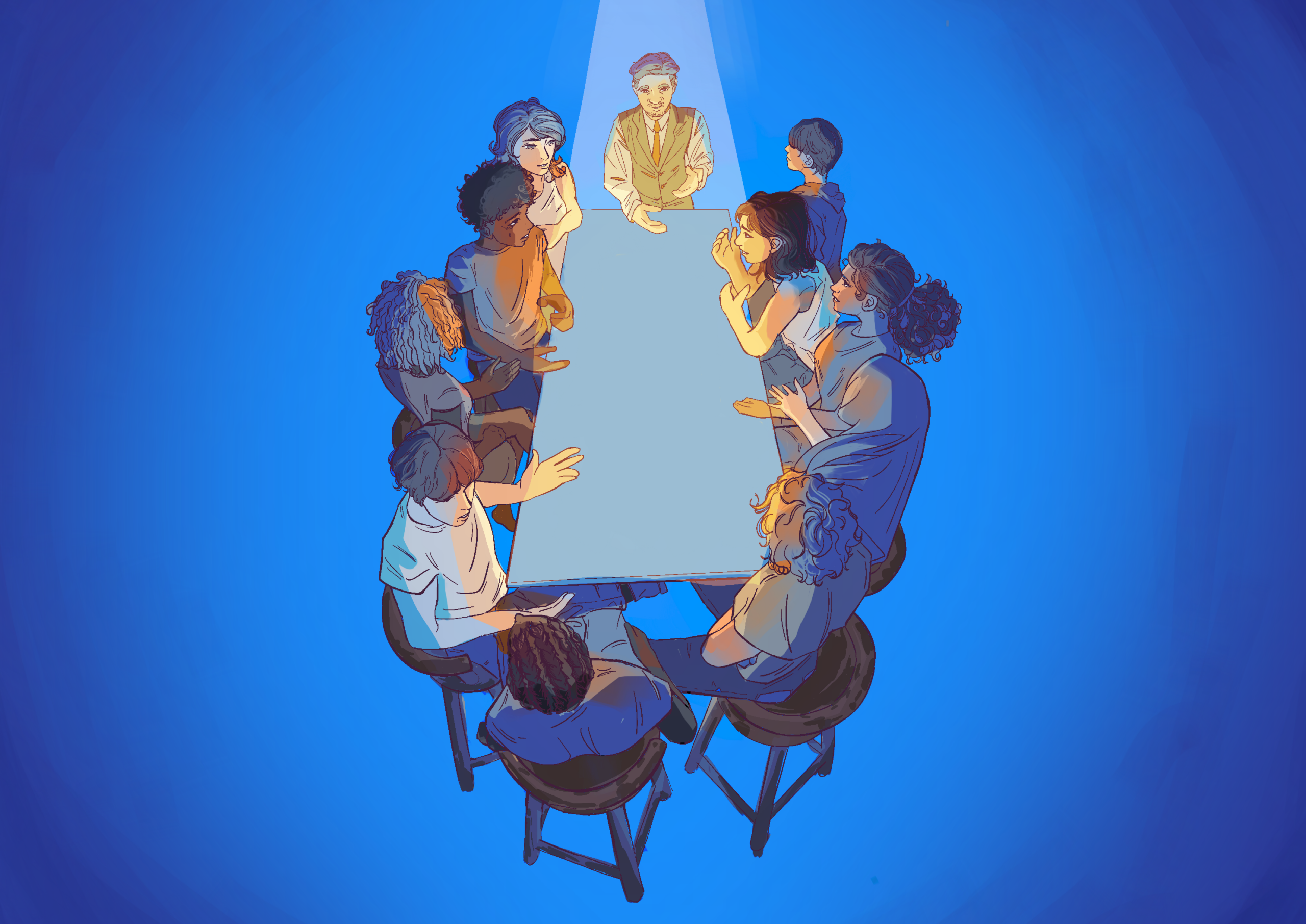
Eubanks found a similar experiential push in her seminar with Professor Heck, where her eight-person class embarked on unorthodox field trips, most notably a phone-free trek through Rock Creek Park.
“We walked two hours through it. And he told us to grapple with the question, ‘What orients your soul?’” Eubanks said. “We’re all basically freshly 18, dealing with such an existential question, and just really feeling clueless as to what a right answer would be.”
Despite the surprise of being pushed into deep personal reflections at 8 a.m., Eubanks said that she found this experience to be “enriching.”
“I got to learn so much more about myself and so much more about others,” Eubanks said. “It was truly, I think, a spiritual experience, which is very unorthodox for a class.”
Though Eubanks’ mother is an ordained minister, her household was “non-denominational Christian,” and she was exposed to countless religious ideologies. After her professor tasked students to visit a local religious institution, Eubanks spoke with a community organizer at a local Catholic church and explored a faith tradition she had never experienced before.
Eubanks cited this moment in cementing the realization that her intended major of Government was not her true calling, drawing her instead to Justice and Peace Studies, concentrating on Religion, Politics, and the Common Good.
The course reshaped Eubanks’ approach to college. The following semester, she dropped a large lecture course because she missed the seminar’s open dialogue, enrolling instead in Heck’s upper-level theology course on atheism.
“I do prefer that type of form when it comes to something so philosophical or theological,” Eubanks said. “I saw that I gravitated towards that with Atheism, as Professor Heck repeated the same type of method. But also in some of my other classes that kind of had a smaller feel, and kind of wanted to incorporate that type of, like, group circle, group huddle, discussion, rather than just simply lecturing at us.”
Strength in small numbers
Professor Erin Cline, one of the program’s longest-serving professors, teaches the annual seminar “Human Flourishing,” which explores what it means to live a good life through the work of various philosophers. She attributes the program’s success to its small class numbers.
“I believe in the model and the way that it impacts students to be in a small, personalized seminar where they get to have some choice in the topic,” Cline said.
Her belief was reinforced when students in her inaugural cohort proposed reuniting during their senior year to revisit the course material with new perspectives.
“I was delighted that they had thought that they knew that when they’re in college, their views of things are going to change, and they’re going to grow as people,” Cline said.
Because many of Cline’s students now enroll in her first-year seminar after hearing about it through word-of-mouth from past participants, she tends to attract students eager to explore theology and already looking forward to their senior-year reunion.
“I think they see themselves as more of a cohesive group when they know that might be a possibility,” Cline said. “It’s like, oh, wow, okay, we’re going to come full circle if we want to.’”
This continued enthusiasm has made leading her Ignatius seminar one of the most fulfilling parts of her teaching career, Cline said.
For Cline, a successful seminar has little to do with grades; rather, success is determined by whether professors can create a safe environment for open communication and healthy discourse among the group.
Indeed, Cline hopes that students will focus less on achieving the highest marks and approach these seminars as a way to widen their worldview and broaden their social network, valuing lasting connection and knowledge over numbers.
“Everybody’s coming from a different place and this is one of the great opportunities that we have,” Cline said. “At a university like Georgetown, we have students from all over the world. There is a lot of opportunity really, to open up and to get to know people that you otherwise would never cross paths with.”
Finding a place at Georgetown
While professors like Cline see how these seminars build community from the podium, for students, that tight-knit environment can alter the course of their collegiate experience entirely.
Lola Avery (CAS ’29) enrolled in “Randomness, Chance, and Probability” to fulfill her Quantitative Reasoning and Data Literacy core requirement. As a Public Policy major, Avery was apprehensive about taking a mathematics-based course, which she ranked at the bottom of her seminar preferences. She said Professor Erblin Mehmetaj’s easygoing nature and the classroom community made the more technical aspects of the course “less stringent.”
Over the course of the semester, exposure to new perspectives sparked a growing interest in international relations, leading Avery to consider transferring to the Walsh School of Foreign Service (SFS). However, without the traditional courses students take to transfer to the SFS, self-doubt quickly set in.
“I think it’s very normal to have ups and downs, and I think especially at a school like Georgetown, where it seems like everyone knows what they’re doing all the time, it can feel vulnerable to, for the first time, admit, ‘I don’t know what I want to do right now or my interests have changed,’” Avery said.
Unsure of her next step, Avery went to Mehmetaj’s office hours, where he spent 30 minutes talking through her fears and unpacking her hesitation.
“I feel like he was one of the most influential people in that decision just because he gave me the push that I needed and that vote of confidence from a professor—from an adult—that I feel like I’d been missing just because I felt like a lot of the professors didn’t know me that well,” Avery said.
As CAS rolls out the First-Year Seminar mandate officially, Avery sees immense value in the policy, provided that the university maintains the intimate class sizes that allow for building relationships. For her, the program’s success hinges on keeping the experience personally transformative rather than turning it into another box to check off for an eventual degree.
“[First-Year Seminars are] a unique opportunity to meet people that you wouldn’t necessarily meet,” Avery said. “I would not have met any of my best friends from that course because we didn’t live in the same dorms, weren’t all the same majors, were [in] different schools.”
This kinship, Avery said, is not something first-years should overlook, even if placed in a seminar that may not seem academically appealing.
“Go into it with the understanding that it’s not just about what you’re learning on paper,” Avery said. “It’s about the overall classroom experience.”