


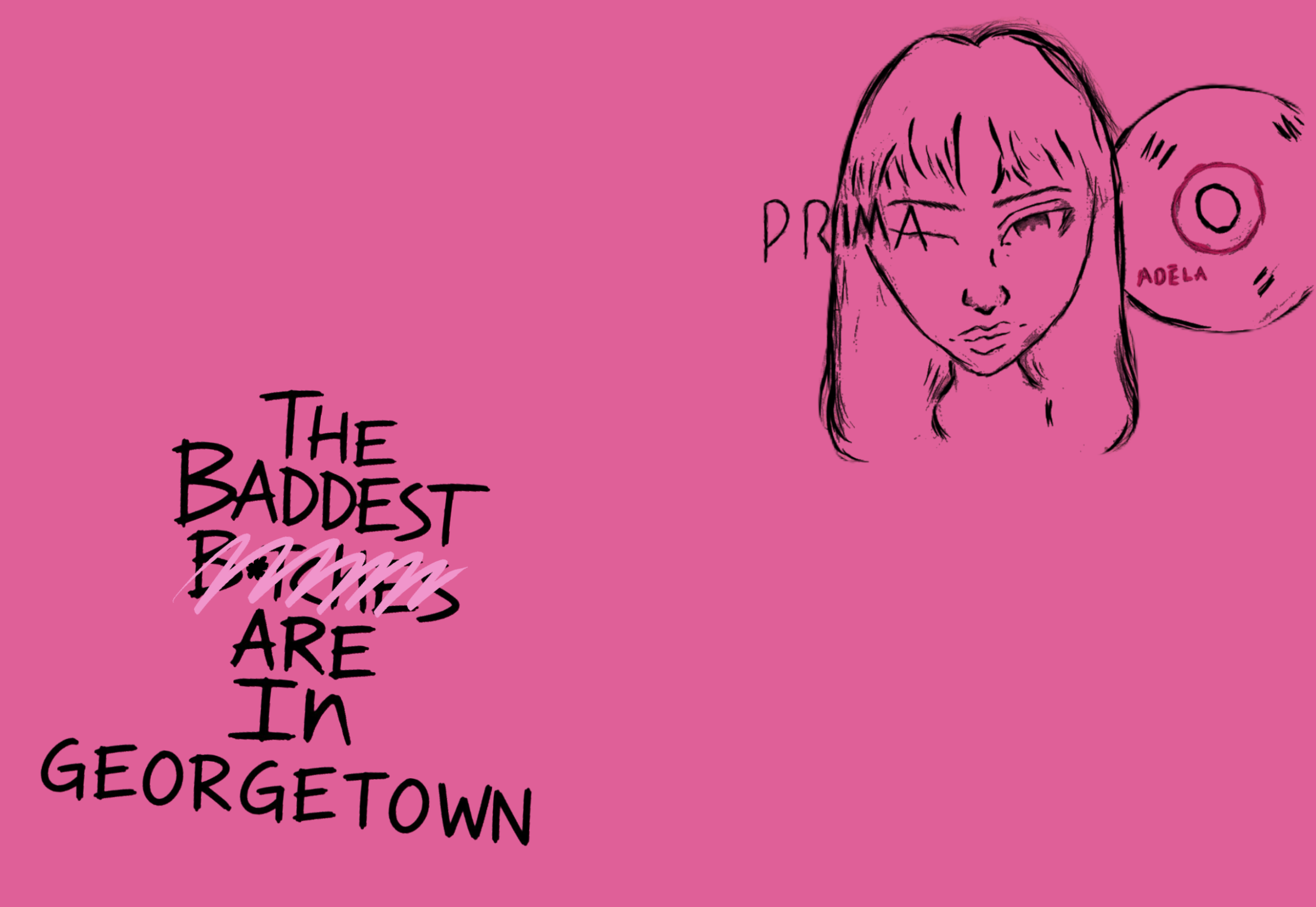
The pop star industrial complex has produced many things. Myriad varieties of auto-tune; meat dresses; Mickey Mouse Clubhouse alumni; and, every so often, actual stars. Adéla Jergová might be the latest one.
Many recognize Adéla as a contestant from The Debut: Dream Academy (2023), the notoriously contrived competition series that produced girl group KATSEYE. She spent much of her childhood training as a ballet dancer, eventually making her way to Los Angeles with ambitions of making music. Unfortunately, none of that mattered much once the public was given the chance to vote a contestant off the show. She was the first to go.
Since then, she has moved quickly: two self-released singles, an abrasive EP, an opening slot on Demi Lovato’s tour, and an industrial quantity of pink hair dye. Now comes PRIMA (2026), her full- length debut album, and a record about the business of becoming the thing she was once told she could never be.
Naked ambition makes PRIMA significantly more captivating than the average debut. Adéla is not particularly interested in maintaining the illusion that pop stardom arises spontaneously. The album navigates money, image, sex, and ancestry; even when she is being sincere, she acknowledges the performance involved. She wants fame but is also fascinated by how strange it is to want it.
That interrogation begins with opener “KGB.” Its title and provocative imagery initially suggest the usual internet-age bid for controversy, but the song cares less about shock than it does autobiography. She recounts leaving Slovakia, “working the night shift to learn English,” and pursuing the American pop fantasy she absorbed as a child.
The following track, “Nicole Kidman,” is similarly interested in celebrity as a form of fantasy and self-possession. Adéla said the title came to her after she was getting dressed for a Golden Globes party when she caught herself in the mirror and thought—as she sings in the track—“I feel like Nicole [Kidman].” Through the track’s clipped samples and slick hip-hop production, Adéla invokes Kidman to enumerate the pleasures of being attractive and famous with unabashed enthusiasm, and declares herself “in control.”
But beneath the playfulness, PRIMA dances around the less glamorous forms of desire—much of the album oscillates between sexual indulgence and introspection. “Starving Artist” features Adéla reuniting with an ex, slipping back into the same dingy apartment where “nothing has changed.” One track later, on “Marijuana,” she gets high, resorts to car sex, and, amid the haze, wonders whether the other person might actually mean something to her; in other words, “I think I like you like you like marijuana.” The songs are vulgar and deliberately silly, but that silliness affords Adéla room to be more candid about her loneliness and uncertainty.
Unfortunately, not every song is as distinctive as the persona surrounding it. “Hitachi,” a piano-led breakup song built around a vibrator joke, has the contours of a perfectly competent ballad without much to separate it from the rest of the record. “Fantasize” is similarly pleasant but comparatively anonymous. These songs remind us what PRIMA is outside of an autobiography: a debut, made by an artist still discovering which parts of her persona will survive novelty.
Part of the frustration with PRIMA is that it lacks the anger and bite of her previous EP, The Provocateur (2025), and some listeners have consequently cast PRIMA as a retreat into a more conventional 2000s pop sound. While this interpretation isn’t entirely misguided, it assumes that Adéla’s experimentalism is a quality she opted to preserve. The album is clearly referential, but for a record concerned with self-discovery, borrowing from the music that shaped her in youth is unequivocally within scope.
Her willingness to inhabit familiar forms becomes most revealing when the distance between Adéla the pop star and Adéla the person collapses. Despite its slight bashing on X, formerly known as Twitter, “Therapy” gets at PRIMA’s crux, with Adéla shedding much of the album’s polish for a stream-of-consciousness account of her life as she addresses those managing her career: “They are old white men, and they’re so annoying, but they hold the keys to my future, so I have to do it anyway.”
It is an unusually direct method of addressing the compromises of pop stardom. She resents the unflagging greed of the music industry, but she clearly wants what it can give her. This contradiction is one with a long lineage in pop music—Adéla’s version feels less grandiose. She is acutely aware that the process of becoming famous is now something audiences can witness in online, in real time and she has decided to foreground that visibility.
The final track and album highlight, “Ain’t in LA,” offers the listener a sentimental resolution. The song rejects the mythology of Los Angeles as a prerequisite for success, imagining instead that the dream might be portable. The song has also become her breakthrough, reaching the Billboard Hot 100 and making her the first Slovak artist to appear on the chart. The success of “Ain’t in LA” complicates its sentiment. Adéla spent years trying to get to Los Angeles, and now the song that has taken her furthest is about not needing to be there.
This tension is what gives PRIMA its charm. Adéla wants to be a star, yet remains bemused by the absurdity of everything required to become one. At its best, the album doesn’t resolve that contradiction; it performs it, moving between bravado and insecurity, fantasy and confession.
Adéla’s debut ultimately asserts her as no longer a contestant, but a competitor in her own right. The album is a candid account of what happens after the audition, when the fantasy of stardom gives way to the reality of its becoming. She has the role now. The harder part, PRIMA suggests, is deciding what the role is worth.
Voice’s Choices: “Nicole Kidman,” “Marijuana,” “Ain’t in LA”