

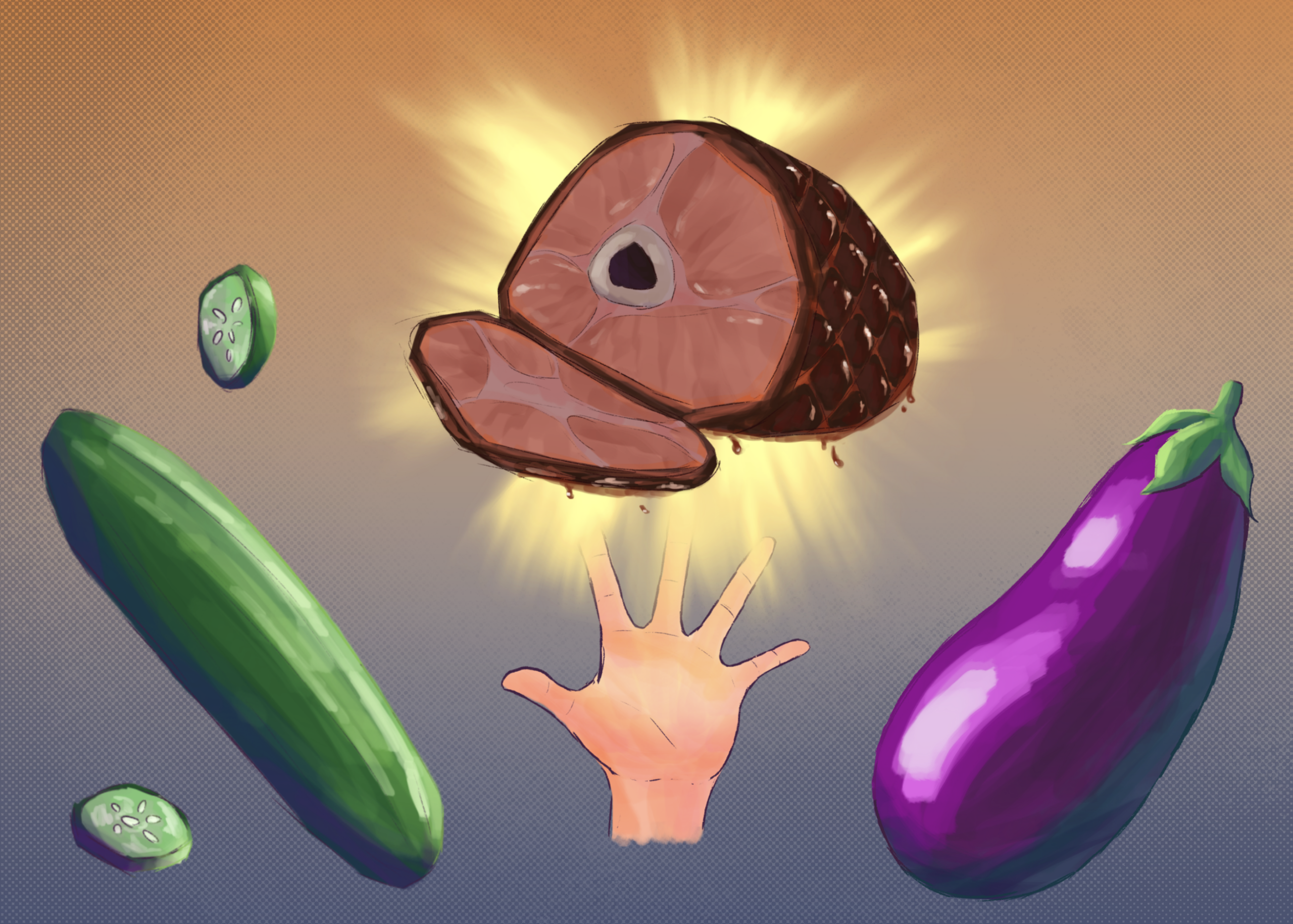
Last semester was one of the worst periods of my life. My reprieve was found in the company of Voice photo editor Julia Carvalho (CAS ’29), from whom I acquired both a craving for cheese quesadillas and a rather persistent desire to become the thing I swore I would never become: a vegetarian.
My vegetarianism got off to a surprisingly strong start. Since all freshmen are required to purchase the all-access meal plan and I was (am) broke, dining on campus was my only option. At the Epi’s buffet, I was delighted to discover that finding vegetarian options was not nearly as difficult as I had feared. Under this guise, I also assumed maintaining my vegetarianism through the summer would be simple. Yet even after giving up on it in the first few weeks of break, I still felt an emptiness, some nebulous terror looming over my head.
Turns out, I was craving a different kind of meat.
We talk about the “Gen Z sex drought” as if it’s some enigmatic event, a cultural dry spell falling equally upon the just and the unjust. But aggregate statistics are a coward’s way out of naming the hell that has become modern youth shagging. A dry spell is more than an abstract data point about declining hookup rates; it’s an active audit of your market value. And for me, that audit has been running in the red.
I grew up in a conservative corner of Florida where the prospect of being openly queer, much less queer and sexually adventurous, was hardly something to take for granted. So when I first arrived at Georgetown, I assumed that at least the latter part would become easier. D.C. is full of gay people, and Georgetown is full of young people. I was finally in a place where, statistically speaking, I could finally have a piece of the pie.
Alas, I’ve discovered that proximity to possibility is not the same as possibility itself. On paper, Georgetown is a vibrant hub of ambition, but in practice we know it to be yet another university where students treat their resumes like bodies and their bodies like resumes. People have internships to secure, organizations to lead, events to attend. The queer community is hardly nonexistent amid all this; if anything, it’s remarkably organized, with affinity groups and social circles sprawling across campus. You can know plenty of queer people and still feel perpetually one degree removed. Somewhere in the sauce, as it turns out, having someone to fuck is not exactly a graduation requirement.
However, I am wary of blaming Georgetown for my lack of game. These frustrations certainly predate my arrival on campus, but being here has elucidated just how difficult they can be to escape. In my hometown, the problem was largely one of scarcity: being gay was complicated enough, and the pool of people with whom I could explore was small. At Georgetown, that scarcity has been replaced by something arguably worse—abundance without access. No matter how you take your tofu, there is an irrefutable blueprint for being young and desirable: skinny bodies, illusions of wealth, specific performances of gender. Falling outside that blueprint can make the queer culture you were promised feel considerably less inclusive than advertised. Georgetown simply makes these expectations feel particularly pronounced; affluence and social capital are difficult to miss.
Then there is the most frustrating deterrent: time. Sex is a luxury, not only because it requires finding an empty evening. When you are balancing a full course load, trying to maintain even a shred of a social life, and acutely aware of how poor you are, the spontaneity that makes sex possible can feel completely inaccessible. Being first-generation and/or low-income not only means less access to financial resources, but also less freedom to treat time as discretionary, leaving little room for the inefficiency of intimacy. Sex demands privacy, transportation, money, time, and the willingness to let something happen without knowing whether it will even be worth it. When your schedule is hyper-optimized, sex becomes just another impossible side gig.
None of these obstacles would bother me quite so much if I did not want sex as badly as I do, and that is the part I find most difficult to intellectualize. It is easy to morph virginity into a sociological problem, to blame Georgetown, capitalism, the internet, or Jake Shane. It is harder to admit that I would die for someone to want me even just a little bit. I want to feel fuckable! Instead, I have become extraordinarily talented at explaining my own deprivation—which is sadly not the sexiest skill.
So, my meatless summer came to an unceremonious end over a greasy piece of chicken. The dietary experiment failed. I gave up the moral high ground of black bean burgers because, eventually, pretending I wasn’t hungry became more exhausting than giving in.
My deeper hunger, of course, remains unresolved. I am still irritated, and still navigating the peculiar alienation of sexual deprivation on this campus. I even have a single dorm room, which I had once imagined would be an asset to my sex life but is instead essentially a chastity chamber.
Maybe Georgetown is just not built to proffer sexual opportunity. Maybe there is nothing particularly wrong with me, or with Georgetown, or with being twenty- something and horny, or even with being a virgin. Maybe sometimes you can take all the steps you think will make you happy and discover that it cannot manufacture the thing you wanted most. And maybe that’s really what being vegetarian and being a virgin have in common: you never stop wanting meat.