


Georgetown University has cracked down on student parking restrictions and increased incentives for students to remain on campus for their senior year as the university looks to get community and government approval to increase its undergraduate enrollment.
Washington, D.C. requires universities located in residential neighborhoods to create a campus plan to show how they will balance university life with respecting the surrounding residents. The plan, as well as any amendments, must be approved by the D.C. Zoning Commission (ZC). Georgetown’s current campus plan was published in 2017 and is set to last through 2036.
The university is currently seeking an amendment to the campus plan that would allow Georgetown to enroll an additional 100 undergraduate students and increase the School of Medicine’s enrollment by 80 students over the next four years.
A university spokesperson told the Voice that they hope an increase to the enrollment cap will “allow more students to experience a Georgetown education.” However, the move also appears to be motivated by the university’s ongoing financial struggles, with the spokesperson adding that the increase will also help Georgetown “in the midst of uncertain times in higher education.”
Parking enforcement
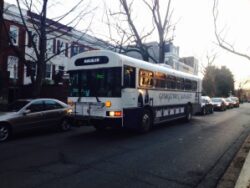
Georgetown has long prohibited students from bringing cars to campus and parking on neighborhood streets. However, as part of the university’s pitch to increase enrollment and as a broader compromise with the neighborhood, they’re cracking down on the policy.
A university spokesperson told the Voice that to increase enforcement of its car policies, they will begin to “utilize license plate reader (LPR) technology and vehicle registration data associated with student addresses to identify vehicles associated with undergraduate students parked within the prohibited areas.” This summer, students were also asked to sign an agreement that said they understood the ban on bringing cars and consented to this policy.
Peter Sloniewsky (CAS ’27) serves as a Georgetown student commissioner on the Advisory Neighborhood Commission (ANC) 2E, a nonpartisan elected body that serves as an intermediary between the neighborhood and city government (in this case, the ZC). Sloniewsky wrote to the Voice that he is generally supportive of the policy if it helps the university’s reputation with the neighbors.
“While I don’t know if cars with license plate readers is the most effective way to spend university funds, it is clear to me that this is a hot-button issue for our neighbors,” he wrote. “If a marginal improvement in enforcement for a policy that’s been in place for almost a decade at least is all that it’ll take to build goodwill, I can’t in good faith object.”
However, some students find themselves in a confusing position amid the crackdown. William Mead-McCaughan (CAS ’27) is a native Washingtonian. While he doesn’t have his own car, he often borrows his parents’ cars on the weekend to go home for dinner or run errands. Since the crackdown, he’s stopped parking in the neighborhood despite having D.C. license plates.
He says that the university hasn’t made any public distinctions in the policy for students who live hyperlocally.
“[Georgetown] needs to talk to D.C. people who have a right to park on the street, who may legitimately use their car all the time for really reasonable reasons,” he said. “For my entire life, anywhere else in this city, this is something I’ve been able to do. [For] the small crop of us, this is one of the few local student benefits that exists.”
A university spokesperson also acknowledged that the Academic Resource Center considers requests for disability parking if students request an accommodation.
Topher Mathews, another ANC 2E commissioner, said that he understands students’ gripes about the parking policies. However, he also said that neighbors see a massive shift in parking availability from the summer to the school year, which limits their ability to park near their homes or in convenient places.
“We in the neighborhood would like to prevent there being close to a thousand [additional cars], if every student off campus had a car in the neighborhood,” Mathews explained.
GUSA president Darius Wagner (CAS ’27) agreed with Mathews that neighborhood parking has been a big sticking point between neighbors and the university. However, with the introduction of LPR, Wagner also says that GUSA is hoping to ensure that the “technology is being used responsibly.”
On-campus housing
In order to mitigate the impacts of the increased enrollment cap on the surrounding area, Georgetown has promised that beginning in spring 2028, if more than 970 undergraduate students live in the Georgetown, Burleith, and Foxhall neighborhoods, the enrollment cap will be reduced the following year.
The university is also taking additional steps to incentivize seniors to remain on campus, with an additional 278 beds created by the reconstruction of the Henle Residential Complex. Students have been required to live on campus for three years since 2015, and in the past the university offered no guarantee of housing beyond a student’s junior year, except for students displaying a high financial need. However, the university is now promising four years of guaranteed housing to students. A university spokesperson also told the Voice that the university is exploring even more incentives for students to remain on campus, including fee rebates and a preference in housing assignments.
Wagner agreed that the university has been working towards offering students attractive options for living on campus.
“Seniors and upperclassmen are being able to have better housing options, and that’s sort of leading to sort of more students choosing to live on campus,” Wagner said.
Mathews says that he thinks the university’s proposal, while imperfect, is something that the neighborhood can support—and with them, the ZC too.
“We’re happy with what the university is proposing here,” Mathews said. “We think it’s important for them to get this through.”