


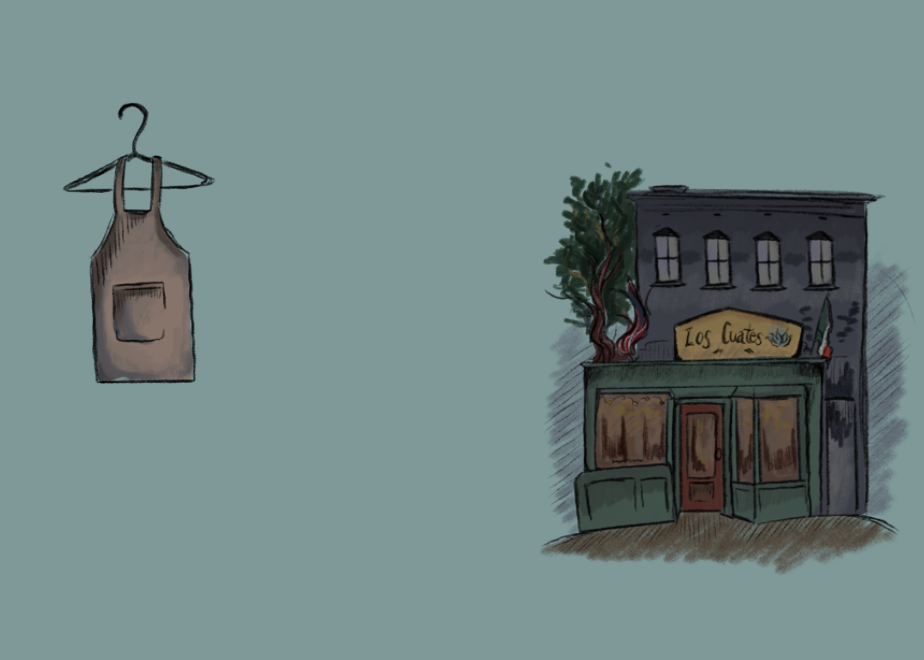

On a quiet September morning in Georgetown, as families walked the cobblestone streets with coffees and shopping bags in hand, a popular local restaurant was opening for the weekend rush. But their best dishwasher, who started working at the restaurant when it opened years ago, didn’t show up for his shift.
Thirty minutes later, his manager was growing frustrated as the dishes piled up. But because the dishwasher had never called out sick or arrived late, the manager decided to forgive his tardiness.
After two hours had passed, the dishwasher’s worried co-workers called his family. When they picked up, his family said that U.S. Immigration and Customs Enforcement (ICE) officers detained him on his way to work and that they were not aware of his whereabouts.
The star dishwasher was the first of two workers from that restaurant that ICE detained on their way to work in September. He was in ICE custody for two months before being deported in November, leaving his wife and three children behind.
The business manager, who requested anonymity for himself and the business due to fear of ICE and potential retaliation against other employees, said the other workers have been devastated by these absences.
“There was a lot of fear,” he said. “People cried. People stopped driving into work.”
One of the manager’s “runners,” an employee who brings food to and from tables, was so afraid after her co-worker’s detention that she decided to return to her home country.
“She has a kid, and she didn’t know what would happen with kids, so she preferred to go back home,” he said.
These deportations and the fear surrounding them happened amid the Trump administration’s renewed crackdown on immigration. On Aug. 11, the Trump administration issued a “crime emergency” order in D.C., triggering increased presence of officers from federal law enforcement agencies, including ICE, resulting in a surge of immigration-related arrests.
According to statistics tracked by the Deportation Data Project, ICE made a total of 88 arrests in D.C. from January to July 2025. But from Aug. 1 to Oct. 16, arrests skyrocketed to 1,148, including 667 arrests made in the 30-day period after the crime emergency was declared.
Georgetown was one of the first neighborhoods to see an ICE presence when the White House declared the emergency. Georgetown business owners have since reported ICE coming into their businesses, requesting their employees’ legal work status.
The Voice spoke to fourteen businesses in the Georgetown neighborhood. Each of them reported being impacted by ICE activity in the D.C. area, through staffing shortages, a decrease in customers, or having their own employees directly detained.
Mayor Muriel Bowser’s office declined the Voice’s request for comment on continued ICE raids and their impact on businesses in the District.
Widespread impacts on immigrant workers
Ale, an employee at two Georgetown restaurants, said that he has observed a chilling effect caused by the ICE raids; several of his co-workers and friends have taken days off of work to hide in their homes out of fear of ICE detention. Ale requested to go by a shortened version of his name to protect his identity, due to fear of ICE retaliation.
“We see a lot of impact on our community because a lot of people are scared to go to work,” he said. “No one is prepared to go back to their country.”
While Ale’s workplaces in Georgetown have never been raided by ICE, he said that most people he knows can name a business in the area that has been raided.
His co-worker’s brother has remained in ICE detention for over two months after a raid on a restaurant’s kitchen in Foggy Bottom, an area near Georgetown that is home to George Washington University. Ale said that the co-worker knows little about the conditions his brother is facing, having received only one call from him.
“He’s so worried about it, because that’s his brother,” Ale said. “They were doing everything together. He almost cries every time he talks about him.”
Ale said that around 10 of his friends from Venezuela, who all worked as drivers for food delivery services, were detained while driving their motorcycles to make deliveries and were ultimately deported. Now, with delivery drivers avoiding work, delivery times at his workplaces have slowed significantly.
“When we make the food for deliveries, it stays right there for over 30 minutes, waiting for somebody to pick it up,” he said.
These issues experienced by Ale’s restaurants are widespread. Reports of delivery drivers being detained suggest that they are being specifically targeted by ICE officials during routine traffic stops by the MPD. Restaurant owners have noticed a decrease in available delivery drivers, leading to a spike in delivery costs on apps like Uber Eats and GrubHub, according to reporting by The Washingtonian.
Georgetown’s local businesses struggle
Immigrant workers’ fear of coming into work has had consequences for owners operating Georgetown’s businesses. Los Cuates, a Mexican restaurant and a Georgetown staple until 2026 when it permanently closed, was operating without a head chef as a result of labor shortages caused by the immigration raids, said Owner Sergio Kehl. Before he shuttered the Georgetown location, Kehl had to spend time in the kitchen himself with three fewer employees than usual.
“It’s not the same as having somebody who can perform as a chef,” Kehl said. “We cook the food as best we can, but it’s not the same.”
Even if Kehl had a fully staffed kitchen, business had declined since the federal law enforcement surge began in August, he said. Kehl’s biggest customer base was other immigrant workers with stable jobs, who not only make up part of Georgetown’s workforce but are also paying customers.
“With this immigration effort, we lost most of our customers,” Kehl said. “They’re scared. Construction workers used to come here to eat all the time, and they spend a lot of money because they have a lot of work, but now we don’t have that business anymore.”
Kehl also said that he has observed less business from tourists who visit the Georgetown neighborhood on trips to the District as well.
“It’s hurting tourism,” Kehl said. “When you see people from ICE hunting on the street, basically, it’s not good for the economy.”
The federal takeover and immigration raids have caused a decrease in tourism, according to reporting by CNN. Data collected by OpenTable, a restaurant reservation service, indicated a 2% decrease in reservations from July to August.
What Kehl saw at Los Cuates is not unique. Many of D.C.’s local businesses, especially restaurants, have been impacted by Trump’s law enforcement surge, according to the Restaurant Association Metropolitan Washington (RAMW), which provides legislative support and resources to D.C.’s restaurants.
A RAMW representative said that Washingtonians should support local restaurants as they face challenges to their daily operations.
“This is a time of real uncertainty for workers, families, and businesses across our region,” RAMW wrote in an email to the Voice. “Restaurants—already navigating thin margins—are directly impacted, yet as always, our community shows resilience.”
D.C.’s Department of Small and Local Business Development, which supports the development of District business, did not respond to the Voice’s requests for comment on how it has supported Georgetown businesses amid increased immigration raids.
Fears of shutting down
According to Kehl, the combination of fewer customers and not enough workers had brought revenue down at Los Cuates by about 50%.
Kehl first realized how grave the situation had become for his restaurant when vendors came to check on his appliances in September. His washing machine service reported that Los Cuates’ dishwasher usage dropped by 1,300 cycles from August to September, and his Pepsi vendor said that soda purchases fell to half of their previous level.
“They told me everywhere is the same,” Kehl said. “They say this business is half of what it was before. The Pepsi company says people are not ordering. People are not doing well.”
Before the Georgetown location closed, Kehl has posted a GoFundMe page in hopes of raising $100,000 to keep his Los Cuates open. The Falls Church location is still open.
“We don’t have the sales to cover rent or basic bills like electricity, gas, water, cable,” Kehl said.
Continuing to work
For some migrant workers, there is no choice other than continuing to work.
While Ale understands the concern of his family, friends, and co-workers, he said he believes that he has no other option but to go into work to support himself.
“I’m doing nothing wrong. I have to go to work,” Ale said. “I do the right things in the United States. I have no criminal record. I’ve never been in trouble, I go to school, I work really hard. I cannot stay in my home and do nothing.”
Ale crossed the U.S.-Mexico border when he was 17 years old, entering through Texas. He said the fear of being detained by ICE pales in comparison to his journey across the Rio Grande.
“It is really, really, really hard to get to this country as an immigrant,” Ale said. “A lot of people die every day. I used to have to hide when I was coming to the United States from border control, from police in Mexico, and I am not going to do that right here.”
Supporting their workers
To help their team feel more comfortable coming into work after their dishwasher was deported, the restaurant’s manager put in place several precautions to protect immigrant workers. The business enacted a new standard operating procedure that encourages everyone to remain calm in the presence of ICE, the manager said.
“They don’t need to answer any questions. They don’t need to show any proof of documents. Never run away, never go out of the store,” he said.
He said that they also put “private, employee-only” signs on the outside doors, but he is unsure whether ICE will comply with them.
Even so, the manager said he would do everything he could to protect his co-workers from deportation. After their best dishwasher was detained, his co-workers decided to take action, the restaurant manager said.
“We did a fundraiser to help him pay the lawyer,” the manager said. “We paid him through our sick days. We did everything we could to help him financially.”
Despite their efforts, the dishwasher was deported.
One sentiment remained consistent among the business owners: immigrant laborers deserve to remain part of our Georgetown community.
“They pay taxes, even though they don’t get the tax back. They make the economy move because they work and live here,” the manager, whose business banded together to support their dishwasher, said. “They are wonderful people.”