

Sinners – Aaron Pollock
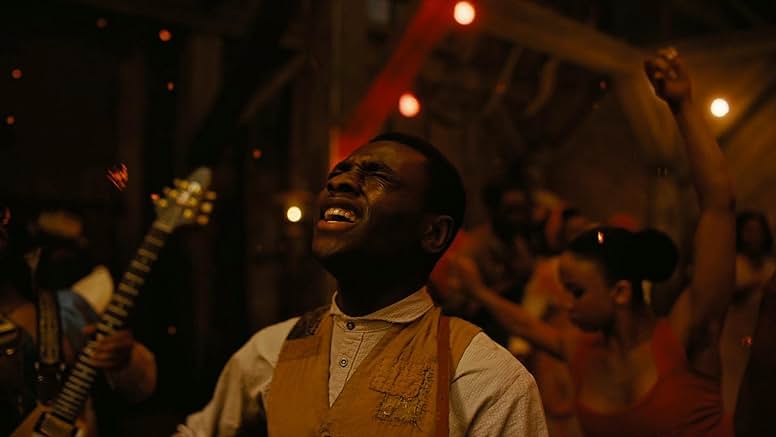
Sinners (2025) transports moviegoers to an enchanted Mississippi Delta, during Prohibition when illicit booze and blues flooded juke joints. Twin brothers Smoke and Stack (Michael B. Jordan) return home from lives of organized crime in Chicago with suspiciously newfound wealth to fund a juke joint as a playground for various taboos. Their indulgence backfires when music from the joint accidentally pierces the veil between life and death, resulting in a vampire attack. Despite the ensuing tragedy, the juke joint offered just a moment’s escape from the drudgery of daily life: smooth, perhaps sinful, blues. Sinners seems likely to win Best Everything with 16 total Oscar nominations ranging from Best Costume Design, for which Ruth E. Carter has already become the most Oscar-nominated Black woman of all time, or to the inaugural award for Best Casting.
Marty Supreme – Elizabeth Adler
Josh Safdie’s eccentric table-tennis thriller follows the misadventures that befall the irreverent Marty Mauser (Timothée Chalamet) in his quest for glory. From the eclectic mix of actors (including Mr. Wonderful himself, Kevin O’Leary) to the time-traveling 80s-synth soundtrack to the mile-a-minute quirky dialogue, Marty Supreme (2025) is a mess of odds and ends that shouldn’t work together—but it does. The film is just all-around entertaining: Chalamet excels in both drama and comedy while Safdie’s directorial style is polished and precise. This gritty Safdie gem presents strong competition for Best Picture, Best Actor, and Best Director.
Sentimental Value – Hudson Witte
Joachim Trier’s Sentimental Value (2025) stands out amongst fellow nominees as a Norwegian flick with European art cinema as its subject. It centers around an estranged father and director, Gustav Borg (Stellan Skarsgård), who reenters his family’s lives to recruit his actress daughter Nora (Renate Reinsve) to star in his final film. Certainly, part of the Academy’s fondness comes from its plot about creative pursuits and the tolls they take on families, explaining its deserving nominations in categories such as Best Director, Actress, Supporting Actor and Original Screenplay. Still, with its exhilaratingly unique blend of iciness and emotionality, Sentimental Value probably remains too unique to win any Oscars.
Train Dreams – Hudson Witte
Trains chug down fixed tracks, while Clint Bentley’s Train Dreams (2025) meanders through the entire life of ordinary lumberjack Robert Grainier. The film contrasts a wafting and dreamy narrative with a digital camera that captures every moment with striking clarity. These beautiful, crisp images—the best part of the movie—force a reckoning with the ghosts of America’s past: legions of forgotten men and their complicity in racist violence. That visual choice swaps the dreaminess for an imposing certitude. Look for this movie to (probably) win the Academy Award for Best Cinematography, then slip from public memory—just like its subjects—because of its contradictory form and quiet aims.
Frankenstein – Elizabeth Adler
Beautifully cinematic, visually stunning, tragically shallow. Guillermo del Toro’s wonderfully shot Frankenstein (2025) draws you in at first glance, but true to the film’s themes, looks can be deceiving. Each still looks like a work of art, but there’s not much under the surface. The lazy dialogue and one-dimensional character development gloss over the complex themes of Mary Shelley’s novel, reducing the story to a gorgeous but lifeless shell—perfect for those who Sparknotes-ed their way through AP Lit. Wins for Best Cinematography or Best Makeup & Hairstyling would be acceptable, but this Netflix original certainly isn’t Best Picture or Best Screenplay material.
F1 – Alex Hwang
Brad Pitt is back on track in Kosinski’s F1 (2025), and not just on the circuit. Sonny Hayes (Pitt) is a disgraced ex-driver who has returned to the track to lock horns with hotshot rookie Joshua Pearce (Damson Idris). The rest writes itself. F1 is just as loud and deep as a pit stop, while the racing footage – shot during real Grand Prix weekends – is unlike anything ever put to screen. The audiophilic mixing of tire screeches and ambient noise is, undoubtedly, exactly what Best Sound aims to reward. The film editing is impressive, but not as impressive as that of One Battle After Another (2025). It has no shot at Best Visual Effects against Avatar: Fire and Ash (2025). And Best Picture? Please hang up your hat.
One Battle After Another – Alexandra Risi
With its invigorating action scenes, hit soundtrack, and morally conflicted characters, One Battle After Another (2025) is everything the academy looks for in a major hit. Despite hitting many of its marks in many places, however, the film stumbles where it counts. It sells itself short by relying on all-too-long chase scenes and action sequences, instead of the arguably more interesting moral struggles of the characters. While DiCaprio’s central performance is convincing, his performance brings little charisma to the film. While supporting actors, like Sean Penn and Benicio del Toro, bring complex and meaningful emotional centers to the film, DiCaprio and the film’s reliance on action over character work leave viewers wanting more.
Bugonia – Alexandra Risi
Is humanity really worth saving? Yorgos Lanthimos’s Bugonia (2025) explores this question in a heartbreakingly unique way, with all the chaos that entails. As Teddy (Jesse Plemons) and his cousin Don (Aidan Delbis) kidnap Michelle Fuller (Emma Stone), a famed CEO who they believe must secretly be an alien, chaos ensues as the pair tries to reach her emperor and save the human race. Stone, Plemons, and Delbis have incredible chemistry, where each of their movements feels like a deliberate character choice, and they create an emotionally moving film. But is this film digestible enough to take home the win? While it provides a meaningful commentary on humanity’s journey to perfection, the film’s surface-level political aims overwhelm its depth.
Hamnet – Jacob Gardner
If you’re looking to cry, or looking to re-ignite your passion for feminism, you’re in the right place. Hamnet (2025) re-centers a Shakespearean footnote into a fierce elegy. Jessie Buckley’s portrayal of Agnes Shakespeare (wife of William we-all-know-who) is incandescent—precise, aching, unforgettable—while the cinematography bathes her grief as a mother in painterly light. Woman-centered, slyly revisionist, and visually ravishing: Hamnet makes a historically masculinized tragedy feel newly, gloriously hers. I believe Jessie Buckley has more than earned a Best Actress In A Leading Role victory, and I wouldn’t be surprised if Hamnet walked away with Best Directing.
The Secret Agent – Quinn Ross
If you’ve been feeling a lack of deception in your life, The Secret Agent (2025) should be your next watch. No character is exactly as they seem, each scene is filled with hints towards the chaos that will occur next, and the story is built on the shaky foundation of political corruption. This lack of certainty is opposed by gorgeous Brazilian scenery, a passionate use of color, and a plethora of captivating characters, most notably the tenacious Dona Sebastiana (Tânia Maria) and the outspoken and tragic lead Armando (Wagner Moura). This film will help you get over your irrational fear of sharks, and is a sure pick for Best International Feature Film.