

Along the western coast of Florida, the salty air wafts through every opening of my 2011 Ford Escape. In the rearview mirror, my curls bloom outward, doubling in size. I turn the volume up—“Anticipating” by Britney Spears is playing—as the sun begins its descent into crepuscular glow. The beauty of an evening drive used to be my everything.
I once told myself that I loved driving because it provided a moving space of freedom that my teenage years necessitated. The car was an escape, a clean exit from whatever version of myself I didn’t feel like being that day or from any place that made that version necessary.
And while that feeling of escape remains, I’ve discovered the car’s appeal was actually quite the opposite. The car not only allowed me to pick up and go, but rather, just as often, to bring someone with.
My proudly self-bought car certainly did not come with all the bells and whistles. The radio cut out if you hit a pothole too hard, and the passenger window took a full 10 seconds to roll down, as if sentient and considering the request. But none of that mattered once another person joined.
There is a particular intimacy to driving someone somewhere: waiting outside their house, deciding the music, asking where you’re going even if you already know. To drive someone is to take responsibility for them, however briefly. You are the one navigating, the one paying attention, the one making sure they arrive safely. You and your passenger are sitting just inches apart but looking forward, which makes it easier to say things you might not say face-to-face. The conversation isn’t a performance. It can start, stop, drift. It can disappear entirely without becoming awkward or suffocating.
I didn’t realize I would miss my car until I didn’t have it.
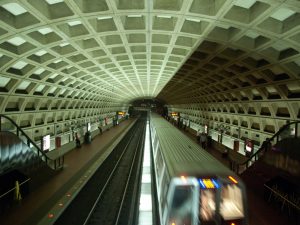
My attachment to driving became apparent immediately upon arriving in D.C. My first week, I faced the oh-so-canon conundrum of getting on the right Metro line but in the wrong direction. I sat on the train, staring at the map on the wall like it might rearrange itself out of pity. I rode the red line towards Glenmont five stops too far before I realized, got off, and waited again just to ride it all the way back and then some. It was disorienting; everyone moved with a kind of purpose I couldn’t quite match.
In the brutal heat of July, the Metro didn’t offer that inherent sense of being with someone, of fighting over the AC to combat our collective melting. All I wanted was to be back behind the wheel—alone, or better yet, with a friend.
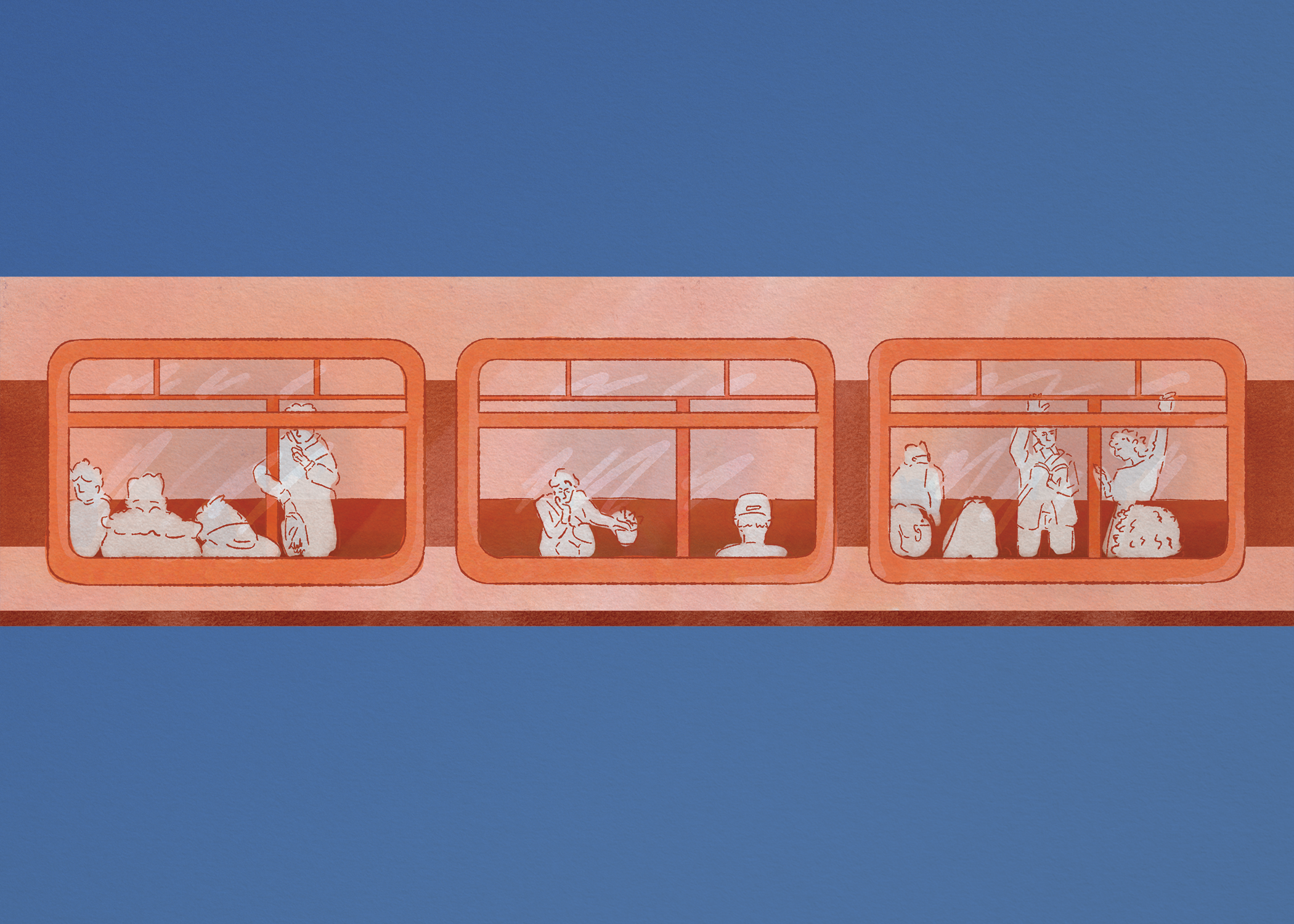
Transportation creates space for connection, and the public variant is a seemingly unique species. It lacks the enclosed, intentional intimacy of a car, instead possessing something looser, more ambient. You sit across from strangers, share space without introduction, overhear conversations you were never meant to hear. Someone plays Central Cee too loudly. Someone falls asleep and their drool pools on the floor. Someone is clearly having a worse day than you.
What emerges from the shared space of public transport is a different kind of permission than the privacy of my car. On a train, no one is looking at you, but you are not simply alone either. You exist beside people without needing to account for yourself. You can be quiet, unfinished—held in motion, both literally and socially.
Amid the absence of a car, I found that the public nature of the Metro offered me a different kind of escape from Georgetown’s campus. In the Georgetown neighborhood, everything is proximal. Everyone walks (or scooters?) to their destination. And on campus, there is a constant visibility where your anonymity is vanquished: you will pass the same people on the sidewalks, in cramped classrooms, and during the dinner rush at Leo’s. Without a car, without an immediate way out, there’s less distance and privacy between you and everyone else.
But public transportation changes that. It offers movement without such concentrated exposure; you step on the train and become one of many. On the Metro, it feels more acceptable to be alone since each person’s solitude becomes common among strangers.
The Metro community is not something you opt into. When you step onto a train, you become a part of it—moving alongside strangers, whether you are ready to be seen or not.
Admittedly, I still miss my car. I miss the enclosure, the control, the potential for screaming when the right song comes on. But it wasn’t just the driving I missed. It was the feeling of company without expectation. The sense that being with someone didn’t have to look like small talk about GPAs or the peril of English majors. Connection could happen in the in-between. Between stops, between conversations, even between versions of yourself.
And maybe that is what I’ve been learning here, without a car: that community does not always look like closeness. Maybe it looks like proximity, or a shared direction. Maybe it looks like sitting next to someone, not speaking, as the city moves around you.
Now, when the train pulls into the station with a rush of air, louder than it needs to be, I’ll step inside, take a seat by the window, and let my headphones fill the space the same way they would in my car. Someone across from me will be asleep. Someone else will be watching their reflection in the glass. And, whether I am alone or not, all of us will be going somewhere, together.