

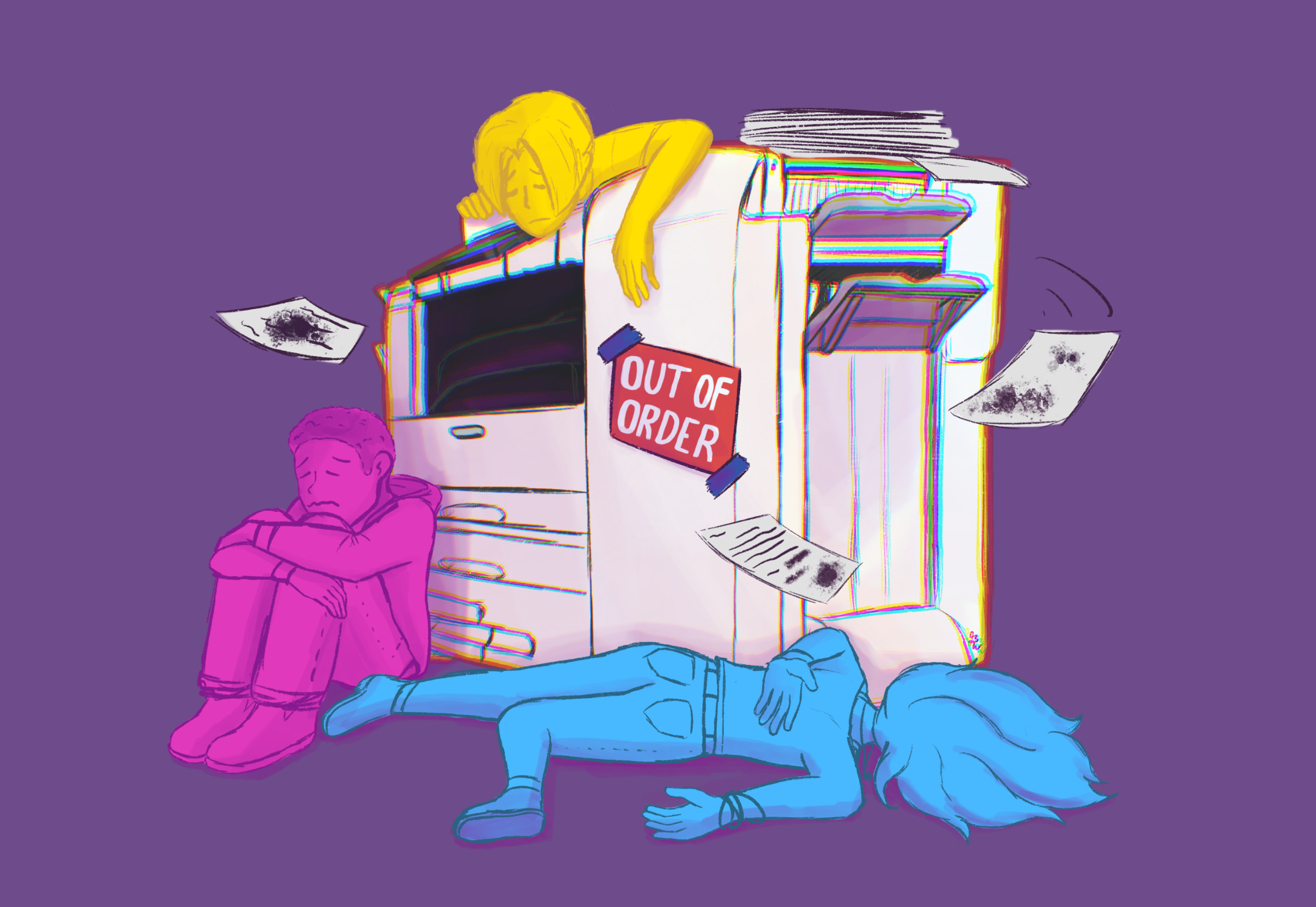
At 1 p.m. in Lauinger Library, I switch between staring at the printer and my PaperCut, hoping that if I will it hard enough, I’ll hear the sweet sound of ink being pressed onto paper in the behemoth of a device. Minutes go by and still nothing. The machinery stays vexingly silent. Sighing, I click “request refund” and gather my things for class.
Upon my arrival at Georgetown, an orientation leader described the common Georgetown experience of wrestling with the printers. Some have even had to perform the maintenance themselves, desperately finagling with the machines for class materials.
With the start of the academic school year, students are reminded of the necessity of Georgetown’s printers now more than ever, as new assignments and readings pile up. More and more professors expect exclusively printed materials in an effort to reduce student artificial intelligence (AI) usage. They expect visible annotations and proof of deeper thinking in preparation for class, and rightly so; research suggests that the frequent use of AI tools can lower critical thinking capabilities through a process known as cognitive offloading.
Teachers and students at Georgetown share the core Jesuit value of “academic excellence” and, despite the logistical benefits of AI, pursue full realization of knowledge in their courses by rejecting the technology’s infiltration into assignments. But students who want to live up to the guiding values of St. Ignatius are unable to do so if the Georgetown’s printers continue functioning in their present state.
Printers consistently break and malfunction across campus in a never- ending saga lamented by seniors and freshmen alike. Fizz posts going back three years describe dissatisfaction with them, sharing frustrations like: “Just lost years off my life and my entire net worth trying to use these ratchet printers,” in one anonymous post.
This directly affects students, as they may face academic consequences for not acquiring the printed reading, even if the excuse was because they didn’t have the time or money to trial run a recurrently broken machine.
Regardless of whether a professor requires paper readings, many students learn better with a physical text. Amongst neurotypical and neurodiverse students alike, reading in print provides the added benefit of improved understanding. As we realize the value of human capability in the face of AI, Georgetown should promote this turn towards thorough comprehension by supporting student printing efforts. Students shouldn’t have to struggle through grueling online readings or end up resorting to expensive textbooks in an effort to better understand an assignment.
For students like me with attention- deficit/hyperactivity disorder (ADHD) or other attention processing differences, print material is essential for better comprehension. According to a study done for the Research in Developmental Disabilities journal, “learning from digital texts leads to inferior reading comprehension for students with ADHD.” Our common experience of “feeling behind” is further exacerbated when printers limit our access to vital tools. Without the printed reading, I often spend valuable class time scrolling through text, simply trying to figure out where I thought what and when. For both neurotypical and neurodivergent students, the Georgetown printing problem hinders the educational experience.
While students can attempt to fix the machines, without proper instruction or knowledge of the intricacies of printers, they might unknowingly exacerbate the issue and damage the printers even more. The unnecessary cost of troubleshooting as a result of these malfunctions can fundamentally change a student’s day-to-day life and experience at Georgetown.
Using my personal average cost per printer job of $0.50 and assuming an average of four jobs per week, I might spend at least an extra $20 a semester after accounting for Georgetown’s $8 stipend. This estimate also doesn’t include the extra costs for printing study guides and cheat sheets during exam season.
While it may seem marginal, this $20 could be spent on nine more Metro rides for students commuting to internships or jobs, a new tie for an important interview, or three (maybe four, if you’re lucky) lattes for chronically overcaffeinated IPOL majors. For low-income students, it can weigh even heavier. At schools like Bates College and Stony Brook University, students don’t have to worry about this extra bit of spending, picking up their class materials with the ease of complimentary printing.
Although Georgetown will supposedly refill a student’s printing stipend if needed, the bureaucratic measures needed to do so are often unnecessarily drawn out. Students have to send an email to the Provost’s Office and wait for a response, even if they need something printed immediately but don’t have the funds to pay for it. Now, I won’t claim to be an expert on Georgetown’s financial standing and ability to directly pay for student printing. But, with $1.8 billion in donations alone as of 2025, the university has to answer for why students paying up to $100,000 a year are unable to access basic learning resources without inordinate struggle. At the very least, the university should address this detrimental issue and endeavor to fix it.
Thankfully, after trekking across campus to find a working machine, I was eventually able to print the history reading I needed for class. Nevertheless, I worry about the inevitable case when, one day soon, I will have to arrive unstudied as a result of the mercurial nature of Georgetown’s printers. Georgetown students should not have to fear lower grades or unpreparedness in their courses due to factors beyond their control. Students with financial strain, neurodivergence, or just genuine academic preference for physical reading face real accessibility issues as a result of the university’s lack of response to concerns about printer functioning. Georgetown needs to address this university-wide problem efficiently. Only then can its students return to learning without hindrance.