


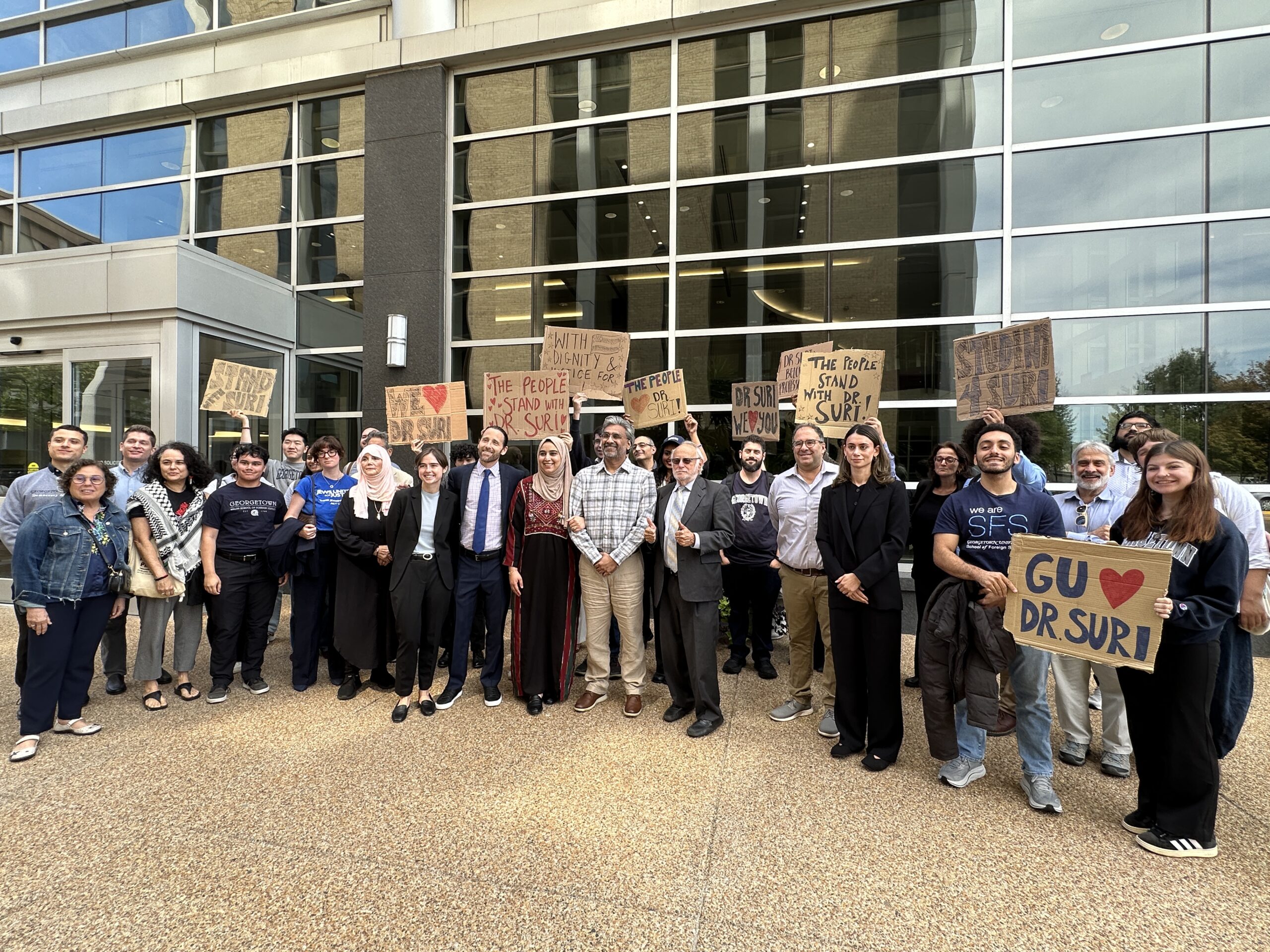

Lawyers for the U.S. government asked the U.S. Supreme Court on Monday to hear their appeal in Trump v. Khan Suri, arguing that previous courts lacked the jurisdiction to hear his legal challenges to his detention. They argue that the Supreme Court must decide whether noncitizens’ claims of unlawful detention can be heard in federal court after multiple circuit courts came to different conclusions.
Lawyers for the U.S. Department of Justice (DOJ) argue that the Immigration and Nationality Act (INA) mandates that courts do not have jurisdiction to review “any other cause or claim arising from or relating to the implementation or operation of an order of removal.”
“Those claims—which go to the validity of his apprehension, detention, and removal in equal force—all stem from respondent’s objection to being placed in removal proceedings in the first place. That is, his challenge to his detention is entirely derivative of his challenge to his being removed,” the DOJ wrote in their petition to the Supreme Court.
Khan Suri was detained outside his home in March 2025 while residing in the U.S. legally on a J-1 exchange visa, issued to teachers, students, and scholars. After spending 58 days in ICE detention, federal Judge Patricia Tolliver Giles ruled that Khan Suri needed to be released on bond. In July, a federal appeals court ruled that he should remain out of detention while his case proceeds.
The DOJ argues that Khan Suri could still contest his detention through the Board of Immigration Appeals (BIA) while also contesting his deportation. However, Khan Suri’s lawyers have argued that a challenge to his detention is necessary and separate from his removal proceedings, because by the time his removal case is decided, he will have already suffered a separate and undue harm through an extended detention. Judge DeAndrea Benjamin of the Fourth Circuit agreed with this assessment in her opinion in July.
“If a noncitizen is challenging their detention pending removal, then waiting for their removal proceedings does them no good,” Benjamin wrote. “They have already been detained, allegedly in violation of the Constitution. This ‘absurd’ reading of the INA would make such detention claims ‘effectively unreviewable.’”
Khan Suri is currently undergoing two different court cases. The first case, which has been appealed to SCOTUS, addressed if Khan Suri’s detention itself was legal, which his lawyers argue acted as a retaliation against his support for Palestine and marriage to a Palestinian. He is also undergoing a separate immigration case, which determines whether the Department of Homeland Security (DHS) can deport him.
The Fourth Circuit’s 2-1 decision in favor of Khan Suri created a circuit split, or disagreement between federal courts in different cases on the same issue. Khan Suri is one of many individuals across the country fighting their detention in court. In January 2026, the Third Circuit ruled in the case of Columbia University graduate Mahmoud Khalil that the INA does prohibit cases related to immigration detention from being heard in federal court, and in July, the Second Circuit ruled the same in the case of another Columbia student, Mohsen Mahdawi.
“This case presents an important question of immigration law that has divided the circuits: Must aliens challenge the grounds for their removal solely through the petition-for-review process that Congress prescribed under Title 8 of the U.S. Code, or can aliens detained pending removal proceedings file habeas petitions that collaterally attack the bases for those removal proceedings?” the Department of Justice wrote.
Instead, the DOJ argues that a section of the INA that strips district courts of jurisdiction over “nearly all” claims “arising from removal proceedings,” therefore bars Khan Suri from “collaterally challenging the bases for [his] removal by filing habeas petitions that raise the same basic claims just as defects to their detention.”
In cases where there is a circuit split, the Supreme Court is typically asked to intervene to issue the ultimate national ruling on the matter. However, the Trump administration asking the Supreme Court to hear the case does not guarantee that they will do so—the court receives over 10,000 petitions every year and typically only hears around 65-70 cases. Once the petition is received, four of the court’s nine justices must determine that the case has merit for them to review in order for it to enter the Supreme Court’s docket.
Khan Suri believes that his case has a good chance at being selected because of its wide-reaching implications.
“They will do it, because they want a precedent that no immigration related case should be decided through habeas in federal court,” Khan Suri said on Monday night at a teach-in about his case.
The DOJ concurred in their petition.
“The question presented is remarkably important. Whether an alien can collaterally attack his removal by filing a habeas petition challenging his detention potentially affects thousands upon thousands of cases, well beyond the immediate fact pattern at issue here,” they wrote.
They also argued that upholding the Fourth Circuit’s decision could allow other noncitizens to cite Khan Suri’s case as precedent. They continue that, “left unchecked, such suits risk producing an overwhelming litigation burden on both the government and the courts.”
Lawyers for Khalil have also appealed his case to the Supreme Court, which means the court will likely decide between the two cases, or hear neither. Khalil’s case is broader than Khan Suri’s, covering both his detention and the government’s attempts to deport him. However, the DOJ also argued that the court should take both cases, arguing that “doing so would guard against the possibility of mootness present in cases like this, where removal proceedings remain ongoing.”
The Supreme Court has been a mixed bag in ruling on cases related to immigration as of late. The court upheld birthright citizenship in Trump v. Barbara in June, but also allowed the Trump administration to end removal protections for Syrian and Haitian nationals in Mullen v. Doe and also allowed the administration to revive restrictions on the amount of people who can apply for asylum each day in Mullin v. Al Otro Lado.
Khan Suri said on Monday night that he remains hopeful that his case will continue to succeed.
“I am 100% sure that someday, sometime, justice will prevail,” he said.