

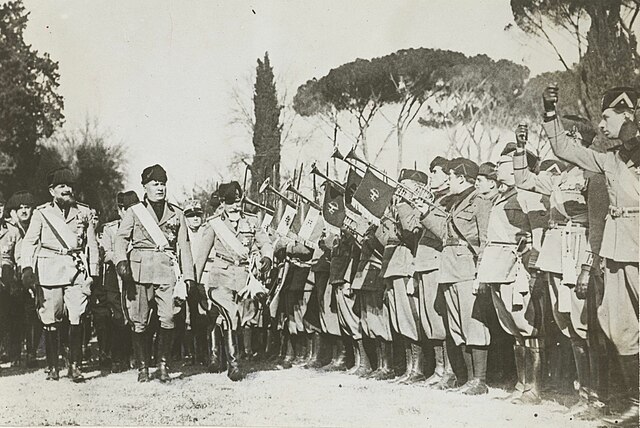

Mussolini: Son of the Century (2025) should feel less familiar, given that World War II concluded eighty years ago. However, through grainy, real-world historical footage of parades and speeches, viewers watch fragments of a past that refuses to fade away. What the show ultimately portrays is not the rise of a tyrant but also the mechanics of social normalization, and how power and deceit, once repeated often enough, end up so overwhelming that we become numb to the danger.
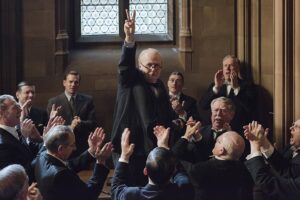
Joe Wright, the director of the Oscar-winning Darkest Hour (2017), directs every frame of Mussolini: Son of the Century with a great deal of theatrical precision. In Darkest Hour, this turns war rooms, tunnels, and parliament into stage-like spaces where Churchill’s speeches visibly shape the fate of soldiers offscreen, which make the cost of his resolve painfully clear. Whilst in Mussolini: Son of the Century the same careful staging around Mussolini in rallies, chambers, and private offices shows how Mussolini’s backroom deals, maneuvering, and staged crises visibly translate into rewritten laws, intimidated deputies, and opponents who end up murdered.
That is, until the frame shifts back to the viewer. Suddenly, the viewer finds themselves face to face with Mussolini himself, who introduces himself with the tough confidence that secured his spot as Italy’s longest-serving leader.
Luca Marinelli plays Mussolini as someone who understands attention far better than philosophy or belief. His performance is for everyone and no one. Sometimes, Mussolini finds himself flattering the crowd. At other times, he mocks the viewer directly, calling us the plural “you,” as if the thought amuses him that we cannot look away from him. He knows that love and hatred feel almost identical once they turn into fixation. In other words, attention is his fuel. At one point, he turns to the viewer and offers the promise of national rebirth in the simplest possible terms: “Make Italy Great Again.”
Corporatism is Mussolini’s prescription for the disease of disorder. It is believed that society functions best when it is like one body (corpus in Latin), and each organ serves the whole. Conflict between boss and worker is instead replaced by coordination and negotiated agreements, a vision seductively simple. Mussolini promises an end to the internal division and disorder he insists have plagued Italy. What makes his promise so unsettling is how closely it mirrors his own leadership.
Marinelli portrays a man who wants unification in all senses and sees the glorification of himself as the way to achieve that unity. He wants to be the center of attention and the voice to which all others align. Corporatism, in this sense, is not simply an ideology. It is an extension of Mussolini’s self and his need to be the center around which everything else revolves.
Mussolini often insists that only those on the margins make history: men who return home from war to nothing, the humiliated, the angry. He tells them they are the ones who will rebuild and usher in the nation’s rebirth, and for the first time, the forgotten felt seen. Their rage is transformed into discipline as their violence becomes more organized and targeted, creating a sense of inclusion into a new kind of belonging.
Despite his success in uplifting those forgotten in Italy, Mussolini faces an internal struggle between his revolutionary ideas, inspired by his socialist past, and the need to ally with ultraconservative forces. He turns crucifixes and royal emblems into mere props to sway the public, while he secretly despises the monarchy and aristocracy. Instead, he presents himself in his own mind as the forger of a new, reborn Italy, instead of the ones conservatives or liberals approved of. The glorious past, to him, is a corpse to be referenced rather than recreated, with the old and errant burned away. He borrows institutions, whether crown or church, for moral cover, but makes it clear privately he exalts neither. The choreography in some episodes demonstrates this perfectly.
One particular scene that exemplifies this well is where the Parliament convenes to debate a proposed law that would grant ⅔ of all seats to the first party winning just a quarter of the vote. The socialists refer to the bill as a tool to create a dictatorship, while the fascists say it’s for the sake of governability. Mussolini is silent for the whole ideal; he’s sitting down, smug. He occasionally glances at the camera as an aside to explain how he’s continuing to dismantle Italian democracy, like he is a professor teaching a course about advanced cruelty. These asides essentially collapse the distance between past and present, forcing the viewer to experience fascism not as a closed chapter of history but as a method being patiently explained to them. He tells us that to change history, one must cross what was once inviolable. Once the unspeakable has been done, the hard part is over. Whether that particular debate was won or lost was less relevant than the way it expanded what could be publicly politically sayable, making the prospect of dismantling democracy itself a normal subject of parliamentary argument.
While some scenes feel completely fresh and unique, the pacing of the later episodes is incredibly cyclical to an almost suffocating degree. It’s often the very same rallies, the same applause, and the same language repeated until it loses meaning. Giving the directors and producers the benefit of the doubt, perhaps the series is replicating the mechanism of propaganda itself, where exhaustion can win acquiescence to the new order of things. In my opinion, that structure is both the show’s strength and its flaw. Oftentimes, the grandeur of everything makes the true horror feel distant or something to be enjoyed as a guilty pleasure. Fascism, after all, always hid behind the ideas of beauty, order, and lighting. Cruelty itself may look beautiful from a distance.
That said, one of the show’s most iconic scenes is in the final episode, set in the Italian Parliament. Mussolini, now Prime Minister, stands accused by his opposition of violence; he’s implicated in the assassination of opposition leader Giacomo Matteotti, seemingly abandoned by some of his conservative allies who think that he’s done for. However, parts of the opposition made a critical mistake of boycotting parliament instead of attending, thus robbing the King of any excuse to dismiss Mussolini. Mussolini then stands to deliver a speech in which he addresses every accusation against him. He recites every charge that has been hurled at him, whether that be criminal, dictator, or barbarian… and he accepts them all. If fascism is guilty, he says, then he alone bears all the guilt. If the nation’s moral climate has produced violence, then he is proud to have contributed to that violence. It is part gambit and part earnest opinion that Italy has been made a stronger nation through the violence of fascism.
He then reminds the chamber that under the Italian constitution, any deputy may indict a minister before the Italian High Court of Justice. He invites them to do so. It would take only one of you, he says, to end me. There’s only silence, and no one moves, for they do not wish to become another Matteotti, with the Blackshirts spectating with daggers in the chamber itself. The law may have remained intact, but a law is only a piece of paper if no one is there to enforce it.
The scene also exposes one of the most unavoidable risks of portraying fascism as a movement created by humans. Like American Psycho (2000), the show refuses to portray its protagonist as a caricature, instead presenting him as a real person. He is petty and capable, insecure and ineffective. It is faithful to history, but it also creates the very same conditions that made his power persuasive to the people of Italy all those years ago. By making him fully real, the series fully accepts the risk that some viewers might be momentarily swayed by his confidence and momentum before being reminded by the show of what those qualities enabled.
The series also refuses to let fascist violence remain something abstract. In an early episode, Mussolini sexually assaults his young secretary, Bianca Ceccato, which results in her pregnancy and is later integrated into his own understanding of power. It is a scene presented without sensationalism, and that restraint is important. By making personal violence inseparable from political ambition, Mussolini: Son of the Century makes it clear that the authority and discipline on display were inseparable from the harm Mussolini and his followers inflicted on individuals. Any temptation to engage with the image of power alone crumples under that very reality.
Mussolini: Son of the Century never quite needs to announce its own relevance, whether examining the conditions of interwar Italy or addressing contemporary issues. Instead, it relies on a sobering, realistic sense of strategy and evokes a morbid familiarity to our own modern society. Mussolini may have died in 1945, as the opening recounted to us, yet our enduring fixation on one of the twentieth century’s defining strongmen—whether in fascination or revulsion—shows how easily his techniques of spectacle, cruelty, and legal erosion still haunt modern politics.