

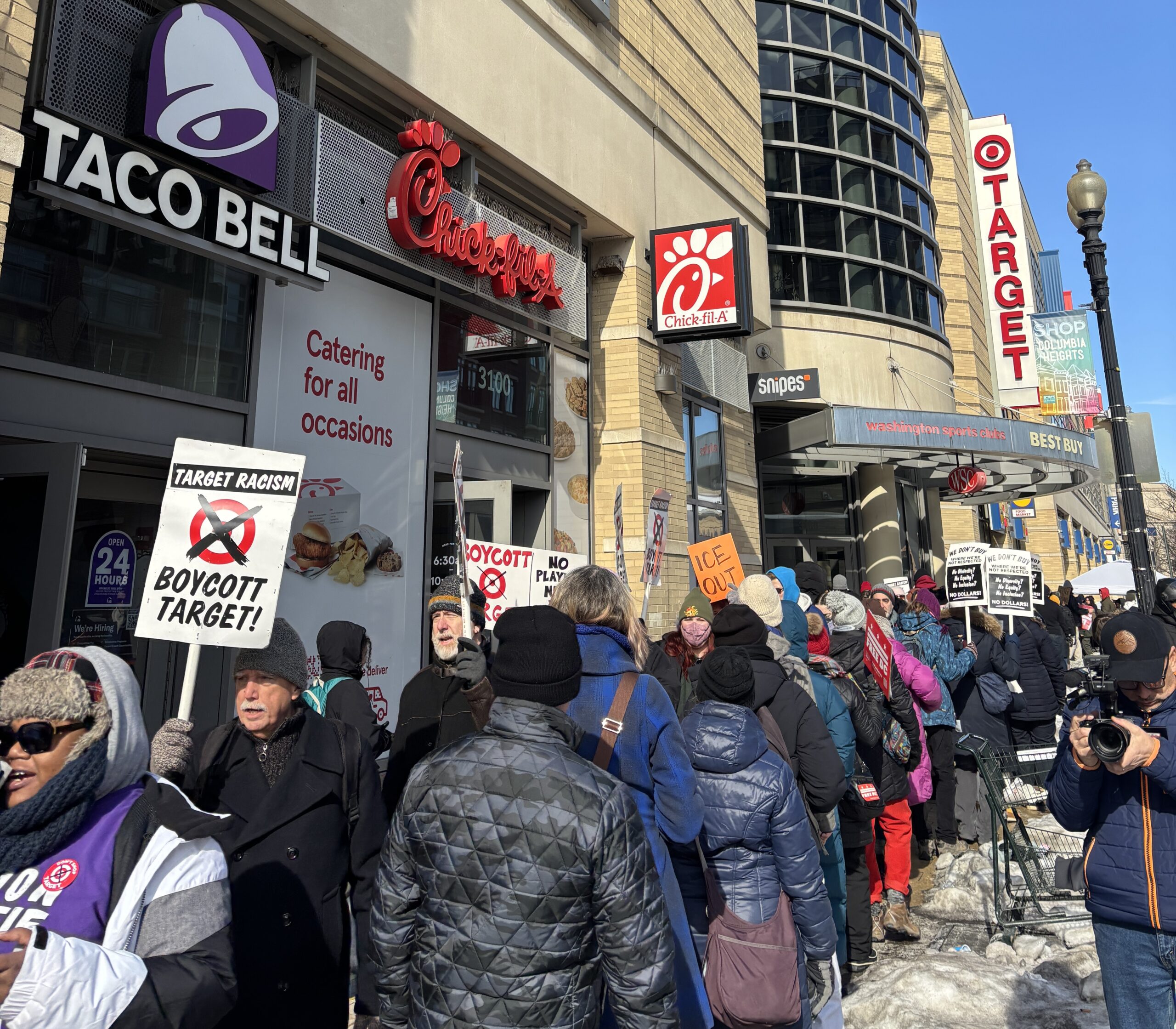
More than a hundred demonstrators picketed outside of a Target in Columbia Heights on Saturday, calling for a boycott of the corporation and condemning what they say is Target’s complicity with Immigration and Customs Enforcement (ICE).
In the last year, Columbia Heights has seen frequent and high-profile ICE activity. The demonstration this weekend was part of a larger, city-wide effort led by Free DC, a D.C. statehood advocacy group which has been organizing weekly protests outside all four Targets in the city.
This week marks a year since the protests and Target boycott began. Initially, the movement took aim at Target for quickly rolling back diversity, equity, and inclusion (DEI) policies just days into the Trump administration. Now, demonstrators say they are protesting Target after ICE detained Target employees outside a store in Minnesota, which Target has not publicly addressed.
Demonstrators around the country and in D.C. are calling on Target, a Minneapolis-based corporation, to speak out against ICE violence. These protests are part of a widespread, national movement of anti-ICE demonstrations since ICE agents killed two people in high-profile incidents in Minneapolis in January.
Protester Natalya Buchwald began attending the demonstrations last year because of Target’s “hypocrisy.” Buchwald said Target protected its image in 2020 by making racial equity commitments, including pledging to invest $2 billion in Black-owned businesses, only to walk back on those promises during the Trump administration.
“I don’t think it’s any coincidence that they are allowing ICE to kidnap employees from their stores or to plan raids in their parking lots. The racism is directly connected,” Buchwald said. “Our dollars are our power, essentially, and we have to use them wisely. Target is not for the people.”
All of the demonstrators who spoke to the Voice cited opposition to ICE actions as one of their reasons for protesting.
“I’m here because I’m very frustrated with people, especially businesses, complying with ICE. ICE shouldn’t be welcome in our communities or in our businesses in our neighborhood,” Shannon Johnson, a former USAID employee who was terminated by the Trump administration, said. “People should be protesting, boycotting and doing whatever we can to ultimately defund ICE.”
Christopher Zacharias, a pastor at John Wesley AME Zion Church in Logan Circle, which is down 14th Street from the Target, said that he feels an obligation to protest ICE activity as a faith leader.
“Throughout the entire Bible, there is the call to speak up for the least of these, whether they are impoverished, and for all of humanity,” Zacharias said. “It is on my specific mandate, as a pastor of a church, as a faith leader, to speak out against these injustices.”
Some demonstrators spoke about their experiences observing ICE activity in Columbia Heights. Dante O’Hara, an organizer behind the protest who lives in the area, said he knows of neighbors who were detained by ICE.
“There’s delivery drivers snatched right in broad daylight by mass agents,” O’Hara said.
“A lot happened around the initial occupation that happened here in August, but it’s still happening,” he said, referring to the federal takeover of police and the deployment of the National Guard to D.C. in August.
Buchwald, who also lives in the neighborhood, said that the ICE presence has affected day-to-day life.
“People are less active in the streets or less willing to come out of their homes,” Buchwald said. “You can feel that energy. You can feel that people are on edge.”
Throughout the demonstration, protesters shouted chants like “Say it loud, say it clear, immigrants are welcome here” and “Say it once, say it twice, we will not put up with ICE.”
Buchwald reflected on the importance of countering ICE through different kinds of community action.
“We need to demonstrate our power together as a collective, and protests like this, boycotts or picket lines like this, are a very visible way to do it. I think it’s only one way as well. People need to be looking for all the ways that you can counter this administration, and counter these attacks on our communities,” Buchwald said.
“I think that if we don’t stand up and protect our neighbors in this moment, then who are we as people, as a country?”