

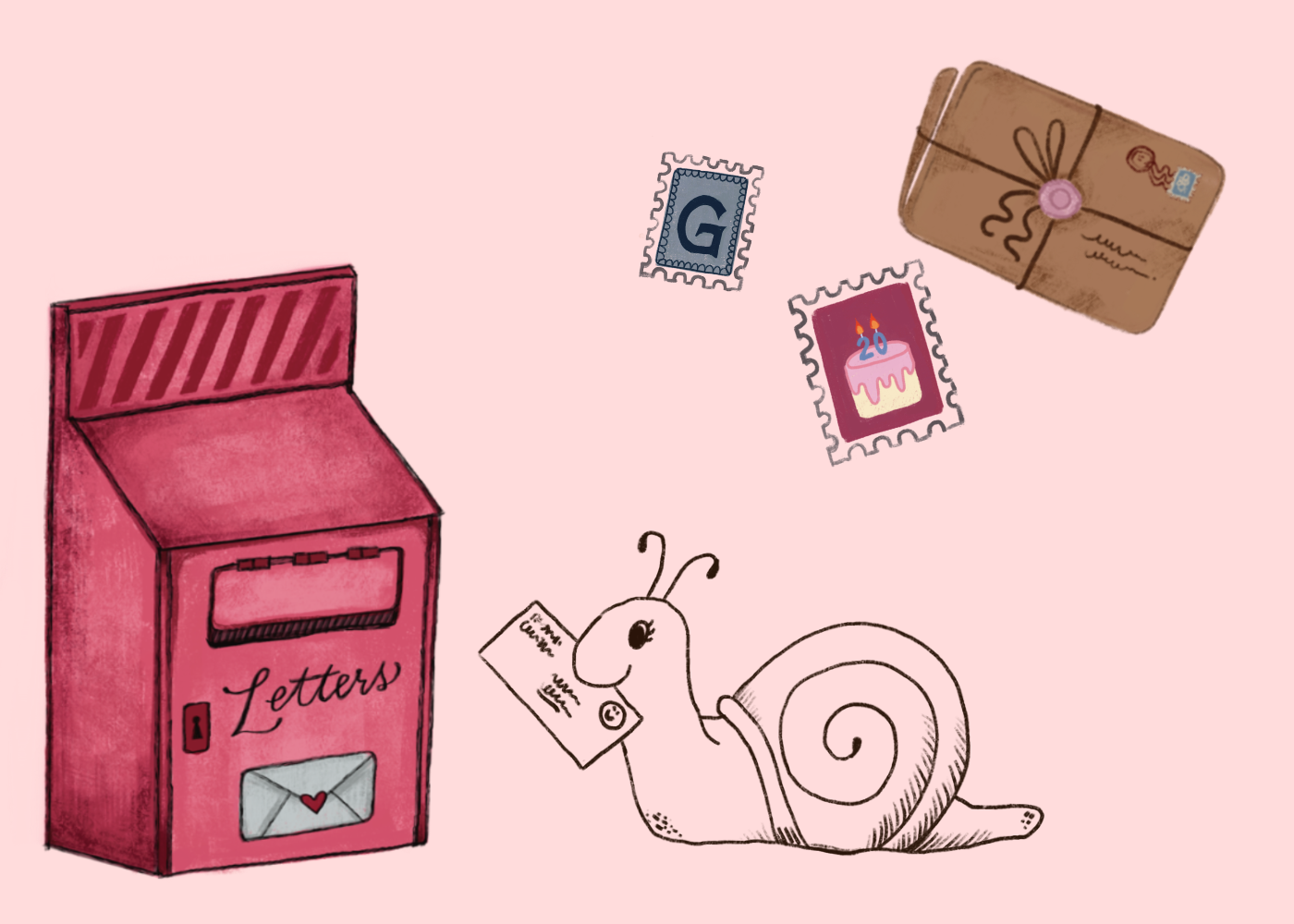

Last semester, I turned 20 during my first week abroad in Denmark. I spent the next month checking my mailbox every day, looking for the birthday cards sent by my grandma and friends at home in Connecticut. I would bike to my apartment after class, rush to lock up, and cross the yard to stick my nose into the mail slot, trying to make out if PostNord—the leading postal service for Nordic countries—had made a delivery.
Receiving mail made me feel connected to a life I missed but was so far from. I wrote letters back to my friends and family, trying to find a way to convey my appreciation for them from afar and to share everything new in my world.
Ever since I was young, letter writing has been the best method for expressing myself. It has always been my way to take a step back, organize my thoughts, empty out my feelings, and calm down. There’s an earnestness in putting pen to paper; it proves that what you have to say is real.
When I came to Denmark, my access to letter writing changed. Sending a letter anywhere outside the country costs at least $7. Even in a city where the cost of living is expected to be high, I never thought it would affect something so historically integral to communication as a letter. When I looked into it, I found out that the entire PostNord system will cease to deliver letters in 2026.
This piece of news shocked me, but the decline of letters is a universal phenomenon. In 2021, the U.S. Postal Service’s annual survey reported that the average household receives about one personal letter every seven weeks, compared to every two weeks in the 1987 survey. Similarly, around 37% of Americans said that they had not sent a letter in five or more years.
In an age of digital communication, the letter has almost become obsolete. There’s an undeniable utility in an email, text, and call. However, our now-constant availability and ease of communication can lead people to be careless and unintentional as they try to stay in touch. Texts are instantaneous, can be sent in mass quantities, or in haste. A study by Common Sense Media finds that, on average, young adults receive over 225 notifications a day. This influx of messages contributes to the lack of time and intention in our modern-day communication. Reaching out via text doesn’t have to be meaningful or purposeful anymore.
By contrast, letters demand patience and thought. Virginia Woolf wrote, “Naturally, when a letter cost half a crown to send, it had to prove itself a document of some importance.” Sacrifice signifies value, and even if the letter doesn’t have a high monetary cost, writing will always require the sacrifice of time. The multistep letter-writing process forces us to slow down and consider. Putting pen to paper, stamping the envelope, licking it shut, walking to a post office, and waiting for its delivery shows care.
The handwritten component of a letter also increases its personal value. Studies have found that there’s a neurobiological benefit to writing by hand. Perhaps the tactile connection between our thoughts and words allows us to process our feelings and slow down, making letters more memorable than a text sent in haste. Personality comes through in the folds of the paper, smudges of ink, and choice of cardstock. Words crossed out in human error provide subtext, something lacking in perfectly crafted versions of direct messages. The physicality of a letter makes it worth saving.
In addition to the value attached to a letter, your feelings can occupy a page without the recipient’s instant reaction or interruption. Therein lies the beauty of the letter—as Woolf reflects, it is “intimate, irreticent, indiscreet.” Letters encourage vulnerability; the distance in time and space between the writer and the recipient allows for directness. I think that’s why I’ve been able to enumerate my thoughts best in writing. I appreciate the space to sort through my feelings. There will be no phone ringing or instant reply the second I hit send. Letters have always felt relieving to me in this way. You’re safe when writing a letter; you don’t have to look anyone in the eye.
Although one might expect a letter to contain a literary, emotional outpour, we shouldn’t be deterred by the idea that letters have to be well-crafted poems or overly involved prose. In my life, letters have taken many forms: handwritten thank-you cards, postcards, or just a note in the margin of a book. I feel grateful when I receive mail, which is partially what keeps me writing letters. I cry reading birthday cards and keep a collection of the letters I’ve received with me at college.
Since my return to school this semester, I’ve felt compelled to continue this habit of letter writing and sending. There’s a blue box outside of Village B where you can drop your own letters. There’s also a real joy in hand delivering, something I am particularly excited about now that my friends aren’t an ocean away. Write a letter, and you might even get one in return. There’s nothing like the excitement and suspense of the email subject line: “YOU HAVE LETTER MAIL.”