


It’s a perfectly autumnal day when my mother and I climb the black vinyl steps of Healy Hall, excited to see her favorite journalist—because it’s important to have one—Andrew Sullivan. He’s on campus for the Berkley Center’s Faith and Culture Series, a semesterly event led by my favorite professor (again, important to have), Paul Elie.
Luckily, my mom is already in town for parents’ weekend, Delta Airlines offers flexible rebooking, and her daughter faithfully checks her email. This is an unmissable event.
While my brothers and I often make fun of my mother for her fangirlhood, she’s selective with her choices: Lebron James, my best friend, Zoë, and, of course, Andrew Sullivan. While she first discovered Sullivan’s work when he was a teaching assistant for a government class she took in 1986, he has since become quite the household name, at least in my childhood home. My mom often references his opinions and forwards his articles to her most loyal followers, her three kids.
After the event, they bond over Harvey “B-minus” Mansfield and how absolutely insane it is that forty years have passed. Standing by her side, as I had for many similar conversations, this reunion felt like the epitome of the connection-making that I grew up learning.
I was raised on the art of adjacency. With every new person someone in my family meets, there is a well-practiced and always exhilarating string of “Well, do you know so-and-so,” dashing between friends and traveling across towns until we eventually land on a common connection. “A small world!” we exclaim, well-earned rest after our arduous linguistic journey.
It truly is a familial ritual. My grandparents faithfully follow the athletic pursuits of any and all North Andover-natives; my older brothers can remember which middle or high school sports team they played on with every random Instagram mutual I discover; somehow my dad can locate the exact street someone grew up on in Pittsfield, Massachusetts; and my mom, leader of the connections circus, dominates the game as masterfully as she plays Yahtzee.
As a child, I often found this sort of friend-finding to be a futile pursuit, another pastime of my parents’ that made every grocery store trip a little longer as I stood beside them in the produce aisle while they compared mutual friends (and sometimes even ran into those friends).
However, as I’ve grown older, moved across the country, and developed my own web of friends, it’s comforting when my world feels even a little smaller. Away from home, especially at Georgetown, discovering mutual friends has become a comforting way to forge community.
Friends from faraway places, who know versions of me that now feel long gone, will reach out to identify a niche connection.
A friend who joined me on an 80-day expedition in the Pacific Northwest somehow met one of the 18 people in my American Studies cohort on a family trip to Costa Rica. A fellow Outdoor Education guide lived in the same town as my aunt but knew her as a celebrity school administrator instead of Aunt Liz. After the best New Year’s Eve of my life, I discovered my camp friend’s high school friends that I celebrated with were my Georgetown friend’s camp friends—whew!
To the career-minded and internship-obsessed, this probably sounds an awful lot like networking. While there are definitely commonalities, particularly the endless connection chains and statements of “you should meet,” there is no external expectation or underlying motivation. You’re not in it for anything—not the post-grad job, or even summer internship—except maybe an excuse to reach out to an old friend. Plus, you can avoid logging into LinkedIn entirely!
Notably, there is a particular privilege that comes with this interconnectedness. It is essential to recognize that this practice often depends on the ability to travel, access the internet, and even to move across the country to attend a destination college. Further, it is often rooted in one’s acceptance and engagement with elite institutions. It is from the benefit of having a world so seemingly large that I am gifted with the ability to make it feel smaller.
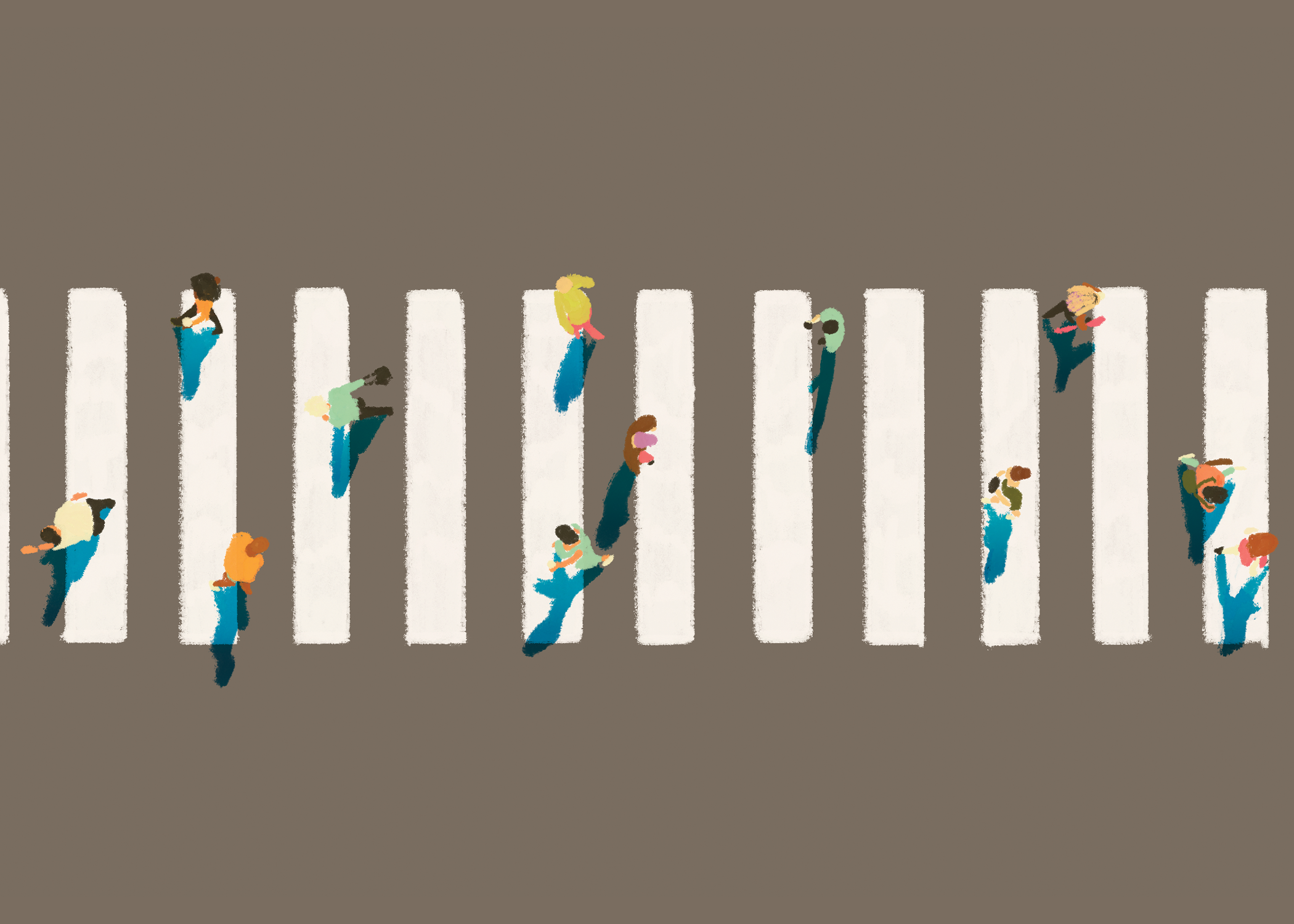
However, this obsession is at least quasi-scientific and universal: there’s a theory that every human being is at most six or fewer social connections away from every other person, aptly named the six degrees of separation. In other words, you’re at most six friend-of-a-friends away from everyone else.
There is something deeply comforting about the closeness of human beings. It explains the thrill of discovering a mutual friend, or that you’ve both visited the same restaurant, or grew up only a few streets apart. Beyond knowing the same places, understanding where someone is from—whether you’ve been to their high school or tried their favorite coffee shop—can bring a sense of home to interactions. To know and be known by what seems like complete strangers generates the joy and understanding often hard to find in new environments.
At the aforementioned event, after reconnecting with Sullivan and indulging in university-sponsored catering, we met a member of the second graduating class of women in the College of Arts and Sciences. Upon realizing we lived in the same dorm—the one and only Darnall Hall—our conversation exploded. We compared experiences: she was shocked by the three-year housing guarantee, and I was by the luxury of having two women’s bathrooms per floor. Even generations apart, this similarity gave us common ground for connection.
While it is a sometimes frustrating and occasionally fruitless practice, shared experience—even if it comes after a dozen questions of “do you know”— is the core of human connection. And it’s a comfort I proudly take with me wherever I go, knowing there is always someone out there who knows me, even if it takes a few tries.